School of Nursing, University of Michigan, 400 North Ingalls Street, Ann Arbor, MI, 48109-5482, USA.
BMC Public Health. 2020 Jun 3;20(1):847. doi: 10.1186/s12889-020-08972-3.
Noise exposure and associated hearing loss affects an estimated 2 million farm youth who are exposed as farm residents, farm family workers, hired workers, children of migrant or seasonal workers, and farm visitors. Risk factors for farm youth include frequent exposure to high farm noise; farm work from an early age, and exposure to high recreational noise (e.g., firearms, ATVs, and personal listening devices).
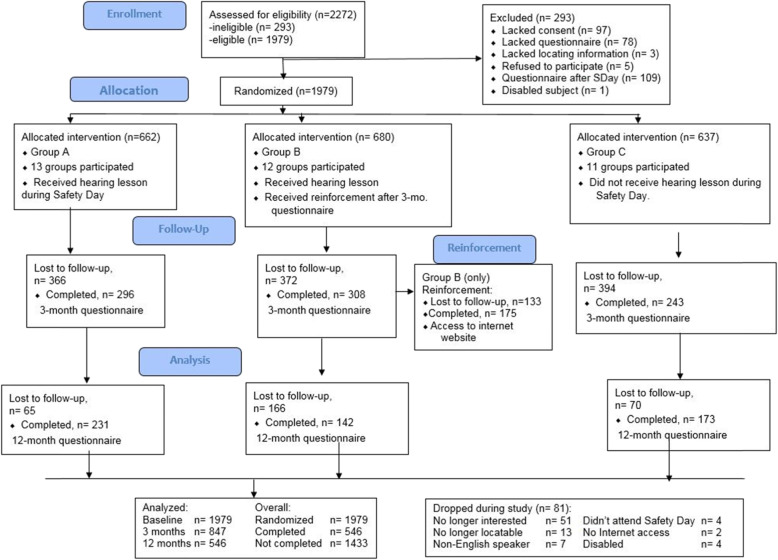
This study compared the effectiveness of two interventions and control. The programs included a community-based interactive youth educational program alone (Group A), a community-based interactive youth educational program followed by an Internet-based booster (Group B), and a no-interaction control (Group C). The study used a cluster randomized control design, with equal allocation ratio to each cluster, without blinding. Inclusion criteria included enrollment in grade 4, parental consent, English speaking, and attending a community-based educational event included in the cluster sampling. A total of 1979 youth were enrolled at 36 sites distributed across the 3 study arms in the following distribution: N = 662 in 13 sites (Group A), N = 680 in 12 sites (Group B), and N = 637 in 11 sites (Group C).
Comparison with pre-intervention data showed no difference in intent to use hearing conservation strategies in experimental groups. However, knowledge and attitudes toward hearing conservation were improved in the groups receiving the Internet-based booster. Participants reported frequent exposure to sources of hazardous noise (e.g., loud sporting events, firecrackers, personal listening devices).
It is feasible and acceptable to incorporate hearing health education into an already existing system designed to deliver health and safety educational programming to farm and rural youth. The program was adopted by the partner agency for dissemination to up to 100,000 youth annually. Results of this study inform future intervention studies, interventions aimed at farm youth, and interventions to increase use of hearing conservation strategies, as well as offer a base for developing programs for non-English speaking children.
Clinicaltrials.gov registration CT02472821. Date of trial registration: 06/09/2015 (retrospectively registered).
噪声暴露和相关听力损失影响了约 200 万农场青年,他们作为农场居民、农场工人家庭的工人、受雇工人、移民或季节性工人的子女以及农场访客而暴露于噪声环境中。农场青年的风险因素包括经常接触高农场噪声;从幼年开始从事农场工作,以及接触高娱乐噪声(例如枪支、ATV 和个人听力设备)。
本研究比较了两种干预措施和对照组的效果。这些方案包括单独的基于社区的互动式青年教育计划(A 组)、基于社区的互动式青年教育计划后再加上基于互联网的加强计划(B 组)以及无互动对照组(C 组)。该研究采用了群组随机对照设计,每个群组的分配比例相等,且不设盲法。纳入标准包括参加 4 年级、父母同意、会说英语以及参加包含在群组抽样中的社区教育活动。共有 1979 名青年在 36 个地点入组,在以下分布中分配到 3 个研究臂中:N = 662 名在 13 个地点(A 组)、N = 680 名在 12 个地点(B 组)和 N = 637 名在 11 个地点(C 组)。
与干预前的数据相比,实验组使用听力保护策略的意愿没有差异。然而,接受基于互联网的加强计划的组的听力保护知识和态度有所提高。参与者报告经常接触危险噪声源(例如,喧闹的体育赛事、鞭炮、个人听力设备)。
将听力健康教育纳入旨在向农场和农村青年提供健康和安全教育计划的现有系统中是可行且可接受的。该方案已被合作伙伴机构采用,每年向多达 10 万名青年传播。本研究的结果为未来的干预研究、针对农场青年的干预措施以及增加听力保护策略的使用提供了信息,并为发展非英语儿童的计划提供了基础。
Clinicaltrials.gov 注册号 CT02472821。试验注册日期:2015 年 6 月 9 日(回溯性注册)。