Buck Institute for Research on Aging, 8001 Redwood Blvd., Novato, CA 94945, USA; Davis School of Gerontology, University of Southern California, University Park, Los Angeles, CA 90007, USA.
Buck Institute for Research on Aging, 8001 Redwood Blvd., Novato, CA 94945, USA; Department of Urology, University of California, San Francisco, 400 Parnassus Avenue, Room A-632, San Francisco, CA 94143, USA.
Curr Biol. 2020 Jul 20;30(14):2749-2760.e3. doi: 10.1016/j.cub.2020.05.020. Epub 2020 Jun 4.
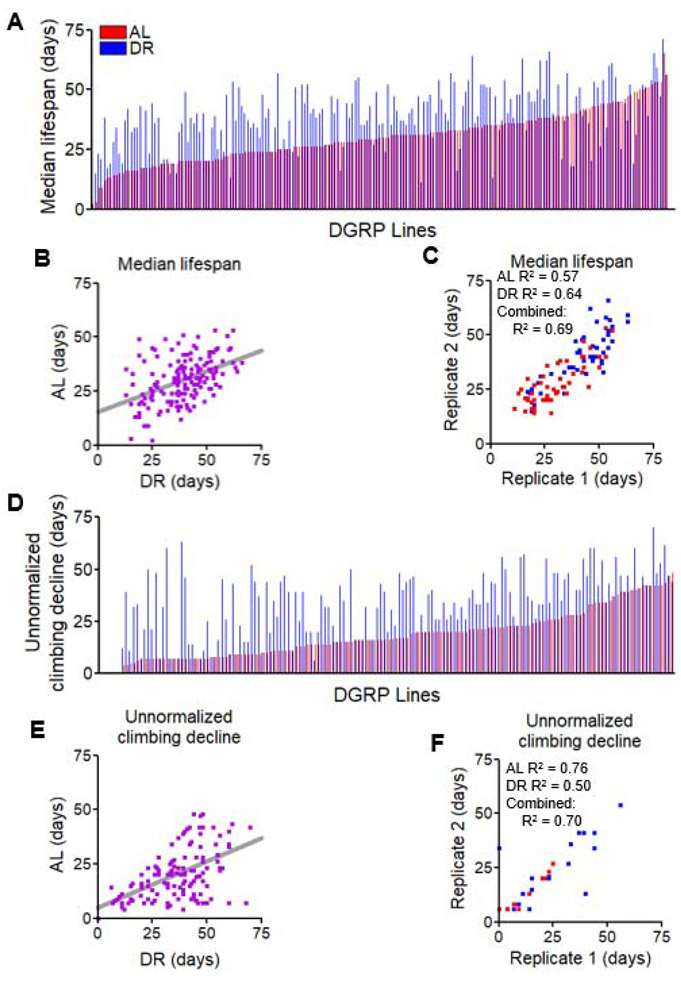
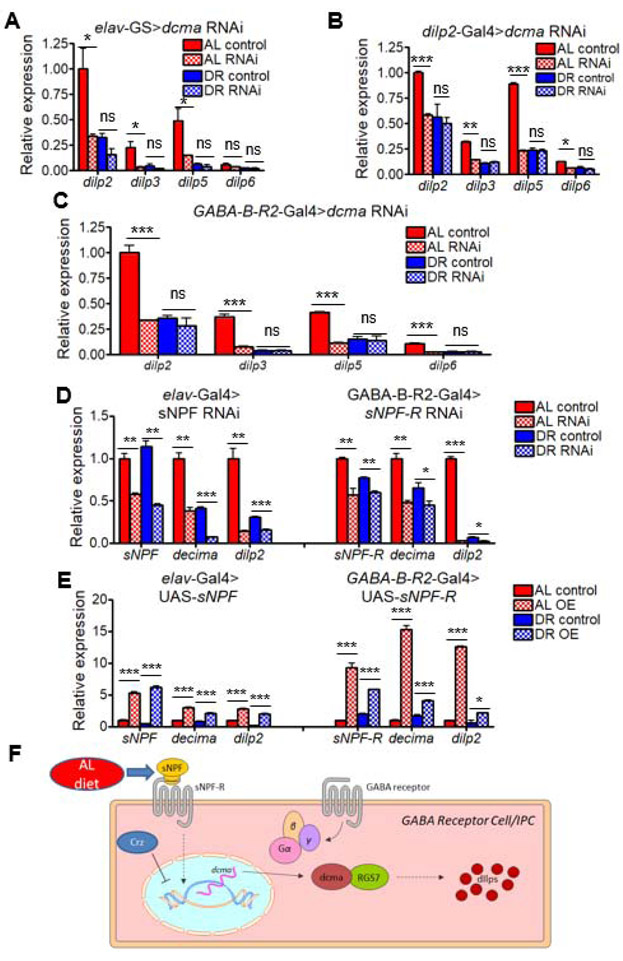
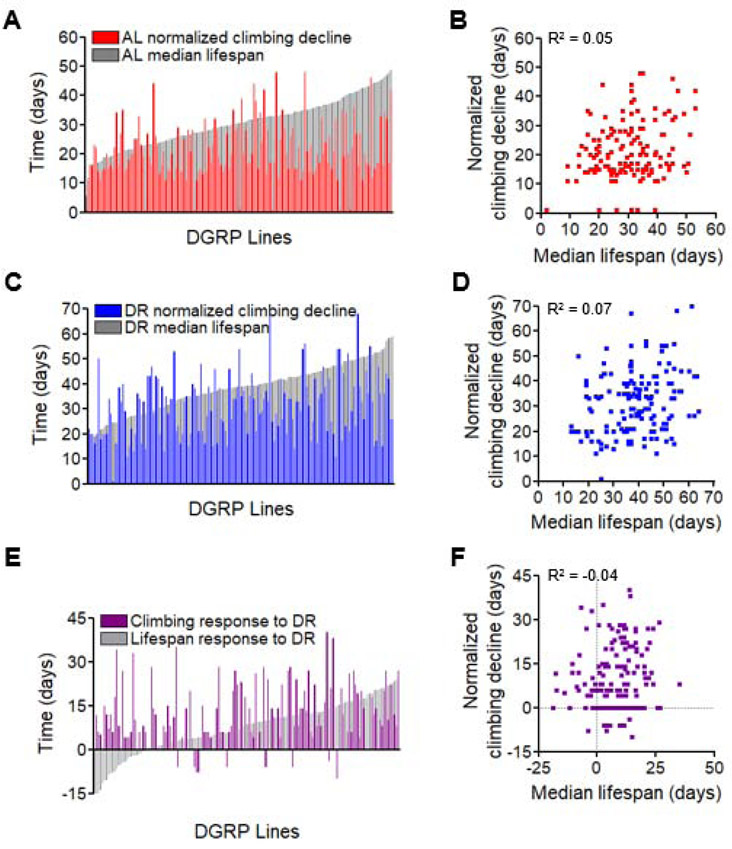
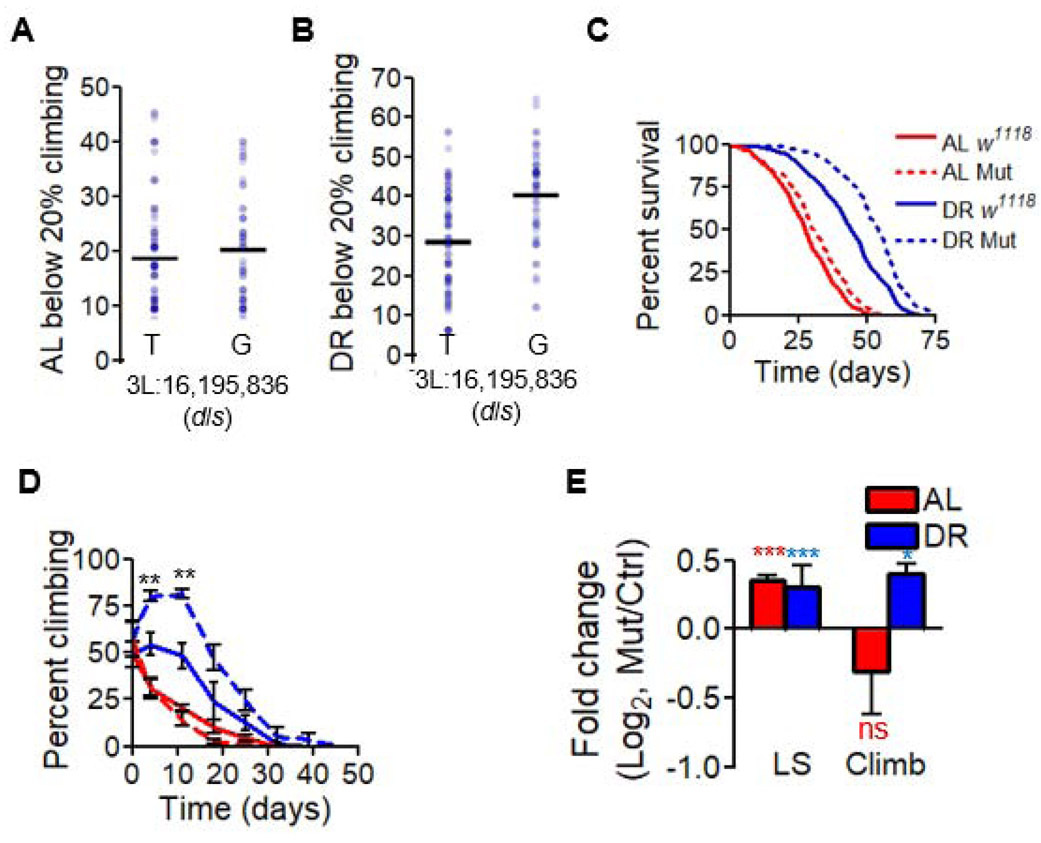
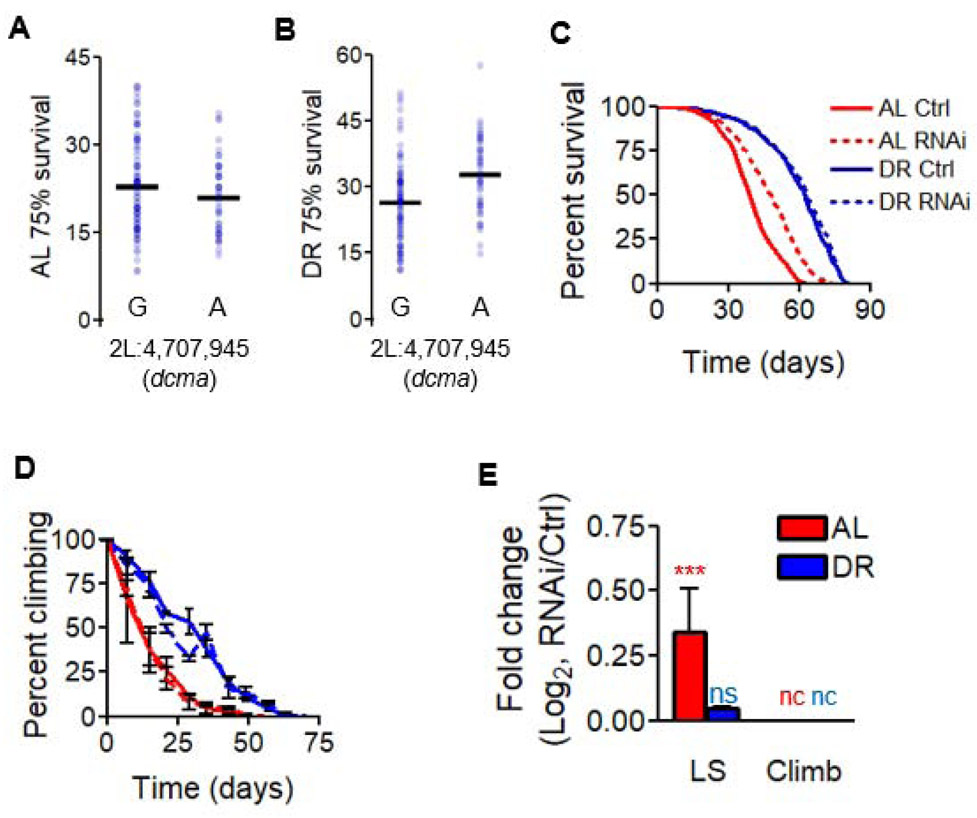
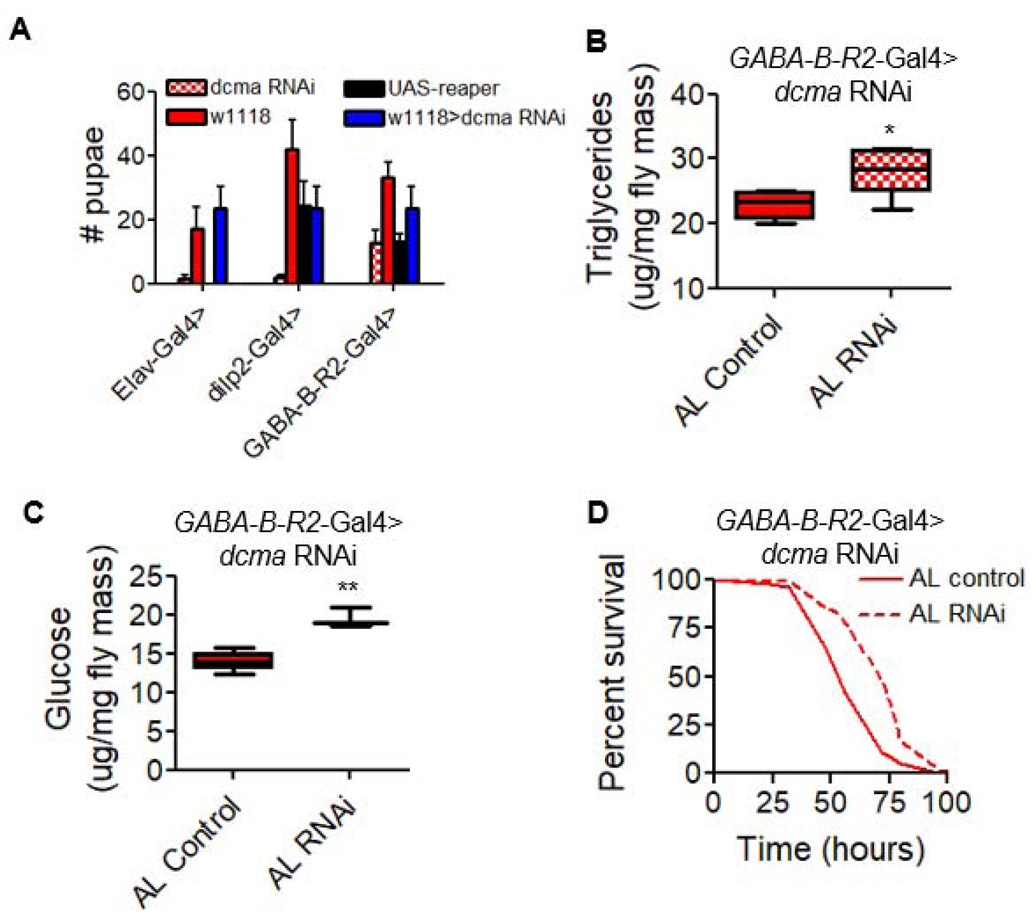
Dietary restriction (DR) is the most robust means to extend lifespan and delay age-related diseases across species. An underlying assumption in the aging field is that DR enhances both lifespan and physical activity through similar mechanisms, but this has not been rigorously tested in different genetic backgrounds. Furthermore, nutrient response genes responsible for lifespan extension or age-related decline in functionality remain underexplored in natural populations. To address this, we measured nutrient-dependent changes in lifespan and age-related decline in climbing ability in the Drosophila Genetic Reference Panel fly strains. On average, DR extended lifespan and delayed decline in climbing ability, but there was a lack of correlation between these traits across individual strains, suggesting that distinct genetic factors modulate these traits independently and that genotype determines response to diet. Only 50% of strains showed positive response to DR for both lifespan and climbing ability, 14% showed a negative response for one trait but not both, and 35% showed no change in one or both traits. Through GWAS, we uncovered a number of genes previously not known to be diet responsive nor to influence lifespan or climbing ability. We validated decima as a gene that alters lifespan and daedalus as one that influences age-related decline in climbing ability. We found that decima influences insulin-like peptide transcription in the GABA receptor neurons downstream of short neuropeptide F precursor (sNPF) signaling. Modulating these genes produced independent effects on lifespan and physical activity decline, which suggests that these age-related traits can be regulated through distinct mechanisms.
饮食限制(DR)是延长寿命和延缓跨物种与年龄相关疾病的最有效方法。衰老领域的一个基本假设是,DR 通过相似的机制增强寿命和身体活动,但这在不同的遗传背景下尚未得到严格测试。此外,负责延长寿命或与年龄相关的功能下降的营养反应基因在自然种群中仍未得到充分探索。为了解决这个问题,我们测量了营养依赖性对寿命和攀爬能力与年龄相关下降的变化,在果蝇遗传参考面板品系中。平均而言,DR 延长了寿命并延缓了攀爬能力的下降,但在个体品系之间,这些特征之间缺乏相关性,这表明不同的遗传因素独立调节这些特征,并且基因型决定了对饮食的反应。只有 50%的品系对寿命和攀爬能力都表现出对 DR 的积极反应,14%的品系对一种特征表现出负反应,但不是两种特征,35%的品系在一种或两种特征上没有变化。通过全基因组关联分析,我们发现了一些以前不知道对饮食有反应或影响寿命或攀爬能力的基因。我们验证了 decima 是一个改变寿命的基因,daedalus 是一个影响与年龄相关的攀爬能力下降的基因。我们发现 decima 影响 GABA 受体神经元中胰岛素样肽转录,下游短神经肽 F 前体(sNPF)信号。调节这些基因对寿命和身体活动下降产生独立的影响,这表明这些与年龄相关的特征可以通过不同的机制进行调节。