B Yeh Kenneth, M Fair Jeanne, Smith Woutrina, Martinez Torres Teresa, Lucas Julie, Monagin Corina, Winegar Richard, Fletcher Jacqueline
Global Health Surveillance and Diagnostics, MRIGlobal, Gaithersburg, MD 20878, USA.
Biosecurity and Public Health, Los Alamos National Laboratory, Los Alamos, NM 87545, USA.
Trop Med Infect Dis. 2020 Jun 3;5(2):90. doi: 10.3390/tropicalmed5020090.
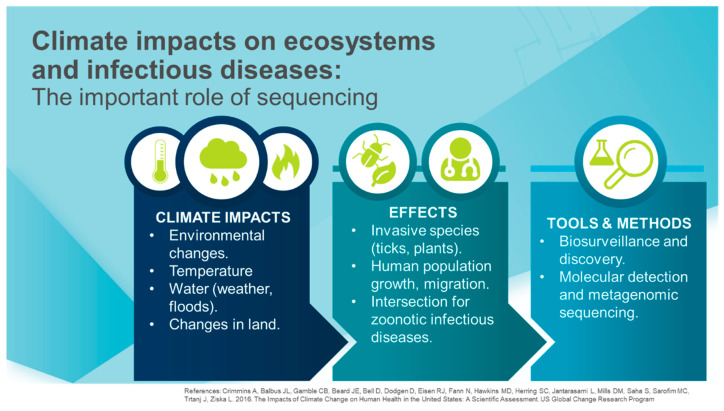
Changes in the Earth's climate and weather continue to impact the planet's ecosystems, including the interface of infectious disease agents with their hosts and vectors. Environmental disasters, natural and human-made activities raise risk factors that indirectly facilitate infectious disease outbreaks. Subsequently, changes in habitat, displaced populations, and environmental stresses that affect the survival of species are amplified over time. The recurrence and spread of vector-borne (e.g., mosquito, tick, aphid) human, animal, and plant pathogens to new geographic locations are also influenced by climate change. The distribution and range of humans, agricultural animals and plants, wildlife and native plants, as well as vectors, parasites, and microbes that cause neglected diseases of the tropics as well as other global regions are also impacted. In addition, genomic sequencing can now be applied to detect signatures of infectious pathogens as they move into new regions. Molecular detection assays complement metagenomic sequencing to help us understand the microbial community found within the microbiomes of hosts and vectors, and help us uncover mechanistic relationships between climate variability and pathogen transmission. Our understanding of, and responses to, such complex dynamics and their impacts can be enhanced through effective, multi-sectoral One Health engagement coupled with applications of both traditional and novel technologies. Concerted efforts are needed to further harness and leverage technology that can identify and track these impacts of climate changes in order to mitigate and adapt to their effects.
地球气候和天气的变化持续影响着地球的生态系统,包括传染病原体与其宿主和病媒的相互作用。环境灾难、自然和人为活动增加了风险因素,间接促使传染病爆发。随后,栖息地的变化、人口迁移以及影响物种生存的环境压力随着时间的推移而加剧。气候变暖也影响着媒介传播(如蚊子、蜱虫、蚜虫)的人类、动物和植物病原体向新地理位置的复发和传播。人类、农业动植物、野生动物和本地植物,以及导致热带地区和其他全球区域被忽视疾病的病媒、寄生虫和微生物的分布和范围也受到影响。此外,现在可以应用基因组测序来检测感染性病原体进入新区域时的特征。分子检测分析补充了宏基因组测序,有助于我们了解宿主和病媒微生物群落中发现的微生物群落,并帮助我们揭示气候变异性与病原体传播之间的机制关系。通过有效的多部门“同一健康”参与以及传统和新技术的应用,可以加强我们对这种复杂动态及其影响的理解和应对。需要共同努力,进一步利用和运用能够识别和追踪气候变化这些影响的技术,以减轻和适应其影响。