Houshyar Roozbeh, Tran-Harding Karen, Glavis-Bloom Justin, Nguyentat Michael, Mongan John, Chahine Chantal, Loehfelm Thomas W, Kohli Marc D, Zaragoza Edward J, Murphy Paul M, Kampalath Rony
Department of Radiologic Sciences, Irvine School of Medicine, University of California, 101 The City Dr S, Orange, CA, 92868, USA.
Department of Radiology, University of Colorado, Aurora, CO, USA.
Emerg Radiol. 2020 Dec;27(6):781-784. doi: 10.1007/s10140-020-01797-y. Epub 2020 Jun 5.
The coronavirus disease 2019 (COVID-19) pandemic has led to significant disruptions in the healthcare system including surges of infected patients exceeding local capacity, closures of primary care offices, and delays of non-emergent medical care. Government-initiated measures to decrease healthcare utilization (i.e., "flattening the curve") have included shelter-in-place mandates and social distancing, which have taken effect across most of the USA. We evaluate the immediate impact of the Public Health Messaging and shelter-in-place mandates on Emergency Department (ED) demand for radiology services.
We analyzed ED radiology volumes from the five University of California health systems during a 2-week time period following the shelter-in-place mandate and compared those volumes with March 2019 and early April 2019 volumes.
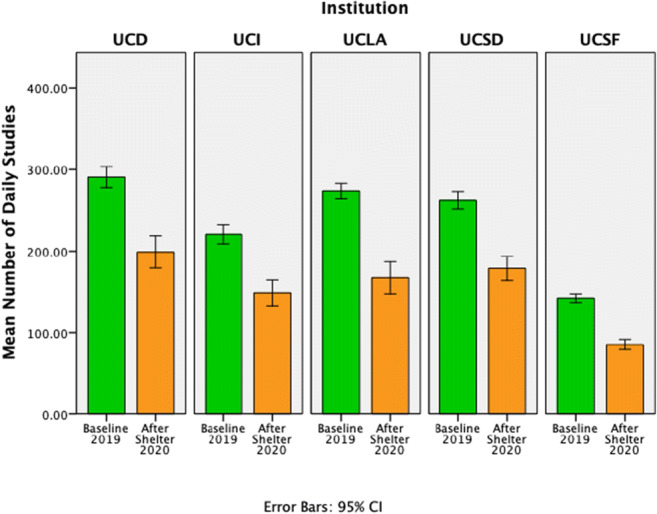
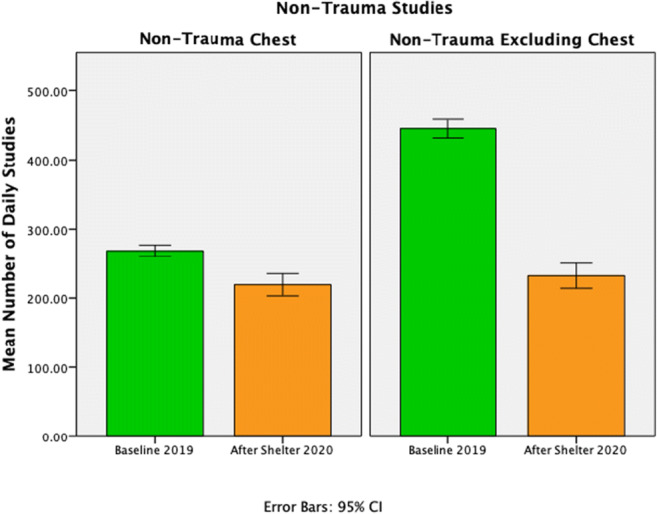
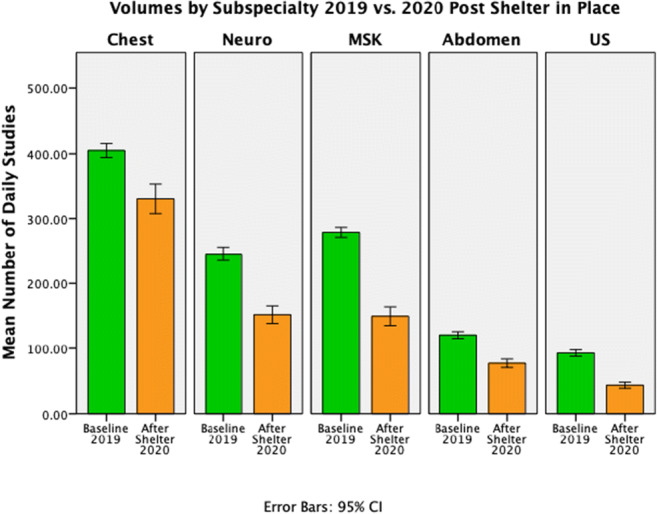
ED radiology volumes declined from the 2019 baseline by 32 to 40% (p < 0.001) across the five health systems with a total decrease in volumes across all 5 systems by 35% (p < 0.001). Stratifying by subspecialty, the smallest declines were seen in non-trauma thoracic imaging, which decreased 18% (p value < 0.001), while all other non-trauma studies decreased by 48% (p < 0.001).
Total ED radiology demand may be a marker for public adherence to shelter-in-place mandates, though ED chest radiology demand may increase with an increase in COVID-19 cases.
2019年冠状病毒病(COVID-19)大流行导致医疗系统出现重大混乱,包括感染患者激增超过当地医疗能力、初级保健办公室关闭以及非紧急医疗护理延迟。政府发起的降低医疗利用率的措施(即“ flattening the curve”)包括就地避难指令和社交距离措施,这些措施已在美国大部分地区生效。我们评估了公共卫生信息和就地避难指令对急诊科(ED)放射科服务需求的直接影响。
我们分析了加利福尼亚大学五个医疗系统在就地避难指令发布后的两周内急诊科的放射检查量,并将这些量与2019年3月和2019年4月初的量进行了比较。
五个医疗系统的急诊科放射检查量较2019年基线下降了32%至40%(p<0.001),所有五个系统的总量下降了35%(p<0.001)。按亚专业分层,非创伤性胸部成像的下降幅度最小,下降了18%(p值<0.001),而所有其他非创伤性检查下降了48%(p<0.001)。
急诊科放射科的总需求可能是公众遵守就地避难指令的一个标志,尽管随着COVID-19病例的增加,急诊科胸部放射检查需求可能会增加。