Guardado Ismael Martínez, Ureña Braulio Sánchez, Cardenosa Alba Camacho, Cardenosa Marta Camacho, Camacho Guillermo Olcina, Andrada Rafael Timón
GAEDAF Research Group. Faculty of Sport Science, University of Extremadura, Spain.
School of Human Movement Sciences and Quality of Life, National University of Costa Rica, Costa Rica.
Biol Sport. 2020 Jun;37(2):121-129. doi: 10.5114/biolsport.2020.93037. Epub 2020 Feb 11.
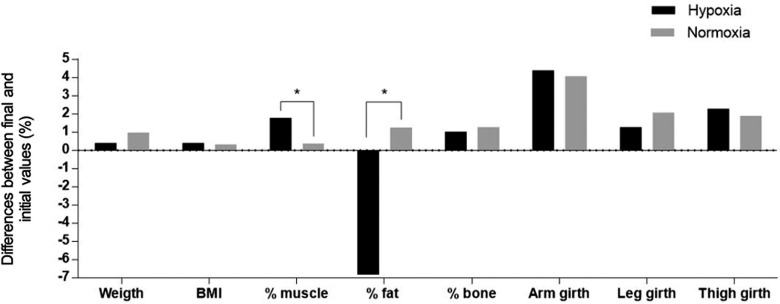
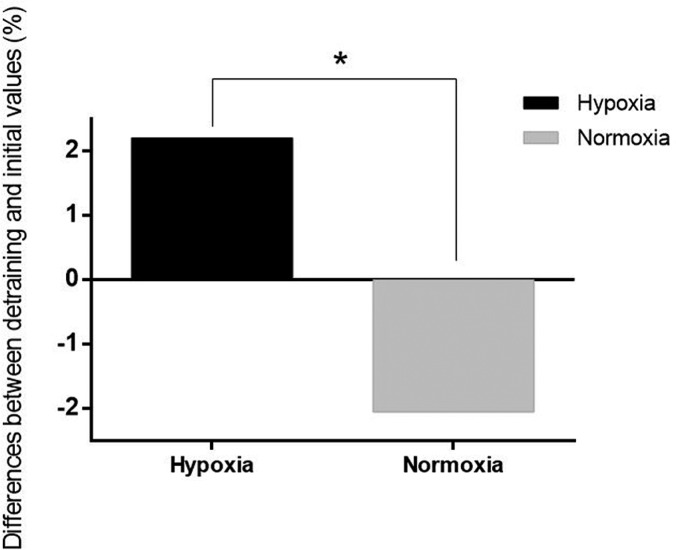
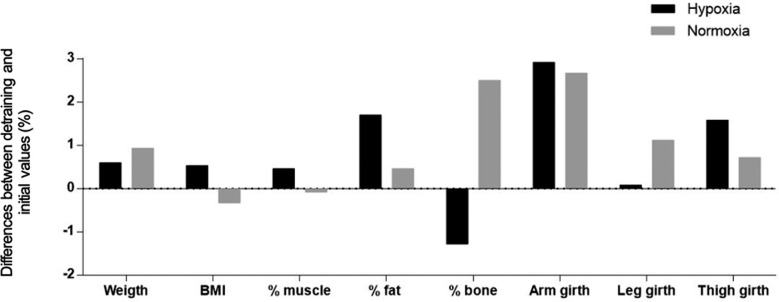
The addition of a hypoxic stimulus during resistance training is suggested to increase the metabolic responses, enhancing hypertrophy and muscle strength. The purpose of this study was to investigate the effects of resistance training performed at submaximal intensities combined with normobaric hypoxia on muscular performance, body composition and haematological parameters. Thirty-two untrained subjects participated in this study (weight: 74.68±12.89 kg; height: 175±0.08 cm; BMI: 24.28±3.80 kg/m). They were randomized to two groups: hypoxia (FiO = 13%) or normoxia (FiO = 20.9%). The training programme lasted 7 weeks (3 d/w) and several muscle groups were exercised (3 sets x 65-80% 1RM to failure). Measurements were taken before, after the training and after a 3-week detraining period. Body composition and muscle mass were assessed through skinfolds and muscle girths. Muscle strength was evaluated by the 1RM estimated test. Finally, haemoglobin and haematocrit were taken from the antecubital vein. Both groups improved their strength performance and muscle perimeters, but the hypoxia group obtained a greater increase in muscle mass (hypoxia: +1.80% vs. normoxia: +0.38%; <0.05) and decrease in fat mass (hypoxia: -6.83% vs. normoxia: +1.26%; <0.05) compared to the normoxia group. Additionally, haematocrit values were also higher for the hypoxia group after the detraining period (hypoxia: +2.20% vs. normoxia: -2.22%; <0.05). In conclusion, resistance training under hypoxic conditions could increase muscle mass and decrease fat mass more effectively than training performed in normoxia, but without contributing to greater muscle strength.
在抗阻训练期间添加低氧刺激,被认为可增强代谢反应,促进肌肉肥大和肌肉力量。本研究的目的是调查次最大强度抗阻训练结合常压缺氧对肌肉性能、身体成分和血液学参数的影响。32名未经训练的受试者参与了本研究(体重:74.68±12.89千克;身高:175±0.08厘米;体重指数:24.28±3.80千克/平方米)。他们被随机分为两组:低氧组(吸入氧分数=13%)或常氧组(吸入氧分数=20.9%)。训练计划持续7周(每周3天),对多个肌肉群进行锻炼(3组,每组65 - 80%的1次重复最大值,直至力竭)。在训练前、训练后以及3周的停训期后进行测量。通过皮褶厚度和肌肉围度评估身体成分和肌肉质量。通过估计的1次重复最大值测试评估肌肉力量。最后,从前臂静脉采集血红蛋白和血细胞比容。两组的力量表现和肌肉周长均有所改善,但与常氧组相比,低氧组的肌肉质量增加幅度更大(低氧组:+1.80%,常氧组:+0.38%;P<0.05),脂肪质量减少幅度更大(低氧组:-6.83%,常氧组:+1.26%;P<0.05)。此外,停训期后低氧组的血细胞比容值也更高(低氧组:+2.20%,常氧组:-2.22%;P<0.05)。总之,与常氧条件下的训练相比,低氧条件下的抗阻训练能更有效地增加肌肉质量和减少脂肪质量,但对增加肌肉力量并无帮助。