Mansour Ossama Yassin, Ramadan Ismail, Abdo Ashraf, Hamdi Mohamed, Eldeeb Hany, Marouf Hazem, Elsalamawy Doaa, Elfatatry Amr, Elnekidy Abdelaziz, Reda M Ihab
Alexandria Stroke and Neurointerventional Services, Alexandria University, Alexandria, Egypt.
Neurology Department, Alexandria University, Alexandria, Egypt.
Front Neurol. 2020 May 19;11:333. doi: 10.3389/fneur.2020.00333. eCollection 2020.
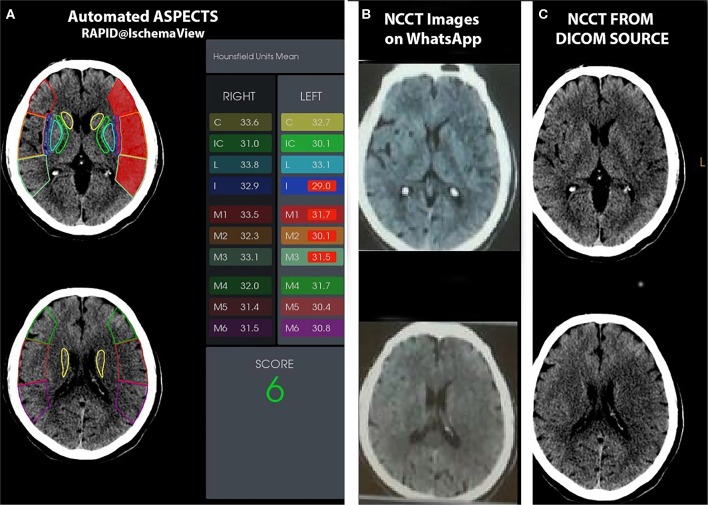
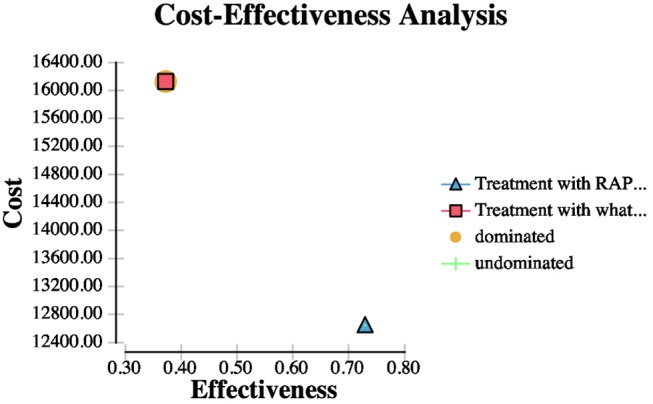
Automated ASPECTS has the potential of reducing interobserver variability in the determination of early ischemic changes. We aimed to assess the performance of an automated ASPECTS vs. ASPECTS interpreted for sent CT images on WhatsApp and to correlate these results with the outcome. Patients with anterior circulation stroke who had baseline NCCT and underwent successful IV-thrombolysis were included. NCCT-ASPECTS was assessed by two neuroradiologists, and discrepancies were resolved by agreement. Two groups of patients were included; group 1, where treatment was decided after an automated ASPECTS interpretation that was provided by RAPID software, and group 2, where patients received IV-tPA after an assessment of CT images sent on WhatsApp. A total of 122 patients were included: 36 in group 1 and 86 in group 2. In group 2, the interobserver agreement for NCCT ASPECTS was moderate (κ = 0.36), as was the dichotomized data (κ = 0.44). IOA, however, improved (to κ = 0.57 and κ = 0.64) when the same CT images were interpreted on a workstation. In group 1, Automated ASPECTS showed excellent agreement (κ = 0.80) with agreement reads for workstation images. There were significantly ( < 0.001) increased odds of functional independence and fewer hemorrhagic complications with thrombolyzed patients in group 1. Automated ASPECTS provided by the RAPID@IschemaView ASPECTS performs at a level equal to the agreement read of expert neuroradiologists, and this performance was severely degraded when WhatsApp captured CT images used for ASPECTS assessment. In our study, we found that automated ASPECTS might predict outcomes after IV thrombolysis.
自动化的ASPECTS评分系统具有减少早期缺血性改变判定过程中观察者间差异的潜力。我们旨在评估自动化ASPECTS评分系统与通过WhatsApp发送的CT图像上解读的ASPECTS评分系统的性能,并将这些结果与预后相关联。纳入前循环卒中且有基线非增强CT(NCCT)并成功接受静脉溶栓治疗的患者。由两名神经放射科医生评估NCCT-ASPECTS评分,分歧通过协商解决。纳入两组患者;第1组,在由RAPID软件提供的自动化ASPECTS解读后决定治疗方案;第2组,在评估通过WhatsApp发送的CT图像后患者接受静脉注射组织型纤溶酶原激活剂(IV-tPA)治疗。共纳入122例患者:第1组36例,第2组86例。在第2组中,NCCT-ASPECTS评分的观察者间一致性为中等(κ = 0.36),二分数据的一致性也为中等(κ = 0.44)。然而,当在工作站上解读相同的CT图像时,观察者间一致性得到改善(κ分别为0.57和0.64)。在第1组中,自动化ASPECTS评分系统与工作站图像的一致性解读显示出极好的一致性(κ = 0.80)。第1组接受溶栓治疗的患者实现功能独立的几率显著增加(<0.001),出血并发症较少。RAPID@IschemaView ASPECTS提供的自动化ASPECTS评分系统的表现与专家神经放射科医生的一致性解读水平相当,而当用于ASPECTS评估的CT图像通过WhatsApp获取时,这种表现会严重下降。在我们的研究中,我们发现自动化ASPECTS评分系统可能预测静脉溶栓后的预后。