Department of Public Health, Faculty of Health Sciences, Wroclaw Medical University, Wroclaw, Poland.
Department of Anaesthesiology and Intensive Therapy, Faculty of Medicine, Wroclaw Medical University, Wroclaw, Poland.
BMC Cardiovasc Disord. 2020 Jun 12;20(1):288. doi: 10.1186/s12872-020-01571-5.
Out-of-hospital cardiac arrest (OHCA) is a common reason for calls for intervention by emergency medical teams (EMTs) in Poland. Regardless of the mechanism, OHCA is a state in which the chance of survival is dependent on rapid action from bystanders and responding health professionals in emergency medical services (EMS). We aimed to identify factors associated with return of spontaneous circulation (ROSC).
The medical records of 2137 EMS responses to OHCA in the city of Wroclaw, Poland between July 2017 and June 2018 were analyzed.
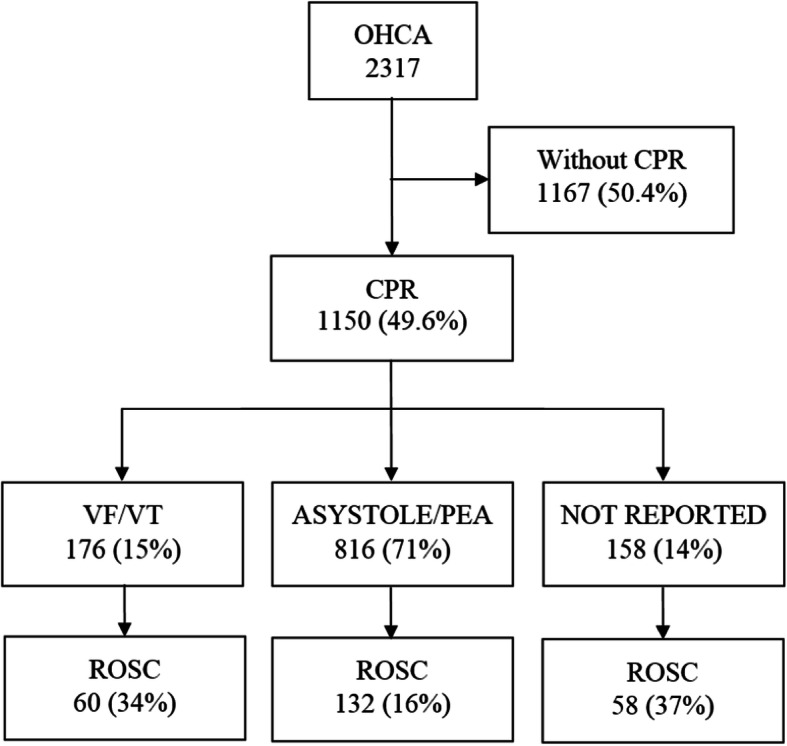
The OHCA incidence rate for the year studied was 102 cases per 100,000 inhabitants. EMS were called to 2317 OHCA events of which 1167 (50.4%) did not have resuscitation attempted on EMS arrival. The difference between the number of successful and failed cardiopulmonary resuscitations (CPRs) was statistically significant (p < 0.001). Of 1150 patients in whom resuscitation was attempted, ROSC was achieved in 250 (27.8%). Rate of ROSC was significantly higher when CPR was initiated by bystanders (p < 0.001). Patients presenting with asystole or pulseless electrical activity (PEA) had a higher risk of CPR failure (86%) than those with ventricular fibrillation/ventricular tachycardia (VF/VT). Patients with VF/VT had a higher chance of ROSC (OR 2.68, 1.86-3.85) than those with asystole (p < 0.001). The chance of ROSC was 1.78 times higher when the event occurred in a public place (p < 0.001).
The factors associated with ROSC were occurrence in a public place, CPR initiation by witnesses, and presence of a shockable rhythm. Gender, age, and the type of EMT did not influence ROSC. Low bystander CPR rates reinforce the need for further efforts to train the public in CPR.
院外心脏骤停(OHCA)是波兰紧急医疗团队(EMT)干预的常见原因。无论机制如何,OHCA 是一种幸存者机会取决于旁观者和紧急医疗服务(EMS)中响应的医疗专业人员快速行动的状态。我们旨在确定与自主循环恢复(ROSC)相关的因素。
分析了 2017 年 7 月至 2018 年 6 月期间波兰弗罗茨瓦夫市 EMT 对 2137 例 OHCA 的医疗记录。
研究年度的 OHCA 发生率为每 10 万人中有 102 例。EMS 接到了 2317 例 OHCA 事件的呼叫,其中 1167 例(50.4%)在 EMS 到达时未尝试复苏。成功和失败心肺复苏术(CPR)之间的差异具有统计学意义(p < 0.001)。在 1150 例尝试复苏的患者中,有 250 例(27.8%)实现了 ROSC。旁观者启动 CPR 时 ROSC 的发生率显着更高(p < 0.001)。出现心搏停止或无脉电活动(PEA)的患者 CPR 失败的风险(86%)高于出现室颤/室性心动过速(VF/VT)的患者。与心搏停止(p < 0.001)相比,VF/VT 患者的 ROSC 机会更高(OR 2.68,1.86-3.85)。事件发生在公共场所时,ROSC 的机会高 1.78 倍(p < 0.001)。
与 ROSC 相关的因素是在公共场所发生、目击者启动 CPR 和存在可除颤节律。性别、年龄和 EMT 类型不影响 ROSC。旁观者 CPR 率低强化了进一步努力培训公众进行 CPR 的必要性。