Renzaglia Karen S, Browning William B, Merced Amelia
Plant Biology Department, Southern Illinois University, Carbondale, IL, United States.
International Institute of Tropical Forestry, USDA Forest Service, San Juan, PR, United States.
Front Plant Sci. 2020 May 28;11:567. doi: 10.3389/fpls.2020.00567. eCollection 2020.
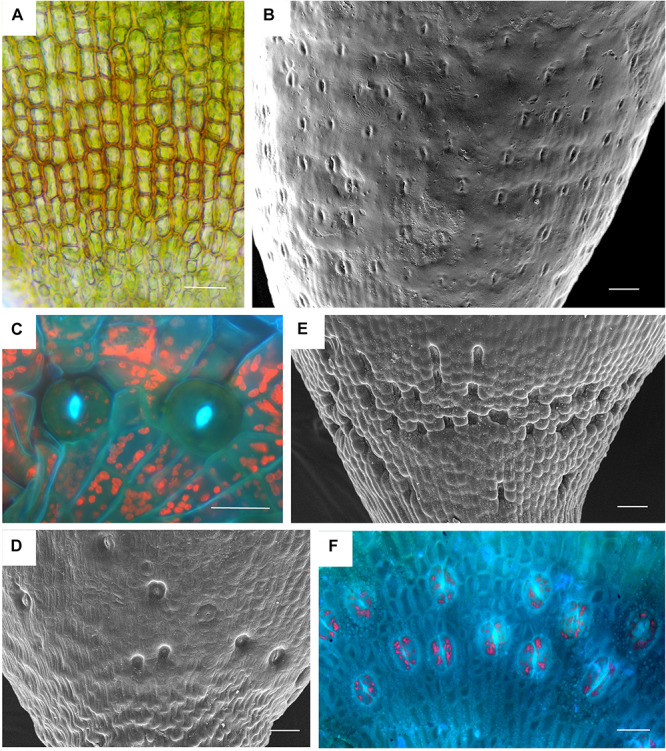
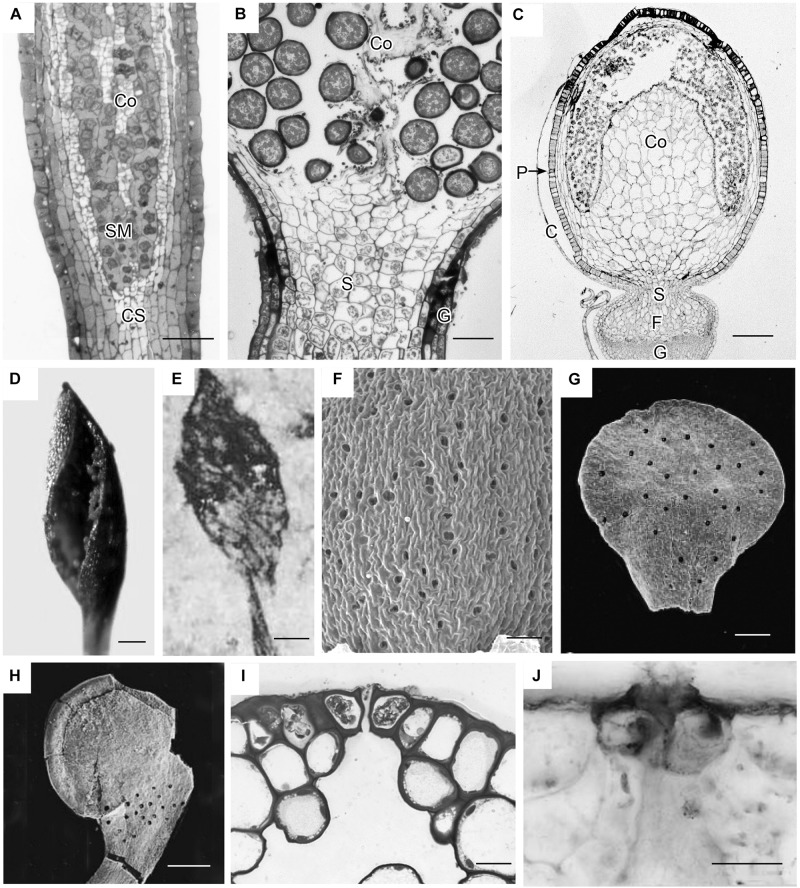
Because stomata in bryophytes are uniquely located on sporangia, the physiological and evolutionary constraints placed on bryophyte stomata are fundamentally different from those on leaves of tracheophytes. Although losses of stomata have been documented in mosses, the extent to which this evolutionary process occurred remains relatively unexplored. We initiated this study by plotting the known occurrences of stomata loss and numbers per capsule on the most recent moss phylogeny. From this, we identified 40 families and 74 genera that lack stomata, of which at least 63 are independent losses. No trends in stomata losses or numbers are evident in any direction across moss diversity. Extant taxa in early divergent moss lineages either lack stomata or produce pseudostomata that do not form pores. The earliest land plant macrofossils from 400 ma exhibit similar sporangial morphologies and stomatal distribution to extant mosses, suggesting that the earliest mosses may have possessed and lost stomata as is common in the group. To understand why stomata are expendable in mosses, we conducted comparative anatomical studies on a range of mosses with and without stomata. We compared the anatomy of stomate and astomate taxa and the development of intercellular spaces, including substomatal cavities, across mosses. Two types of intercellular spaces that develop differently are seen in peristomate mosses, those associated with stomata and those that surround the spore sac. Capsule architecture in astomate mosses ranges from solid in the taxa in early divergent lineages to containing an internal space that is directly connected to the conducing tissue and is involved in capsule expansion and the nourishment, hydration and development of spores. This anatomy reveals there are different architectural arrangements of tissues within moss capsules that are equally effective in accomplishing the essential processes of sporogenesis and spore dispersal. Stomata are not foundational to these processes.
由于苔藓植物的气孔独特地位于孢子囊上,因此施加在苔藓植物气孔上的生理和进化限制与维管植物叶片上的气孔有着根本的不同。尽管在苔藓中已有气孔丧失的记录,但这一进化过程发生的程度仍相对未被探索。我们通过在最新的苔藓系统发育树上绘制已知的气孔丧失情况和每个孢蒴的气孔数量来启动这项研究。据此,我们确定了40个科和74个属缺乏气孔,其中至少63次是独立丧失。在整个苔藓多样性中,气孔丧失或数量没有明显的趋势。早期分化的苔藓谱系中的现存类群要么缺乏气孔,要么产生不形成孔的假气孔。来自4亿年前的最早陆地植物大化石显示出与现存苔藓相似的孢子囊形态和气孔分布,这表明最早的苔藓可能像该类群中常见的那样拥有并丧失了气孔。为了理解为什么气孔在苔藓中是可有可无的,我们对一系列有气孔和无气孔的苔藓进行了比较解剖学研究。我们比较了有气孔和无气孔类群的解剖结构以及苔藓中细胞间隙的发育情况,包括气孔下腔。在有蒴齿苔藓中可以看到两种发育方式不同的细胞间隙,一种与气孔相关,另一种围绕孢子囊。无气孔苔藓的孢蒴结构从早期分化谱系中的类群的实心结构到包含一个直接与传导组织相连的内部空间,该空间参与孢蒴的扩张以及孢子的营养、水合作用和发育。这种解剖结构表明,苔藓孢蒴内的组织有不同的结构排列,在完成孢子发生和孢子传播的基本过程中同样有效。气孔对于这些过程并非是必不可少的。