Laboratory of Cell Morphology, Institute of Cytology of the Russian Academy of Sciences, 4 Tikhoretsky ave., St. Petersburg, 194064, Russia.
Cells. 2020 Jun 19;9(6):1497. doi: 10.3390/cells9061497.
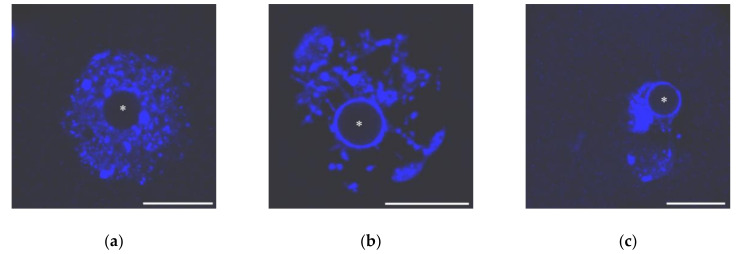
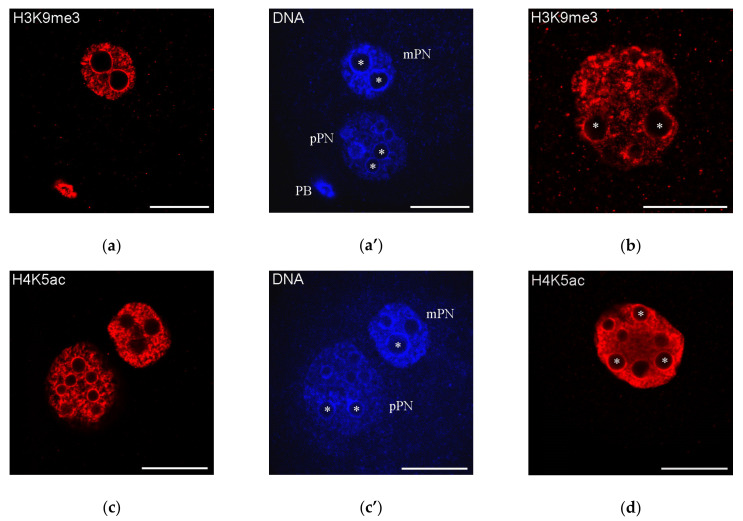
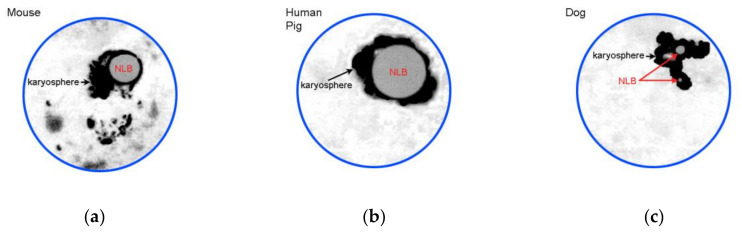
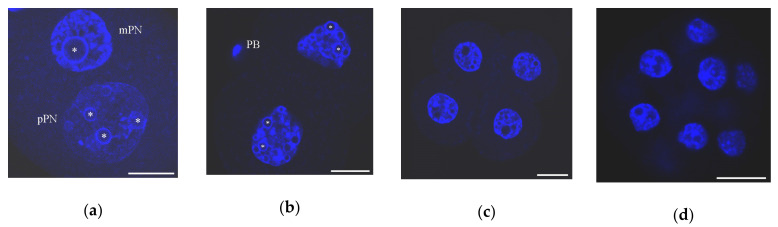
During the period of oocyte growth, chromatin undergoes global rearrangements at both morphological and molecular levels. An intriguing feature of oogenesis in some mammalian species is the formation of a heterochromatin ring-shaped structure, called the karyosphere or surrounded "nucleolus", which is associated with the periphery of the nucleolus-like bodies (NLBs). Morphologically similar heterochromatin structures also form around the nucleolus-precursor bodies (NPBs) in zygotes and persist for several first cleavage divisions in blastomeres. Despite recent progress in our understanding the regulation of gene silencing/expression during early mammalian development, as well as the molecular mechanisms that underlie chromatin condensation and heterochromatin structure, the biological significance of the karyosphere and its counterparts in early embryos is still elusive. We pay attention to both the changes of heterochromatin morphology and to the molecular mechanisms that can affect the configuration and functional activity of chromatin. We briefly discuss how DNA methylation, post-translational histone modifications, alternative histone variants, and some chromatin-associated non-histone proteins may be involved in the formation of peculiar heterochromatin structures intimately associated with NLBs and NPBs, the unique nuclear bodies of oocytes and early embryos.
在卵母细胞生长过程中,染色质在形态和分子水平上都发生了全局性重排。一些哺乳动物物种的卵子发生的一个有趣特征是形成一种异染色质环状结构,称为核球体或被包围的“核仁”,它与核仁样体(NLB)的外围相关。形态上相似的异染色质结构也在合子的核仁前体(NPB)周围形成,并在胚胎分裂的前几个分裂中持续存在。尽管我们在理解早期哺乳动物发育过程中的基因沉默/表达调控以及导致染色质浓缩和异染色质结构的分子机制方面取得了最新进展,但核球体及其在早期胚胎中的对应物的生物学意义仍然难以捉摸。我们既关注异染色质形态的变化,也关注可能影响染色质构型和功能活性的分子机制。我们简要讨论了 DNA 甲基化、组蛋白翻译后修饰、替代组蛋白变体以及一些与染色质相关的非组蛋白蛋白如何可能参与与 NLB 和 NPB 密切相关的特殊异染色质结构的形成,这些结构是卵母细胞和早期胚胎中独特的核体。