Dulwich Katherine L, Asfor Amin, Gray Alice, Giotis Efstathios S, Skinner Michael A, Broadbent Andrew J
Birnaviruses Group, The Pirbright Institute, Woking, United Kingdom.
Department of Infectious Diseases, Imperial College London, London, United Kingdom.
Front Cell Infect Microbiol. 2020 Jun 9;10:315. doi: 10.3389/fcimb.2020.00315. eCollection 2020.
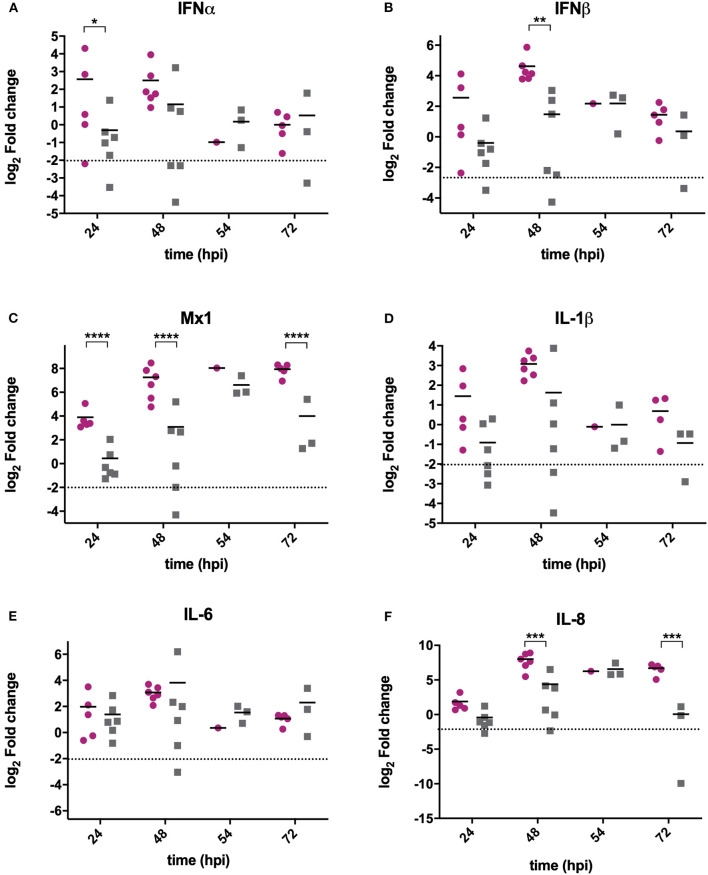
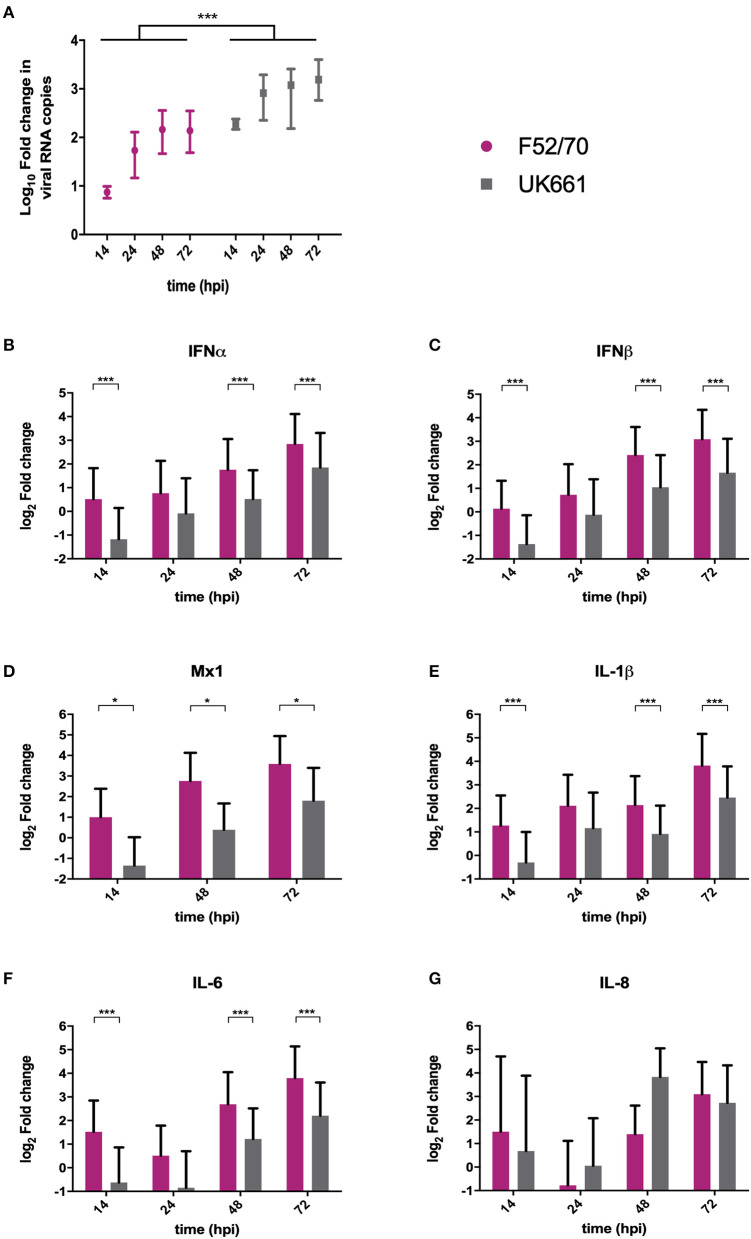
IBDV is economically important to the poultry industry. Very virulent (vv) strains cause higher mortality rates than other strains for reasons that remain poorly understood. In order to provide more information on IBDV disease outcome, groups of chickens ( = 18) were inoculated with the vv strain, UK661, or the classical strain, F52/70. Birds infected with UK661 had a lower survival rate (50%) compared to F52/70 (80%). There was no difference in peak viral replication in the bursa of Fabricius (BF), but the expression of chicken IFNα, IFNβ, MX1, and IL-8 was significantly lower in the BF of birds infected with UK661 compared to F52/70 ( < 0.05) as quantified by RTqPCR, and this trend was also observed in DT40 cells infected with UK661 or F52/70 ( < 0.05). The induction of expression of type I IFN in DF-1 cells stimulated with polyI:C (measured by an IFN-β luciferase reporter assay) was significantly reduced in cells expressing ectopic VP4 from UK661 ( < 0.05), but was higher in cells expressing ectopic VP4 from F52/70. Cells infected with a chimeric recombinant IBDV carrying the UK661-VP4 gene in the background of PBG98, an attenuated vaccine strain that induces high levels of innate responses (PBG98-VP4) also showed a reduced level of IFNα and IL-8 compared to cells infected with a chimeric virus carrying the F52/70-VP4 gene (PBG98-VP4) ( < 0.01), and birds infected with PBG98-VP4 also had a reduced expression of IFNα in the BF compared to birds infected with PBG98-VP4 ( < 0.05). Taken together, these data demonstrate that UK661 induced the expression of lower levels of anti-viral type I IFN and proinflammatory genes than the classical strain and and this was, in part, due to strain-dependent differences in the VP4 protein.
传染性法氏囊病病毒(IBDV)对家禽业具有重要的经济意义。超强毒(vv)毒株导致的死亡率高于其他毒株,但其原因仍知之甚少。为了提供更多关于IBDV疾病结果的信息,将几组鸡(每组 = 18只)接种超强毒株UK661或经典毒株F52/70。与感染F52/70的鸡(80%)相比,感染UK661的鸡存活率较低(50%)。法氏囊(BF)中的病毒复制峰值没有差异,但通过RTqPCR定量分析,感染UK661的鸡的BF中鸡IFNα、IFNβ、MX1和IL-8的表达明显低于感染F52/70的鸡(P < 0.05),并且在感染UK661或F52/70的DT40细胞中也观察到了这种趋势(P < 0.05)。在用聚肌胞苷酸(polyI:C)刺激的DF-1细胞中,I型干扰素表达的诱导(通过IFN-β荧光素酶报告基因检测)在表达来自UK661的异位VP4的细胞中显著降低(P < 0.05),但在表达来自F52/70的异位VP4的细胞中更高。用携带UK661-VP4基因的嵌合重组IBDV感染的细胞,该重组病毒以诱导高水平先天反应的减毒疫苗株PBG98为背景(PBG98-VP4),与用携带F52/70-VP4基因的嵌合病毒感染的细胞(PBG98-VP4)相比,IFNα和IL-8水平也降低(P < 0.01),并且感染PBG98-VP4的鸡与感染PBG98-VP4的鸡相比,BF中IFNα的表达也降低(P < 0.05)。综上所述,这些数据表明,与经典毒株相比,UK661诱导的抗病毒I型干扰素和促炎基因表达水平较低,这部分是由于VP4蛋白存在毒株依赖性差异。