Brothers Trevor, Wlotko Eddie W, Warnke Lena, Kuperberg Gina R
Tufts University, Medford, MA 02155.
Moss Rehabilitation Research Institute, Elkins Park, Pennsylvania 19027.
Neurobiol Lang (Camb). 2020;1(1):135-160. doi: 10.1162/nol_a_00006. Epub 2020 Apr 6.
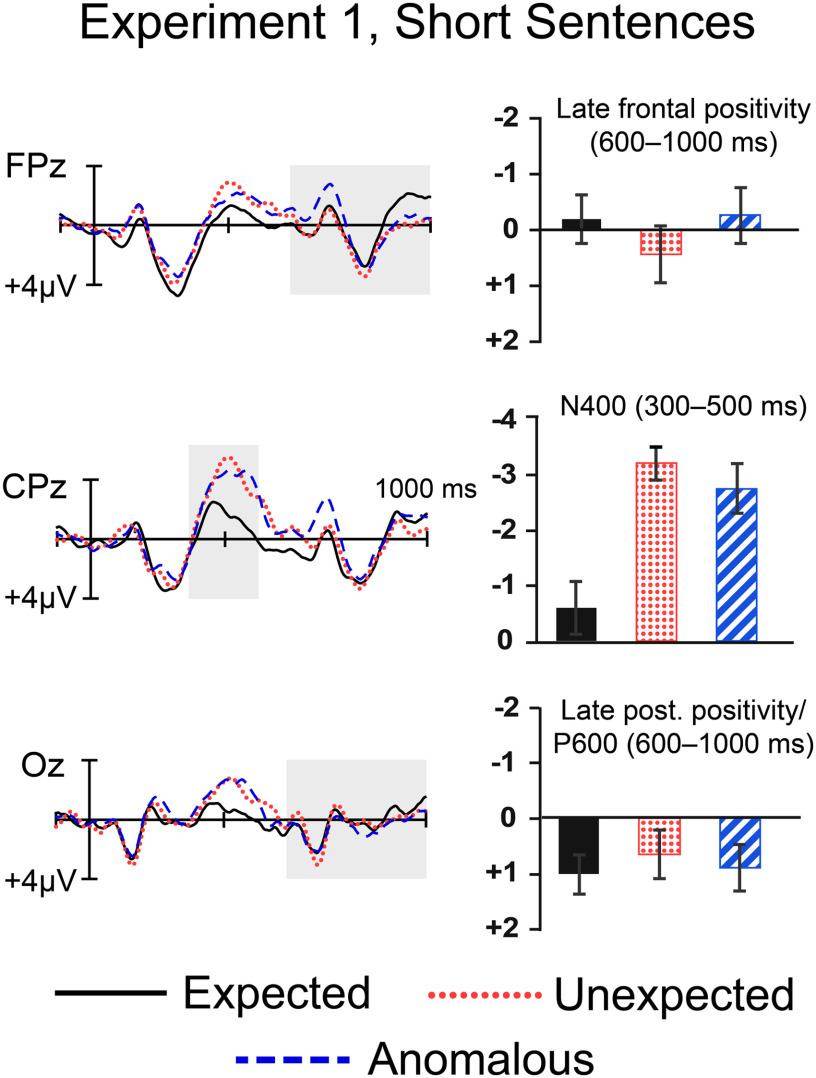
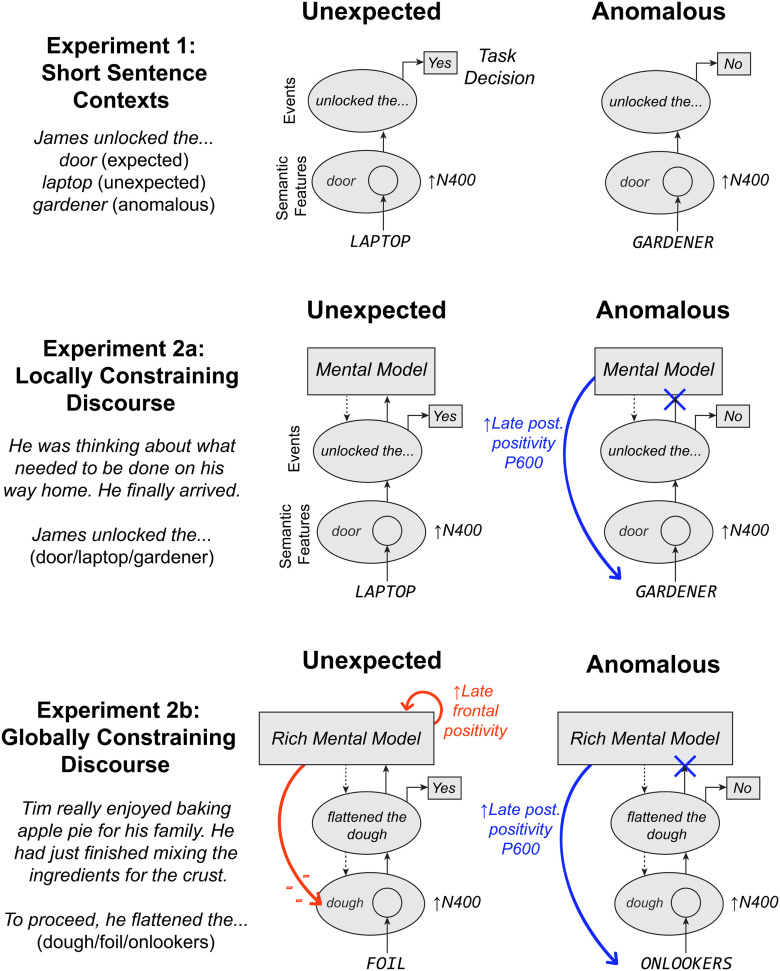
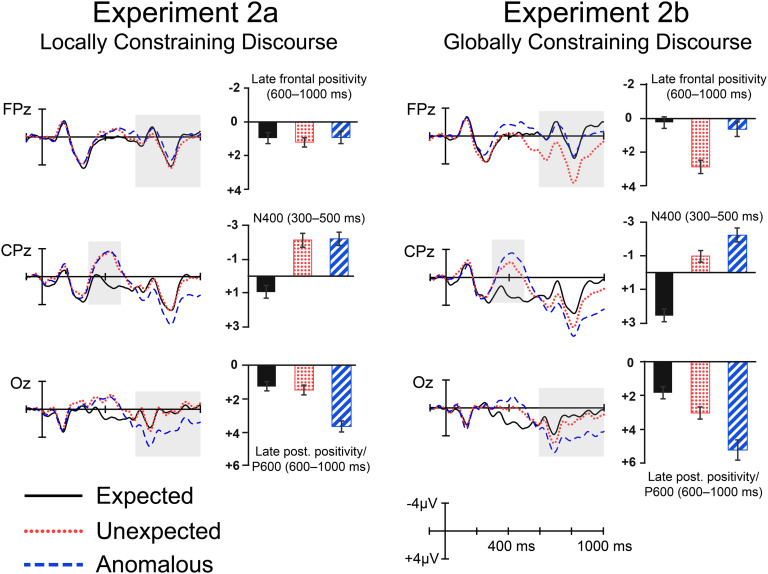
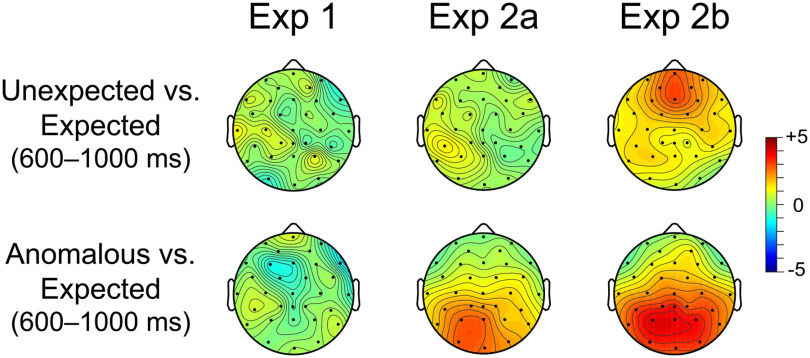
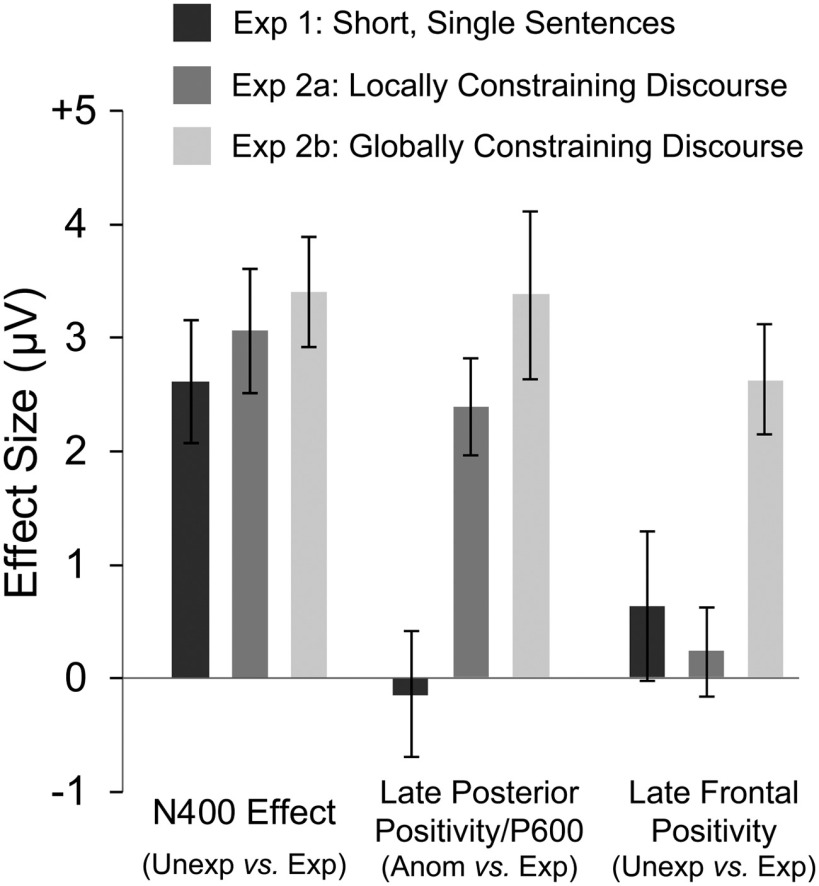
During language comprehension, online neural processing is strongly influenced by the constraints of the prior context. While the N400 ERP response (300-500ms) is known to be sensitive to a word's semantic predictability, less is known about a set of late positive-going ERP responses (600-1000ms) that can be elicited when an incoming word violates strong predictions about upcoming content () or about what is possible given the prior context (). Across three experiments, we systematically manipulated the length of the prior context and the source of lexical constraint to determine their influence on comprehenders' online neural responses to these two types of prediction violations. In Experiment 1, within minimal contexts, both lexical prediction violations and semantically anomalous words produced a larger N400 than expected continuations (), but no late positive effects were observed. Critically, the to semantic anomalies appeared when these same sentences were embedded within longer discourse contexts (Experiment 2a), and the appeared to lexical prediction violations when the preceding context was rich and globally constraining (Experiment 2b). We interpret these findings within a hierarchical generative framework of language comprehension. This framework highlights the role of comprehension goals and broader linguistic context, and how these factors influence both top-down prediction and the decision to update or reanalyze the prior context when these predictions are violated.
在语言理解过程中,在线神经处理受到先前语境约束的强烈影响。虽然已知N400事件相关电位反应(300 - 500毫秒)对单词的语义可预测性敏感,但对于一组晚期正向事件相关电位反应(600 - 1000毫秒)了解较少,当输入的单词违反了对即将出现的内容的强烈预测()或根据先前语境可能出现的情况的预测()时,就会引发这组反应。在三个实验中,我们系统地操纵先前语境的长度和词汇约束的来源,以确定它们对理解者对这两种类型预测违反的在线神经反应的影响。在实验1中,在最小语境中,词汇预测违反和语义异常词都比预期的延续词产生了更大的N400(),但未观察到晚期正向效应。至关重要的是,当这些相同的句子嵌入到更长的语篇语境中时,对语义异常的(实验2a)出现了,而当先前语境丰富且具有全局约束时,对词汇预测违反的(实验2b)出现了。我们在语言理解的层次生成框架内解释这些发现。这个框架突出了理解目标和更广泛的语言语境的作用,以及当这些预测被违反时,这些因素如何影响自上而下的预测以及更新或重新分析先前语境的决定。