Morozova Olga, Li Zehang Richard, Crawford Forrest W
Program in Public Health and Department of Family, Population and Preventive Medicine, Stony Brook University (SUNY), NY, USA.
Department of Statisitcs, University of California, Santa Cruz, Santa Cruz, CA, USA.
medRxiv. 2021 Apr 23:2020.06.12.20126391. doi: 10.1101/2020.06.12.20126391.
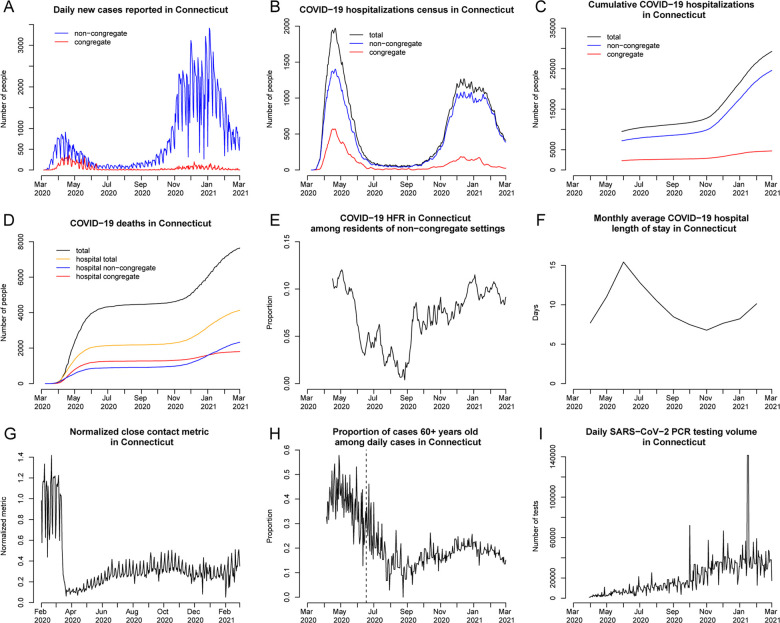
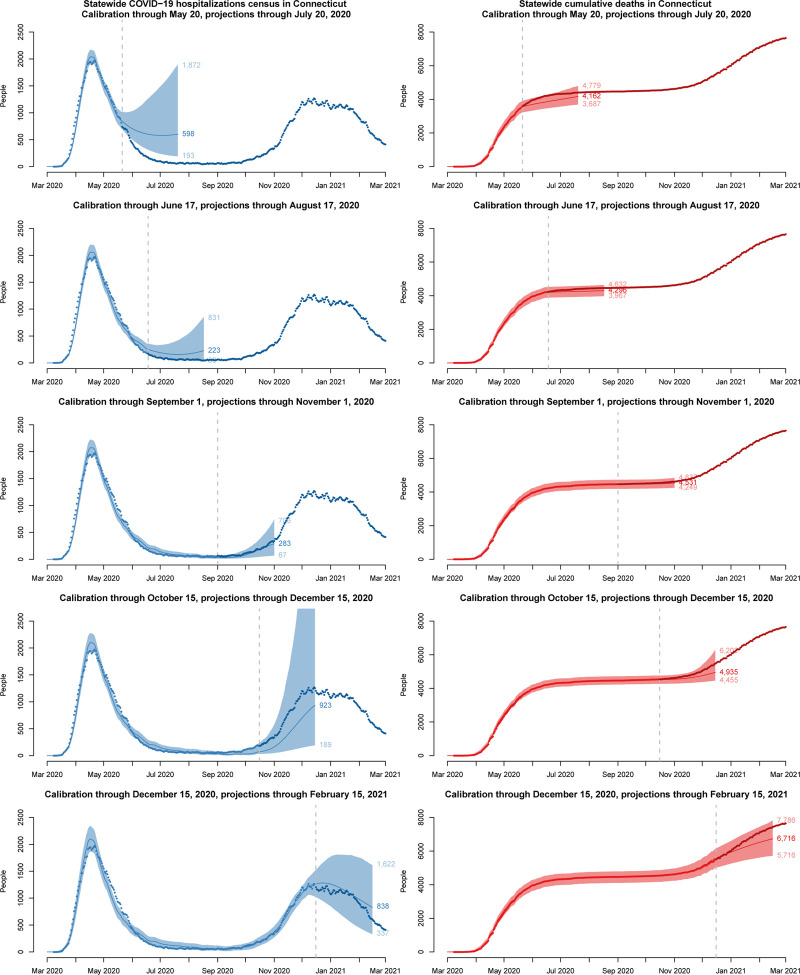
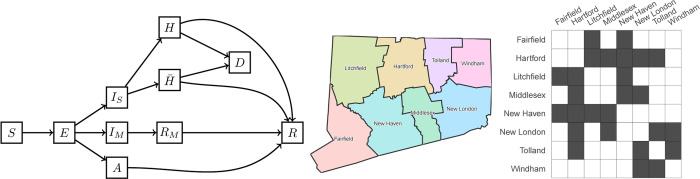
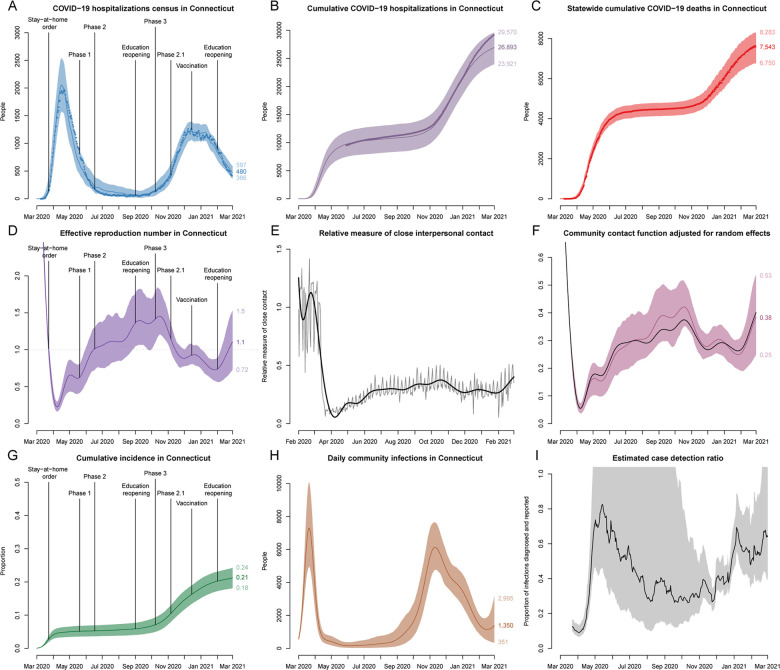
To support public health policymakers in Connecticut, we developed a county-structured compartmental SEIR-type model of SARS-CoV-2 transmission and COVID-19 disease progression. Our goals were to provide projections of infections, hospitalizations, and deaths, as well as estimates of important features of disease transmission, public behavior, healthcare response, and clinical progression of disease. In this paper, we describe a transmission model developed to meet the changing requirements of public health policymakers and officials in Connecticut from March 2020 to February 2021. We outline the model design, implementation and calibration, and describe how projections and estimates were used to support decision-making in Connecticut throughout the first year of the pandemic. We calibrated this model to data on deaths and hospitalizations, developed a novel measure of close interpersonal contact frequency to capture changes in transmission risk over time and used multiple local data sources to infer dynamics of time-varying model inputs. Estimated time-varying epidemiologic features of the COVID-19 epidemic in Connecticut include the effective reproduction number, cumulative incidence of infection, infection hospitalization and fatality ratios, and the case detection ratio. We describe methodology for producing projections of epidemic evolution under uncertain future scenarios, as well as analytical tools for estimating epidemic features that are difficult to measure directly, such as cumulative incidence and the effects of non-pharmaceutical interventions. The approach takes advantage of our unique access to Connecticut public health surveillance and hospital data and our direct connection to state officials and policymakers. We conclude with a discussion of the limitations inherent in predicting uncertain epidemic trajectories and lessons learned from one year of providing COVID-19 projections in Connecticut.
为了支持康涅狄格州的公共卫生政策制定者,我们开发了一个基于县结构的SARS-CoV-2传播和COVID-19疾病进展的分区SEIR型模型。我们的目标是提供感染、住院和死亡的预测,以及疾病传播、公众行为、医疗应对和疾病临床进展等重要特征的估计。在本文中,我们描述了一个为满足2020年3月至2021年2月康涅狄格州公共卫生政策制定者和官员不断变化的需求而开发的传播模型。我们概述了模型设计、实施和校准,并描述了在疫情的第一年中,预测和估计是如何用于支持康涅狄格州的决策制定的。我们将该模型校准到死亡和住院数据,开发了一种新的密切人际接触频率测量方法,以捕捉传播风险随时间的变化,并使用多个本地数据源来推断随时间变化的模型输入的动态。康涅狄格州COVID-19疫情的估计随时间变化的流行病学特征包括有效繁殖数、累计感染发病率、感染住院率和死亡率以及病例检测率。我们描述了在不确定的未来情景下生成疫情演变预测的方法,以及用于估计难以直接测量的疫情特征(如累计发病率和非药物干预效果)的分析工具。该方法利用了我们对康涅狄格州公共卫生监测和医院数据独特的获取途径,以及我们与州官员和政策制定者的直接联系。我们最后讨论了预测不确定疫情轨迹所固有的局限性,以及从在康涅狄格州提供COVID-19预测的一年中吸取的经验教训。