Abrams Steven, Wambua James, Santermans Eva, Willem Lander, Kuylen Elise, Coletti Pietro, Libin Pieter, Faes Christel, Petrof Oana, Herzog Sereina A, Beutels Philippe, Hens Niel
Data Science Institute, Interuniversity Institute of Biostatistics and statistical Bioinformatics, UHasselt, Hasselt, Belgium; Global Health Institute, Family Medicine and Population Health, University of Antwerp, Antwerp, Belgium.
Data Science Institute, Interuniversity Institute of Biostatistics and statistical Bioinformatics, UHasselt, Hasselt, Belgium.
Epidemics. 2021 Jun;35:100449. doi: 10.1016/j.epidem.2021.100449. Epub 2021 Mar 23.
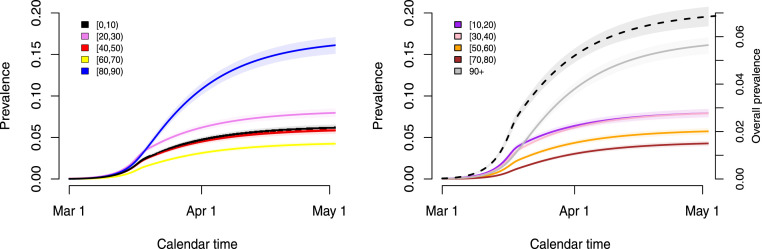
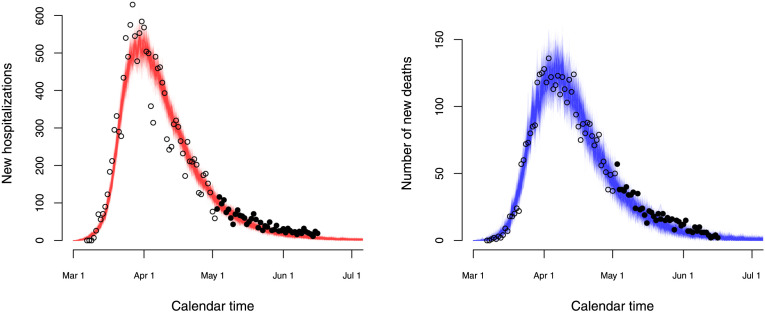
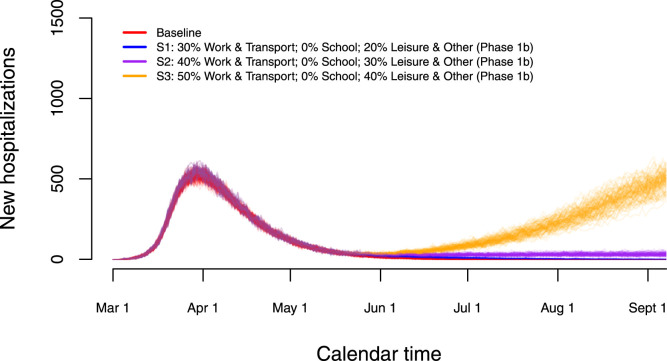
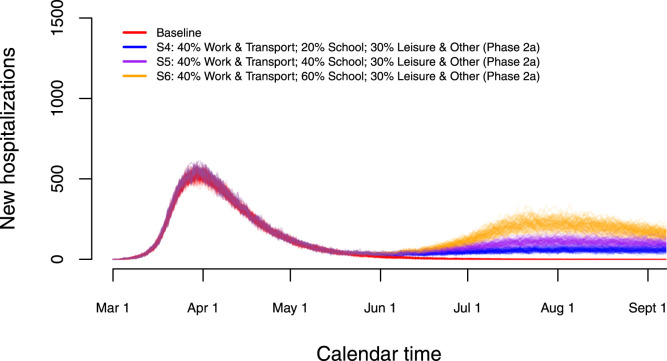
Following the onset of the ongoing COVID-19 pandemic throughout the world, a large fraction of the global population is or has been under strict measures of physical distancing and quarantine, with many countries being in partial or full lockdown. These measures are imposed in order to reduce the spread of the disease and to lift the pressure on healthcare systems. Estimating the impact of such interventions as well as monitoring the gradual relaxing of these stringent measures is quintessential to understand how resurgence of the COVID-19 epidemic can be controlled for in the future. In this paper we use a stochastic age-structured discrete time compartmental model to describe the transmission of COVID-19 in Belgium. Our model explicitly accounts for age-structure by integrating data on social contacts to (i) assess the impact of the lockdown as implemented on March 13, 2020 on the number of new hospitalizations in Belgium; (ii) conduct a scenario analysis estimating the impact of possible exit strategies on potential future COVID-19 waves. More specifically, the aforementioned model is fitted to hospital admission data, data on the daily number of COVID-19 deaths and serial serological survey data informing the (sero)prevalence of the disease in the population while relying on a Bayesian MCMC approach. Our age-structured stochastic model describes the observed outbreak data well, both in terms of hospitalizations as well as COVID-19 related deaths in the Belgian population. Despite an extensive exploration of various projections for the future course of the epidemic, based on the impact of adherence to measures of physical distancing and a potential increase in contacts as a result of the relaxation of the stringent lockdown measures, a lot of uncertainty remains about the evolution of the epidemic in the next months.
在全球范围内持续的新冠疫情爆发后,全球很大一部分人口正在或已经处于严格的物理距离和隔离措施之下,许多国家处于部分或完全封锁状态。实施这些措施是为了减少疾病传播,并减轻医疗系统的压力。评估此类干预措施的影响以及监测这些严格措施的逐步放宽对于理解未来如何控制新冠疫情的复发至关重要。在本文中,我们使用一个随机年龄结构离散时间 compartmental 模型来描述比利时新冠病毒的传播情况。我们的模型通过整合社会接触数据明确考虑了年龄结构,以:(i) 评估 2020 年 3 月 13 日实施的封锁措施对比利时新住院人数的影响;(ii) 进行情景分析,估计可能的退出策略对未来潜在新冠疫情波的影响。更具体地说,上述模型在依靠贝叶斯 MCMC 方法的同时,拟合了医院入院数据、新冠病毒每日死亡人数数据以及告知人群中疾病(血清)流行率的系列血清学调查数据。我们的年龄结构随机模型在比利时人群的住院情况以及与新冠病毒相关的死亡方面都很好地描述了观察到的疫情数据。尽管对疫情未来发展的各种预测进行了广泛探索,基于遵守物理距离措施的影响以及严格封锁措施放宽可能导致的接触增加,但未来几个月疫情的演变仍存在很多不确定性。