INSERM U1016, Centre National de la Recherche Scientifique (CNRS) Unité Mixte de Recherche (UMR) 8104, Université de Paris, Institut Cochin, Paris, France.
Laboratoire d'Excellence GR-Ex, Paris, France.
Blood. 2020 Sep 17;136(12):1381-1393. doi: 10.1182/blood.2019004746.
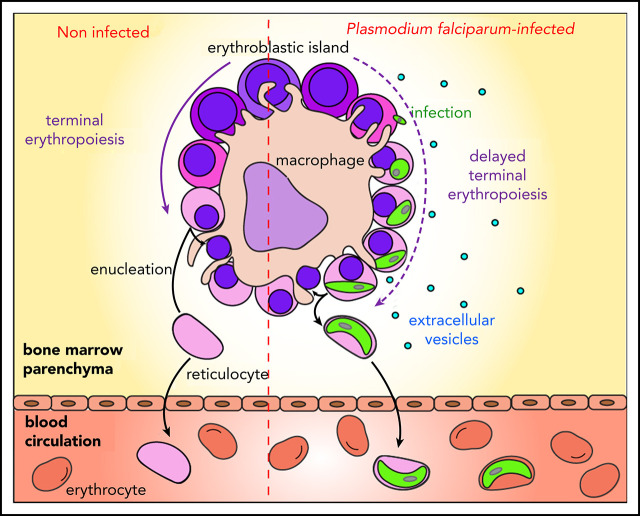
Plasmodium falciparum gametocytes, the sexual stage responsible for malaria parasite transmission from humans to mosquitoes, are key targets for malaria elimination. Immature gametocytes develop in the human bone marrow parenchyma, where they accumulate around erythroblastic islands. Notably though, the interactions between gametocytes and this hematopoietic niche have not been investigated. Here, we identify late erythroblasts as a new host cell for P falciparum sexual stages and show that gametocytes can fully develop inside these nucleated cells in vitro and in vivo, leading to infectious mature gametocytes within reticulocytes. Strikingly, we found that infection of erythroblasts by gametocytes and parasite-derived extracellular vesicles delay erythroid differentiation, thereby allowing gametocyte maturation to coincide with the release of their host cell from the bone marrow. Taken together, our findings highlight new mechanisms that are pivotal for the maintenance of immature gametocytes in the bone marrow and provide further insights on how Plasmodium parasites interfere with erythropoiesis and contribute to anemia in malaria patients.
疟原虫配子体是疟疾寄生虫从人类传播到蚊子的有性阶段,是疟疾消除的关键目标。未成熟的配子体在人类骨髓实质中发育,在那里它们聚集在成红细胞岛上。然而,值得注意的是,配子体与造血生态位之间的相互作用尚未被研究。在这里,我们确定晚期红细胞为疟原虫有性阶段的新宿主细胞,并表明配子体可以在体外和体内完全在这些有核细胞内发育,导致网织红细胞内产生感染性成熟配子体。引人注目地,我们发现配子体和寄生虫衍生的细胞外囊泡感染红细胞会延迟红细胞分化,从而使配子体成熟与宿主细胞从骨髓中释放出来同时发生。总之,我们的研究结果强调了维持骨髓中未成熟配子体的新机制,并进一步深入了解疟原虫寄生虫如何干扰红细胞生成并导致疟疾患者贫血。