Department of Systems Biology, Blavatnik Institute at Harvard Medical School, Boston, MA 02115, USA.
Wyss Institute for Biologically Inspired Engineering, Harvard University, Boston, MA 02115, USA.
Nucleic Acids Res. 2020 Aug 20;48(14):8165-8177. doi: 10.1093/nar/gkaa557.
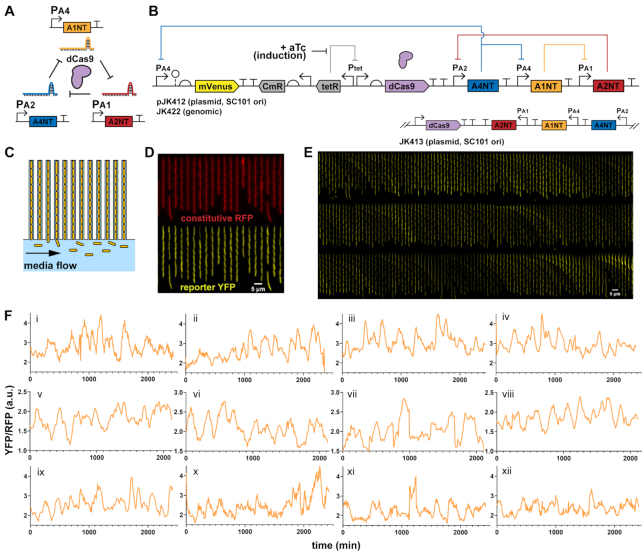
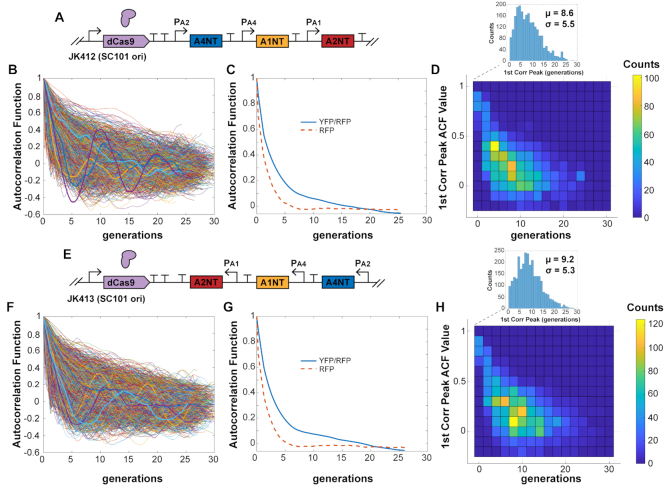
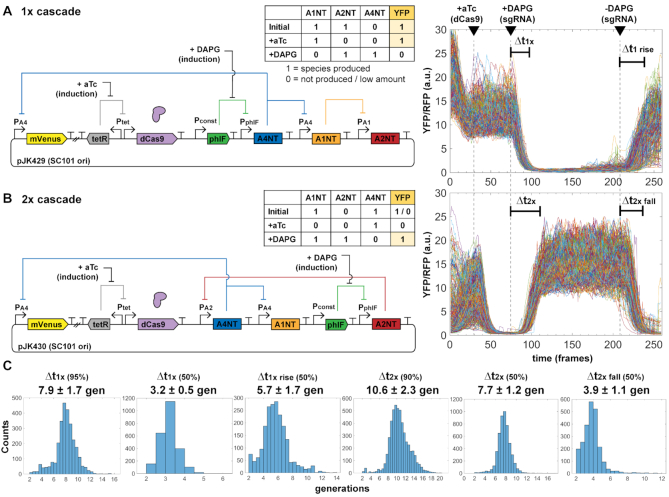
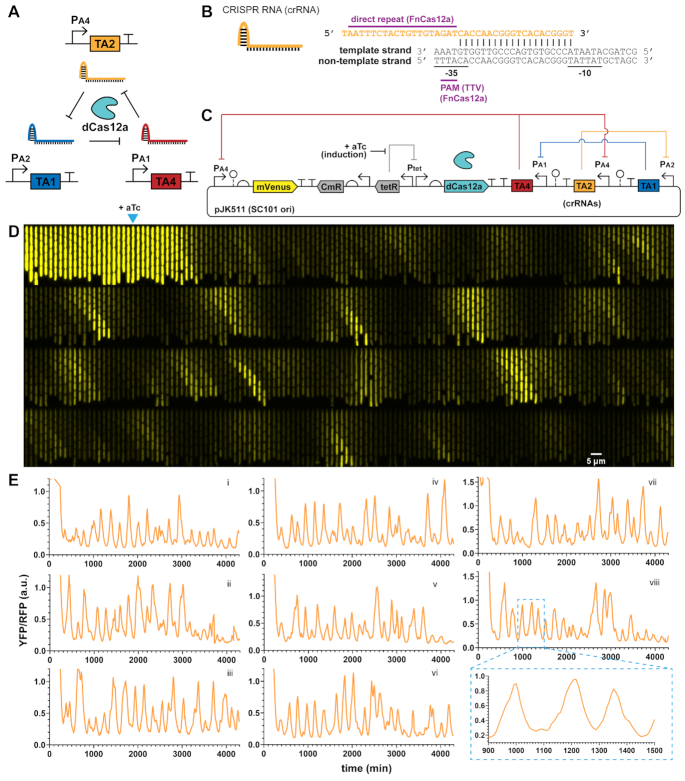
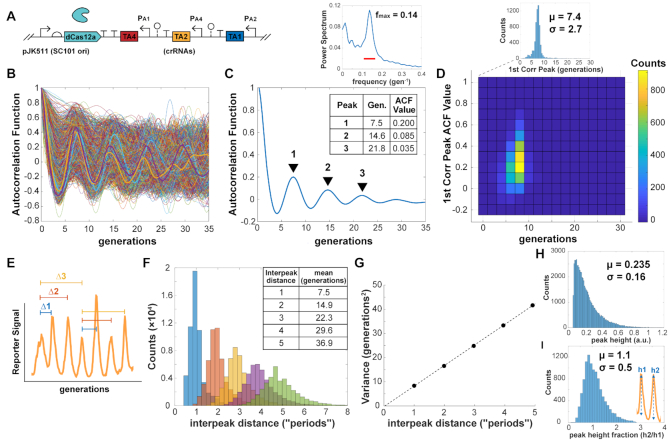
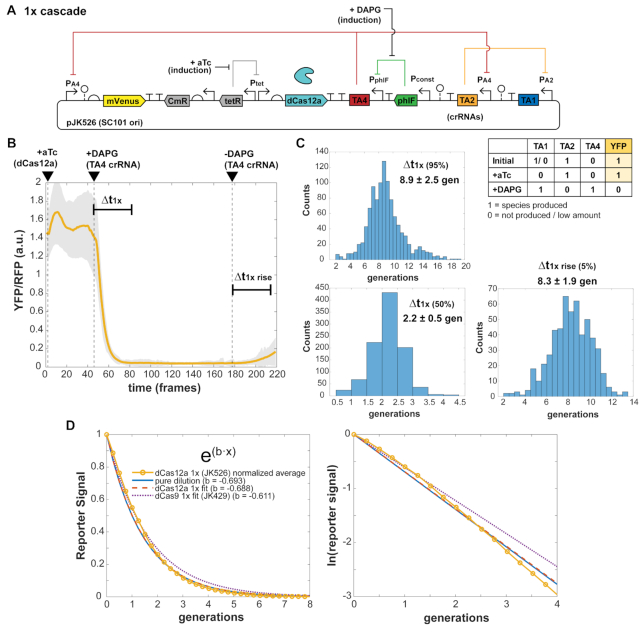
In synthetic circuits, CRISPR-Cas systems have been used effectively for endpoint changes from an initial state to a final state, such as in logic gates. Here, we use deactivated Cas9 (dCas9) and deactivated Cas12a (dCas12a) to construct dynamic RNA ring oscillators that cycle continuously between states over time in bacterial cells. While our dCas9 circuits using 103-nt guide RNAs showed irregular fluctuations with a wide distribution of peak-to-peak period lengths averaging approximately nine generations, a dCas12a oscillator design with 40-nt CRISPR RNAs performed much better, having a strongly repressed off-state, distinct autocorrelation function peaks, and an average peak-to-peak period length of ∼7.5 generations. Along with free-running oscillator circuits, we measure repression response times in open-loop systems with inducible RNA steps to compare with oscillator period times. We track thousands of cells for 24+ h at the single-cell level using a microfluidic device. In creating a circuit with nearly translationally independent behavior, as the RNAs control each others' transcription, we present the possibility for a synthetic oscillator generalizable across many organisms and readily linkable for transcriptional control.
在合成回路中,CRISPR-Cas 系统已被有效地用于将初始状态的端点改变为最终状态,例如在逻辑门中。在这里,我们使用失活的 Cas9(dCas9)和失活的 Cas12a(dCas12a)来构建动态 RNA 环振荡器,该振荡器在细菌细胞中随时间连续在状态之间循环。虽然我们使用 103-nt 向导 RNA 的 dCas9 回路显示出不规则波动,其峰到峰周期长度分布很宽,平均约为九个世代,但使用 40-nt CRISPR RNA 的 dCas12a 振荡器设计要好得多,具有强烈抑制的关闭状态、明显的自相关函数峰和平均峰到峰周期长度约为 7.5 个世代。除了自由运行的振荡器电路,我们还在开环系统中使用诱导 RNA 步骤测量抑制响应时间,以便与振荡器周期时间进行比较。我们使用微流控设备在单细胞水平上跟踪数千个细胞 24+ 小时。通过创建一个具有几乎独立于翻译的行为的电路,因为 RNA 控制彼此的转录,我们提出了一种可在许多生物体中推广的合成振荡器的可能性,并且可以很容易地链接到转录控制。