Cardiovascular Research Center, Division of Cardiology, Corrigan Minehan Heart Center, Department of Medicine, Massachusetts General Hospital, Harvard Medical School, Boston, MA, 02114-2696, USA.
Cardiovascular Performance Program, Division of Cardiology, Corrigan Minehan Heart Center, Department of Medicine, Massachusetts General Hospital, Harvard Medical School, Boston, MA, 02114-2696, USA.
Sci Rep. 2020 Jul 2;10(1):10831. doi: 10.1038/s41598-020-67669-0.
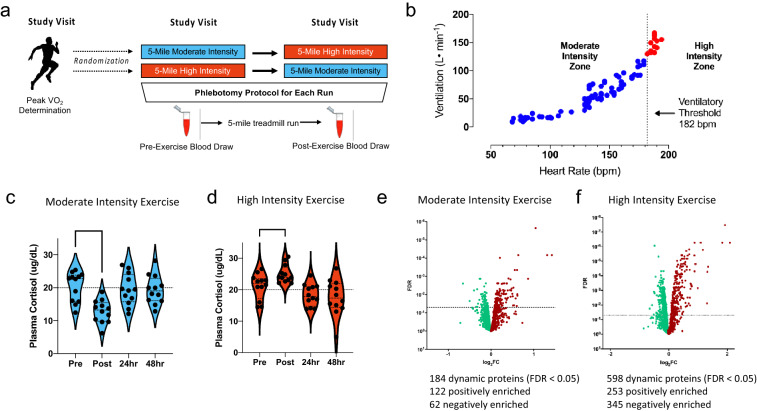
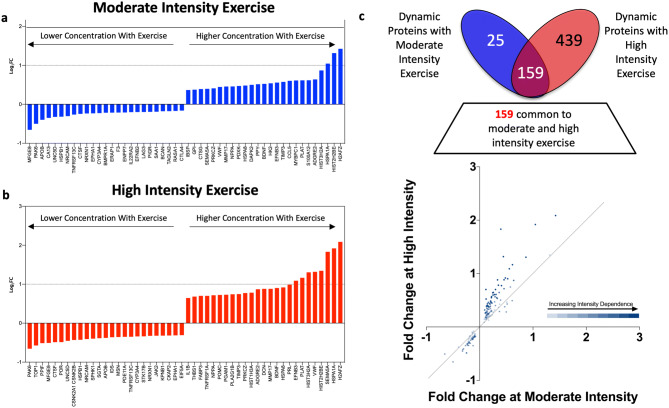
Routine endurance exercise confers numerous health benefits, and high intensity exercise may accelerate and magnify many of these benefits. To date, explanatory molecular mechanisms and the influence of exercise intensity remain poorly understood. Circulating factors are hypothesized to transduce some of the systemic effects of exercise. We sought to examine the role of exercise and exercise intensity on the human plasma proteome. We employed an aptamer-based method to examine 1,305 plasma proteins in 12 participants before and after exercise at two physiologically defined intensities (moderate and high) to determine the proteomic response. We demonstrate that the human plasma proteome is responsive to acute exercise in an intensity-dependent manner with enrichment analysis suggesting functional biological differences between the moderate and high intensity doses. Through integration of available genetic data, we estimate the effects of acute exercise on exercise-associated traits and find proteomic responses that may contribute to observed clinical effects on coronary artery disease and blood pressure regulation. In sum, we provide supportive evidence that moderate and high intensity exercise elicit different signaling responses, that exercise may act in part non-cell autonomously through circulating plasma proteins, and that plasma protein dynamics can simulate some the beneficial and adverse effects of acute exercise.
常规耐力运动带来众多健康益处,高强度运动可能加速和放大其中许多益处。迄今为止,解释性分子机制和运动强度的影响仍知之甚少。循环因子被假设可以传递运动的一些系统效应。我们试图研究运动和运动强度对人类血浆蛋白质组的作用。我们采用基于适体的方法,在 12 名参与者在两种生理定义的强度(中等和高强度)下进行运动前后,检查了 1305 种血浆蛋白,以确定蛋白质组的反应。我们证明,人类血浆蛋白质组对急性运动有强度依赖性反应,富集分析表明中等强度和高强度剂量之间存在功能生物学差异。通过整合现有遗传数据,我们估计急性运动对与运动相关特征的影响,发现可能有助于观察到对冠心病和血压调节的临床效果的蛋白质组反应。总之,我们提供了支持性证据,表明中等强度和高强度运动引起不同的信号反应,运动可能部分通过循环血浆蛋白非细胞自主地发挥作用,而血浆蛋白动力学可以模拟急性运动的一些有益和不利影响。