Dhont Jennifer, Di Tella Marialaura, Dubois Ludwig, Aznar Marianne, Petit Steven, Spałek Mateusz, Boldrini Luca, Franco Pierfrancesco, Bertholet Jenny
Department of Electronics and Informatics (ETRO), Vrije Universiteit Brussel, Brussels, Belgium.
Imec, Leuven, Belgium.
Clin Transl Radiat Oncol. 2020 Jun 18;24:53-59. doi: 10.1016/j.ctro.2020.06.006. eCollection 2020 Sep.
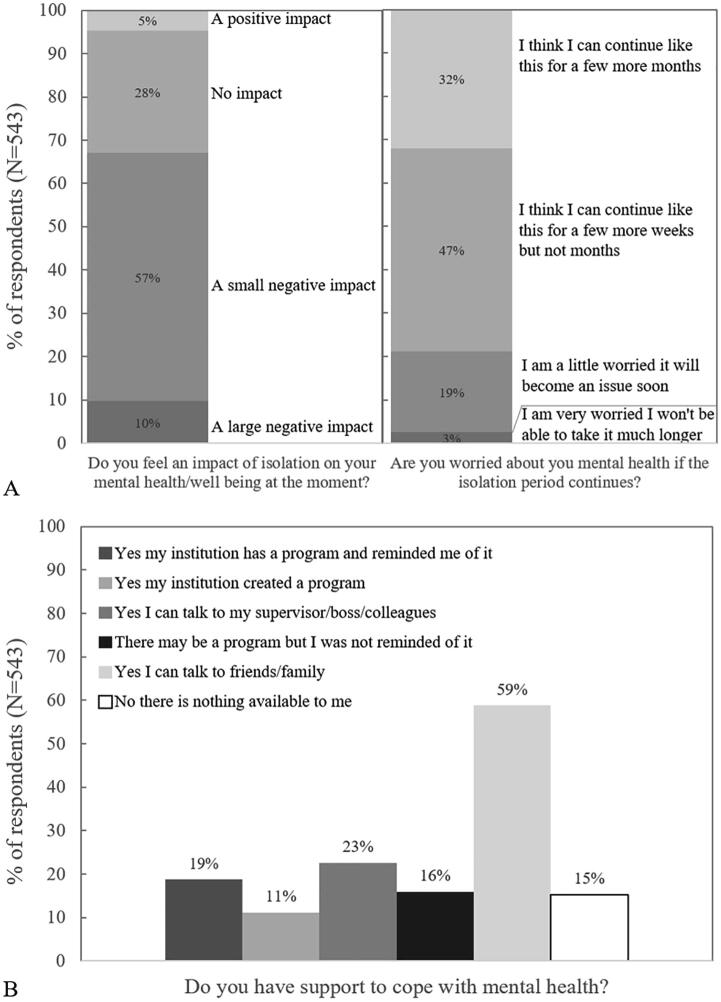
With the COVID-19 pandemic, individuals have been forced to follow strict social isolation guidelines. While crucial to control the pandemic, isolation might have a significant impact on productivity and mental health. Especially for researchers working in healthcare, the current situation is complex. We therefore carried out a survey amongst researchers in the field of radiation oncology to gain insights on the impact of social isolation and working from home and to guide future work.
An online survey was conducted between March 27th and April 5th, 2020. The first part contained 14 questions intended to capture an overview of the specific aspects related to research while in isolation. The second (optional) part of the questionnaire was the validated Hospital Anxiety and Depression Scale (HADS), a self-reported measure used to assess levels of anxiety and depressive symptoms.
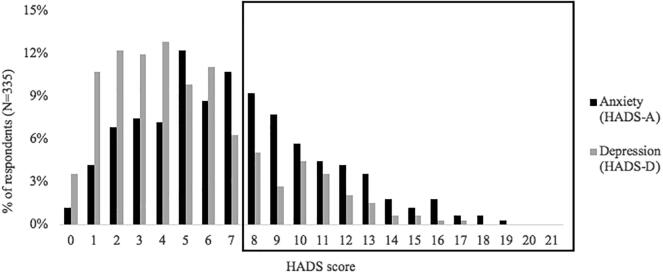
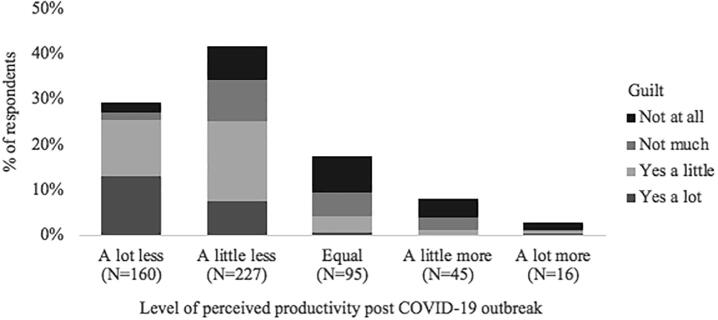
From 543 survey participants, 48.8% reported to work full-time from home. The impact on perceived productivity, with 71.2% of participants feeling less productive, caused 58% of participants to feel some level of guilt.Compared to normative data, relatively high levels of anxiety and depressive symptoms were recorded for the 335 participants who filled out the HADS questionnaire. Group comparisons found the presence of a supportive institutional program as the sole factor of statistical significance in both anxiety and depressive symptom levels. People having to work full-time on location showed higher depressive symptom levels than those working from home. Anxiety scores were negatively correlated with the number of research years.
Results of the survey showed there is a non-negligible impact on both productivity and mental health. As the radiation oncology research community was forced to work from home during the COVID-19 pandemic, lessons can be learned to face future adverse situations but also to improve work-life balance in general.
随着新冠疫情的爆发,人们被迫遵循严格的社交隔离准则。虽然隔离对于控制疫情至关重要,但它可能会对生产力和心理健康产生重大影响。尤其是对于从事医疗保健工作的研究人员来说,当前的情况较为复杂。因此,我们对放射肿瘤学领域的研究人员进行了一项调查,以深入了解社交隔离和在家工作的影响,并为未来的工作提供指导。
于2020年3月27日至4月5日进行了一项在线调查。第一部分包含14个问题,旨在全面了解隔离期间与研究相关的具体方面。问卷的第二部分(可选)是经过验证的医院焦虑抑郁量表(HADS),这是一种用于评估焦虑和抑郁症状水平的自我报告量表。
在543名调查参与者中,48.8%的人报告全职在家工作。对感知生产力的影响方面,71.2%的参与者感觉生产力下降,这导致58%的参与者感到某种程度的内疚。与标准数据相比,填写HADS问卷的335名参与者的焦虑和抑郁症状水平相对较高。组间比较发现,存在支持性的机构项目是焦虑和抑郁症状水平中唯一具有统计学意义的因素。必须在现场全职工作的人比在家工作的人表现出更高的抑郁症状水平。焦虑得分与研究年限呈负相关。
调查结果表明,对生产力和心理健康都有不可忽视的影响。由于放射肿瘤学研究群体在新冠疫情期间被迫在家工作,我们可以从中吸取经验教训,以应对未来的不利情况,同时总体上改善工作与生活的平衡。