Harvard T.H. Chan School of Public Health, Department of Global Health and Population, 665 Huntington Avenue, Boston, MA 02115, USA.
Int J Infect Dis. 2020 Sep;98:328-333. doi: 10.1016/j.ijid.2020.07.004. Epub 2020 Jul 4.
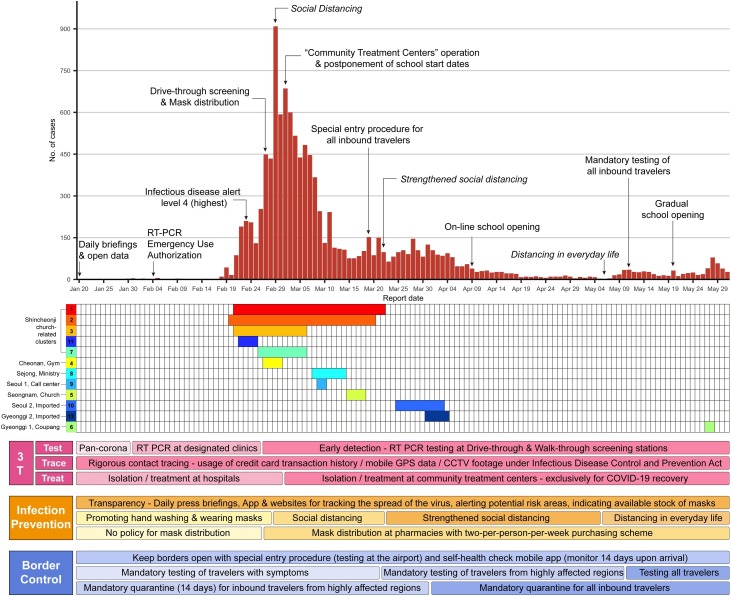
The aim of this study was to assess how coronavirus disease 2019 (COVID-19) clustered across districts in South Korea and to assess whether the pattern and duration of clusters changed following the country's containment strategy.
A spatiotemporal analysis of COVID-19 daily confirmed cases by 250 districts in South Korea from January 20 to May 31, 2020, obtained from the Korea Centers for Disease Control and Prevention and each provincial website, was conducted. The global Moran's I statistic was used for spatial autocorrelation analysis, and the retrospective space-time scan statistic was used to analyze spatiotemporal clusters of COVID-19.
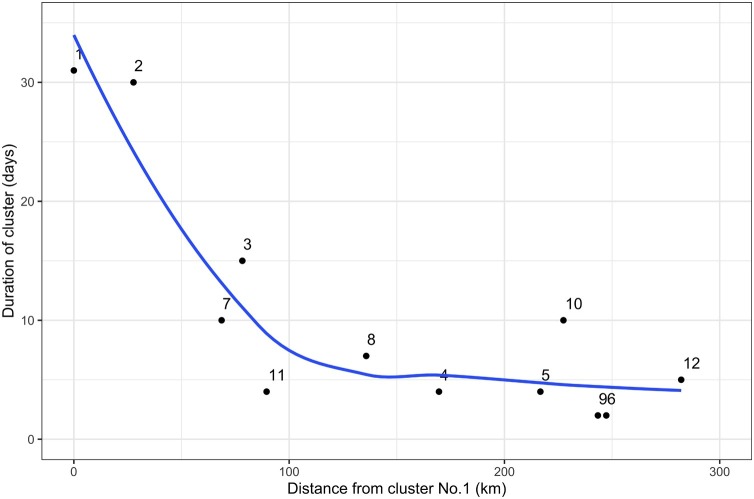
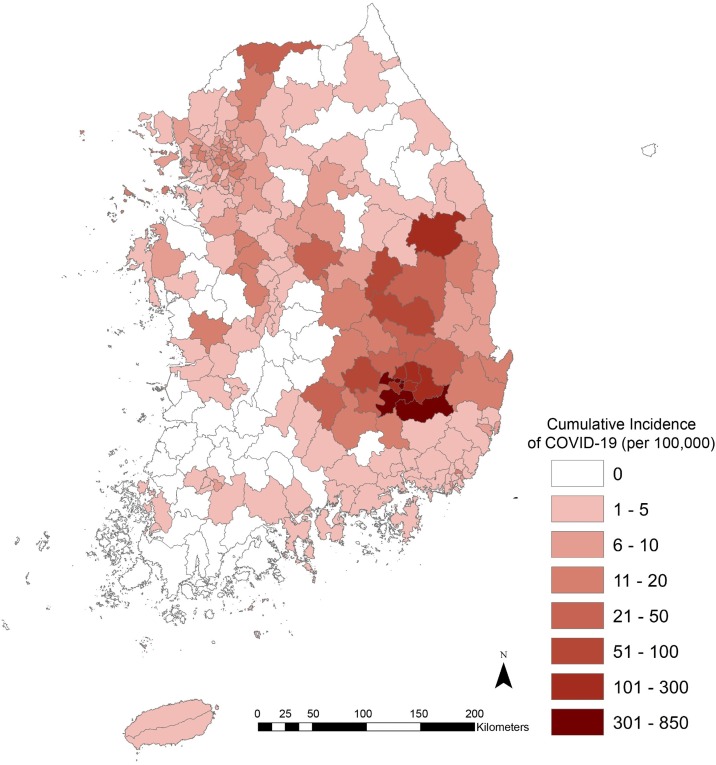
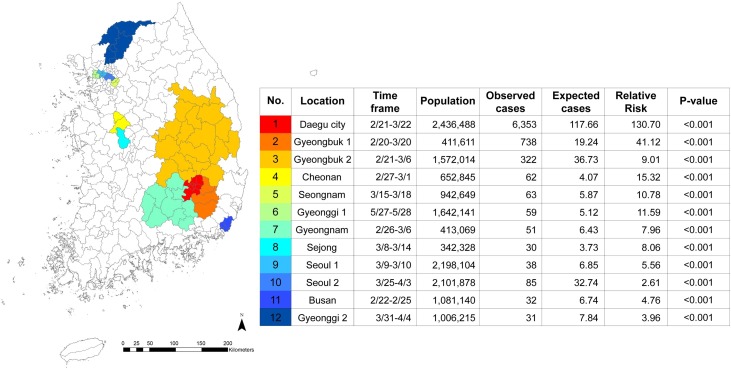
The geographical distribution showed strong spatial autocorrelation, with a global Moran's I coefficient of 0.784 (p=0.0001). Twelve statistically significant spatiotemporal clusters were identified by space-time scan statistic using a discrete Poisson model. The spatial pattern of clusters changed and the duration of clusters became shorter over time.
The results indicate that South Korea's containment strategy for COVID-19 was highly effective in both early detection and mitigation, with recent clusters being small in size and duration. Lessons from South Korea should spark a discussion on epidemic response.
本研究旨在评估 2019 年冠状病毒病(COVID-19)在韩国各地区的聚集情况,并评估在该国采取遏制策略后,聚集的模式和持续时间是否发生变化。
对 2020 年 1 月 20 日至 5 月 31 日期间从韩国疾病控制与预防中心和各省政府网站获得的韩国 250 个地区的 COVID-19 每日确诊病例进行时空分析。使用全局 Moran's I 统计量进行空间自相关分析,使用回顾性时空扫描统计量分析 COVID-19 的时空聚集。
地理分布显示出强烈的空间自相关,全局 Moran's I 系数为 0.784(p=0.0001)。使用离散泊松模型的时空扫描统计量确定了 12 个具有统计学意义的时空聚集。随着时间的推移,聚集的空间模式发生了变化,聚集的持续时间也缩短了。
结果表明,韩国对 COVID-19 的遏制策略在早期检测和缓解方面非常有效,最近的聚集规模较小,持续时间较短。韩国的经验教训应该引发对疫情应对的讨论。