Oh Su Hong, Jang Cheol Seong
Plant Genomics Laboratory, Department of Bioresource Sciences, Kangwon National University, Chuncheon 24341, Korea.
Foods. 2020 Jul 5;9(7):882. doi: 10.3390/foods9070882.
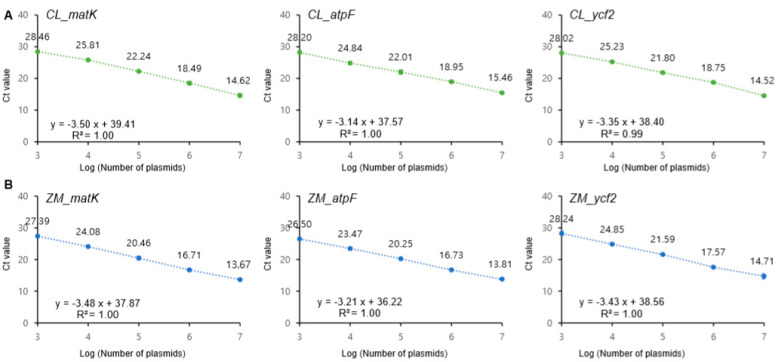
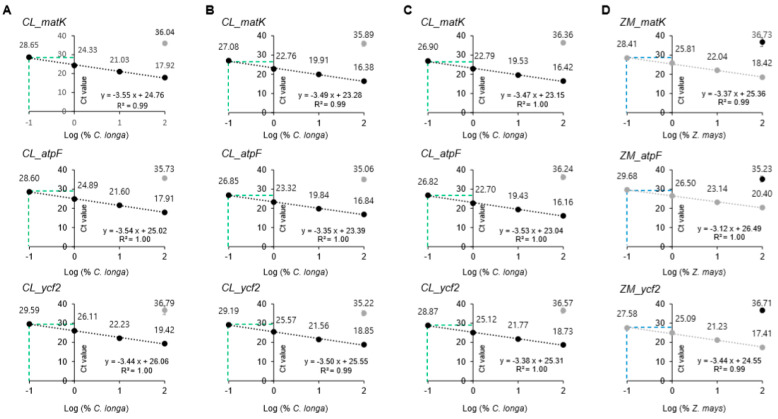
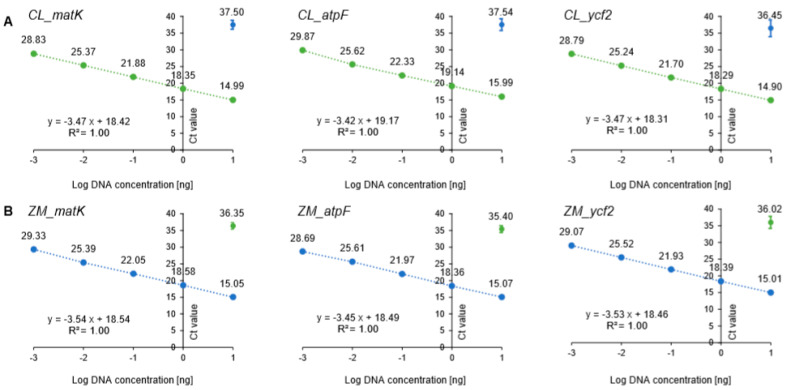
Turmeric, or , is commonly consumed in the South East Asian countries as a medical product and as food due to its therapeutic properties. However, with increasing demand for turmeric powder, adulterated turmeric powders mixed with other cheap starch powders, such as from corn or cassava, are being distributed by food suppliers for economic benefit. Here, we developed molecular markers using quantitative real-time PCR to identify adulteration in commercial turmeric powder products. Chloroplast genes, such as , and , were used to design species-specific primers for and . Of the six primer pairs designed and tested, the correlation coefficients (R) were higher than 0.99 and slopes were -3.136 to -3.498. The efficiency of the primers was between 93.14 and 108.4%. The specificity of the primers was confirmed with ten other species, which could be intentionally added to powders or used as ingredients in complex turmeric foods. In total, 20 blind samples and 10 commercial food products were tested with the designed primer sets to demonstrate the effectiveness of this approach to detect the addition of products in turmeric powders. Taken together, the real-time PCR assay developed here has the potential to contribute to food safety and the protection of consumer's rights.
姜黄,即 ,由于其治疗特性,在东南亚国家通常作为药品和食品食用。然而,随着姜黄粉需求的增加,为了经济利益,食品供应商正在销售掺有其他廉价淀粉粉末(如玉米或木薯淀粉)的掺假姜黄粉。在此,我们开发了基于定量实时PCR的分子标记,以鉴定市售姜黄粉产品中的掺假情况。利用叶绿体基因,如 、 和 ,为 和 设计物种特异性引物。在所设计和测试的六对引物中,相关系数(R)高于0.99,斜率为-3.136至-3.498。引物的效率在93.14%至108.4%之间。用其他十种可能有意添加到 粉末中或用作复合姜黄食品成分的物种确认了引物的特异性。总共用设计的引物组对20个盲样和10种市售 食品进行了测试,以证明该方法检测姜黄粉中添加 产品的有效性。综上所述,这里开发的实时PCR检测方法有可能有助于食品安全和保护消费者权益。