Department of Chemistry, SUNY College of Environmental Science and Forestry, 1 Forestry Drive, Syracuse, NY 13210, USA.
Center for Environmental Medicine and Informatics, SUNY Environmental Science and Forestry, 1 Forestry Drive, Syracuse, NY 13210, USA; Department of Environmental Studies, SUNY College of Environmental Science and Forestry, 1 Forestry Drive, Syracuse, NY 13210, USA.
Sci Total Environ. 2020 Nov 10;742:140496. doi: 10.1016/j.scitotenv.2020.140496. Epub 2020 Jun 25.
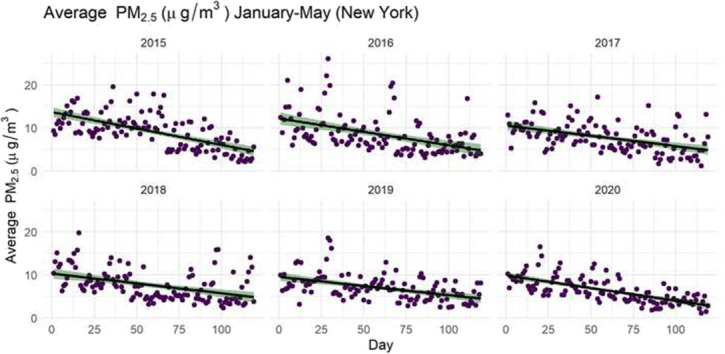
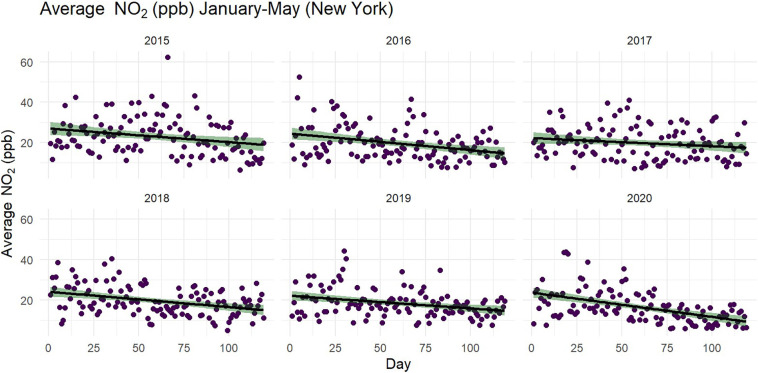
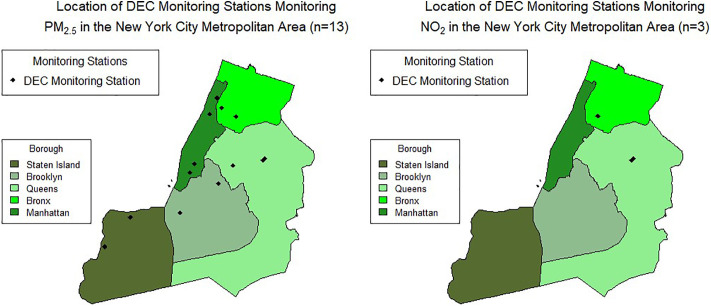
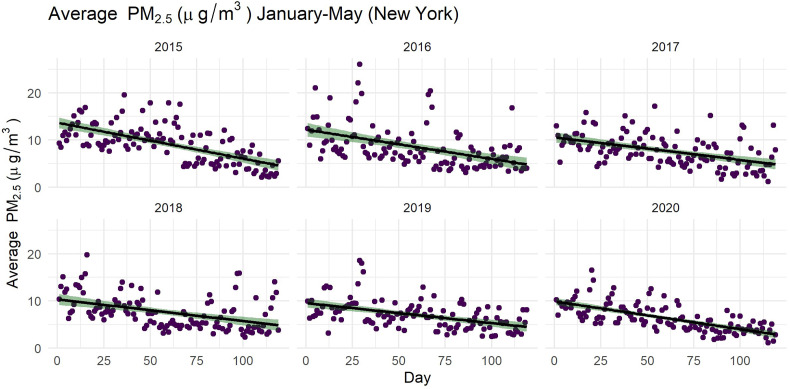
In December 2019, a new, severe coronavirus (COVID-19) appeared in Wuhan, China. Shortly after, the first COVID-19 case was confirmed in the United States. The emergence of this virus led many United States governors to enact executive orders in an effort to limit the person-to-person spread of the virus. One state that utilized such measures was New York, which contains New York City (NYC), the most populous city in the United States. Many reports have shown that due to the government-backed shutdowns, the air quality in major global cities improved. However, there has been only limited work on whether this same trend is seen throughout the United States, specifically within the densely populated NYC area. Thus, the focus of this study was to examine whether changes in air quality were observed in NYC resulting from New York State's COVID-19-associated shutdown measures. To do this, daily concentrations of fine particulate matter (PM) and nitrogen dioxide (NO) were obtained from 15 central monitoring stations throughout the five NYC boroughs for the first 17 weeks (January through May) of 2015-2020. Decreases in PM (36%) and NO (51%) concentrations were observed shortly after the shutdown took place; however, using a linear time lag model, when changes in these pollutant concentrations were compared to those measured during the same span of time in 2015-2019, no significant difference between the years was found. Therefore, we highlight the importance of considering temporal variability and long-term trends of pollutant concentrations when analyzing for short-term differences in air pollutant concentrations related to the COVID-19 shutdowns.
2019 年 12 月,一种新型严重冠状病毒(COVID-19)在中国武汉出现。此后不久,美国首例 COVID-19 病例得到确诊。这种病毒的出现促使许多美国州长颁布行政命令,努力限制病毒的人际传播。采取此类措施的一个州是纽约州,该州包含美国人口最多的城市纽约市(NYC)。许多报告表明,由于政府支持的关闭措施,主要全球城市的空气质量得到了改善。但是,关于这种趋势是否在美国全国范围内,特别是在人口稠密的 NYC 地区都得到了体现,相关研究工作却很有限。因此,本研究的重点是研究纽约州因 COVID-19 相关关闭措施而导致纽约市空气质量是否发生变化。为此,从 2015 年至 2020 年的第一 17 周(1 月至 5 月),从纽约市五个行政区的 15 个中心监测站获得了细颗粒物(PM)和二氧化氮(NO)的每日浓度数据。关闭措施实施后不久,PM(36%)和 NO(51%)浓度均观察到下降;然而,使用线性时间滞后模型,将这些污染物浓度的变化与 2015 年至 2019 年同期测量的浓度进行比较时,发现这两年之间没有显着差异。因此,我们强调在分析与 COVID-19 关闭相关的短期空气污染物浓度差异时,考虑污染物浓度的时间变异性和长期趋势非常重要。