Department of Psychology, Rey Juan Carlos I University, 28933 Madrid, Spain.
Department of Social, Developmental and Educational Psychology, University of Huelva, 21071 Huelva, Spain.
Int J Environ Res Public Health. 2020 Jul 6;17(13):4864. doi: 10.3390/ijerph17134864.
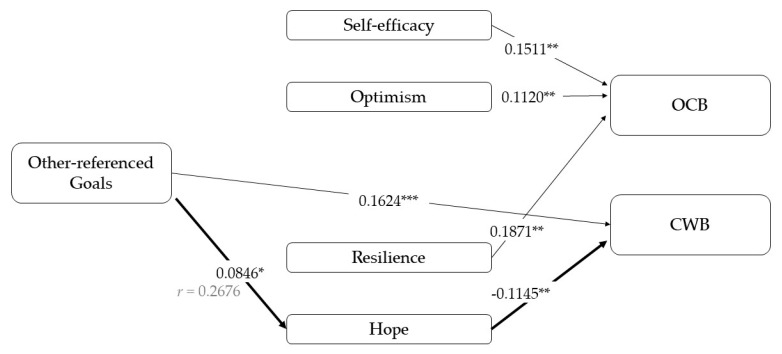
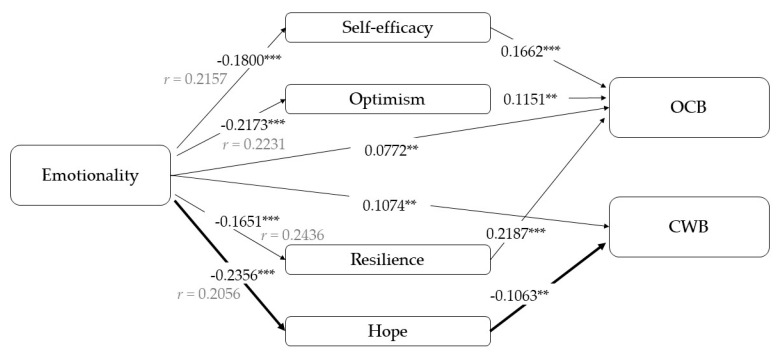
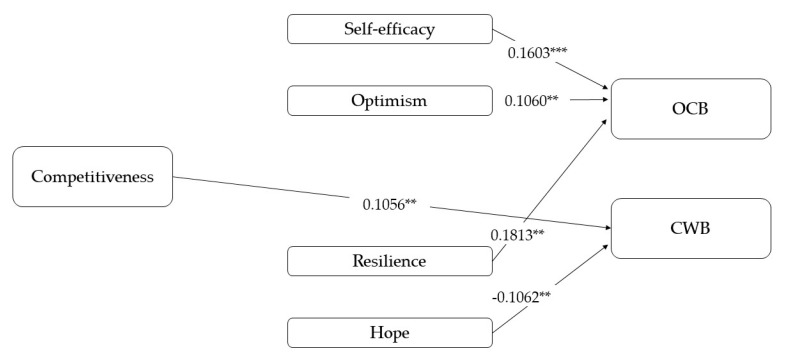
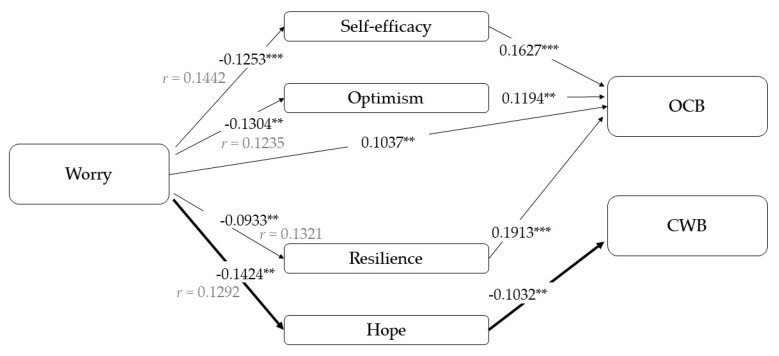
Just as we can speak of different personality traits, it is also possible to identify distinct motivational traits, which may be related to a series of organizational consequences. In this sense, understanding how these traits are related to workers performance is fundamental. Specifically, the purpose of this study is to test the mediating role of psychological capital in the relationship between such traits and organizational citizenship behaviors and counterproductive work behaviors, which is expected to be more significant in the first case. The study was carried out using a panel design, with a sample group of Spanish employees aged over 40 ( = 741), in two waves (with a 4-month interval). The results support the hypothesis that psychological capital resources may play a mediating role in some of the relationships explored and that approach orientation traits are mainly related to a better performance, fostering organizational citizenship behaviors and diminishing counterproductive work behavior. The findings show that employees who develop their personal resources may have a positive impact on their organizations. The implications of this study for counseling practices are discussed.
正如我们可以谈论不同的人格特质一样,也有可能确定不同的动机特质,这些特质可能与一系列组织后果有关。在这个意义上,理解这些特质与员工绩效的关系是至关重要的。具体来说,本研究的目的是检验心理资本在这些特质与组织公民行为和反生产工作行为之间关系中的中介作用,预计在第一种情况下这种作用更为显著。该研究采用面板设计,使用了一个年龄在 40 岁以上的西班牙员工样本组(n = 741),分两个阶段(间隔 4 个月)进行。结果支持了以下假设:心理资本资源可能在一些被探索的关系中起到中介作用,并且趋近导向特质主要与更好的绩效相关,促进组织公民行为并减少反生产工作行为。研究结果表明,发展个人资源的员工可能会对其组织产生积极影响。本文还讨论了该研究对咨询实践的意义。