Salod Zakia, Singh Yashik
Department of TeleHealth, University of KwaZulu-Natal, Durban, South Africa.
J Public Health Res. 2020 Jun 26;9(1):1792. doi: 10.4081/jphr.2020.1772. eCollection 2020 Jun 4.
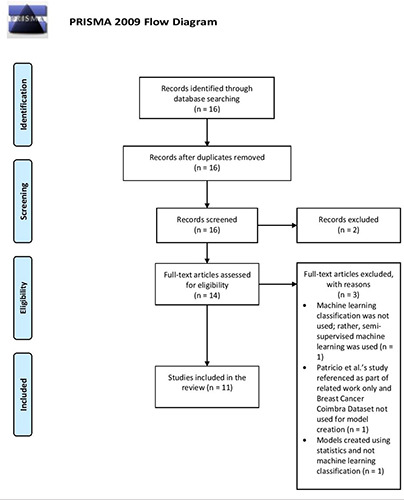
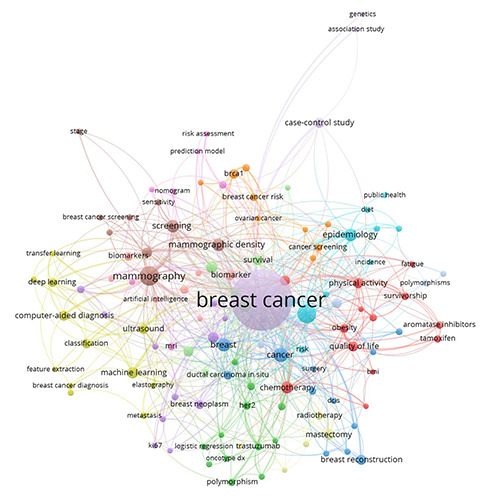
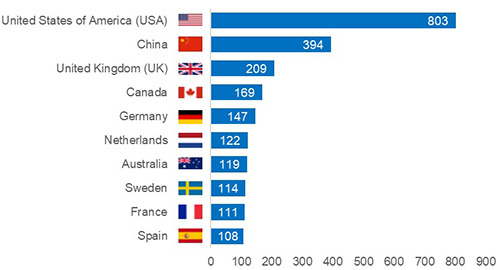
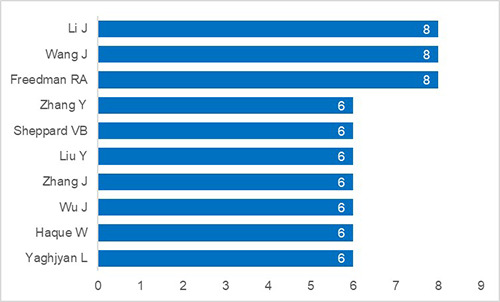
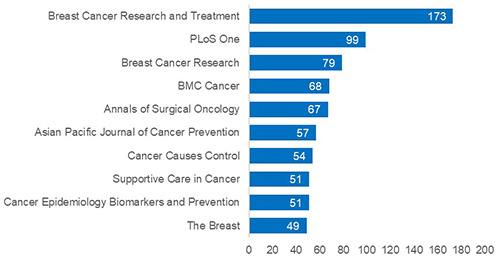
The objective 1 of this study was to investigate trends in breast cancer (BC) prediction using machine learning (ML) publications by analysing country, first author, journal, institutional collaborations and co-occurrence of author keywords. The objective 2 was to provide a review of studies on BC prediction using ML and a blood analysis dataset (Breast Cancer Coimbra Dataset [BCCD]), and the objective 3 was to provide a brief review of studies based on BC prediction using ML and patients' fine needle aspirate cytology data (Wisconsin Breast Cancer Dataset [WBCD]). The design of this study was as follows: for objective 1: bibliometric analysis, data source PubMed (2015-2019); for objective 2: systematic review, data source: Google and Google Scholar (2018-2019); for objective 3: systematic review, data source: Google Scholar (2016-2019). The inclusion criteria for objective 1 were all publication results yielded from the searches. All English papers that had a 'PDF' option from the search results were included for objective 2. A sample of the 'PDF' English papers were included for objective 3. All 116 female patients from the BCCD, consisting of 64 positive BC patients and 52 controls were included in the study for objective 2. For the WBCD, all 699 female patients comprising of 458 with a benign BC tumour and 241 with a malignant BC tumour were included for objective 3. All 2928 publications were included for objective 1. The results showed that the United States of America (USA) produced the highest number of publications (n=803). In total, 2419 first authors contributed towards the publications. Breast Cancer Research and Treatment was the highest ranked journal. Institutional collaborations mainly occurred within the USA. The use of ML for BC screening and detection was the most researched topic. A total of 19 distinct papers were included for objectives 2 and 3. The findings from these studies were never presented to clinicians for validations. In conclusion, the use of ML for BC screening and detection is promising.
本研究的目标1是通过分析国家、第一作者、期刊、机构合作以及作者关键词的共现情况,调查利用机器学习(ML)相关出版物进行乳腺癌(BC)预测的趋势。目标2是对利用ML和血液分析数据集(乳腺癌科英布拉数据集[BCCD])进行BC预测的研究进行综述,目标3是对基于ML和患者细针穿刺细胞学数据(威斯康星乳腺癌数据集[WBCD])进行BC预测的研究进行简要综述。本研究的设计如下:对于目标1:文献计量分析,数据源为PubMed(2015 - 2019年);对于目标2:系统综述,数据源为谷歌和谷歌学术(2018 - 2019年);对于目标3:系统综述,数据源为谷歌学术(2016 - 2019年)。目标1的纳入标准是搜索产生的所有出版结果。目标2纳入搜索结果中有“PDF”选项的所有英文论文。目标3纳入“PDF”英文论文的一个样本。目标2的研究纳入了BCCD的全部116名女性患者,其中包括64名BC阳性患者和52名对照。对于WBCD,目标3纳入了全部699名女性患者,其中458名患有良性BC肿瘤,241名患有恶性BC肿瘤。目标1纳入了所有2928篇出版物。结果显示,美利坚合众国(美国)发表的出版物数量最多(n = 803)。总共有2419位第一作者参与了这些出版物。《乳腺癌研究与治疗》是排名最高的期刊。机构合作主要发生在美国境内。利用ML进行BC筛查和检测是研究最多的主题。目标2和目标3总共纳入了19篇不同的论文。这些研究的结果从未提交给临床医生进行验证。总之,利用ML进行BC筛查和检测前景广阔。