Popescu Sebastian G, Whittington Alex, Gunn Roger N, Matthews Paul M, Glocker Ben, Sharp David J, Cole James H
Computational, Cognitive & Clinical Neuroimaging Laboratory, Department of Brain Sciences, Imperial College London, London, UK.
Biomedical Image Analysis Group, Department of Computing, Imperial College London, London, UK.
Hum Brain Mapp. 2020 Oct 15;41(15):4406-4418. doi: 10.1002/hbm.25133. Epub 2020 Jul 9.
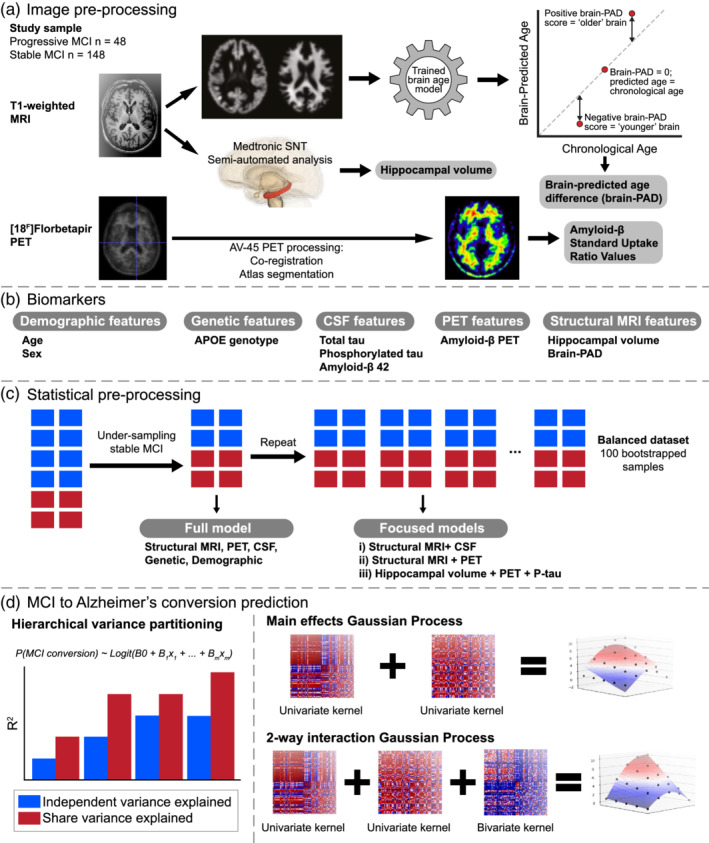
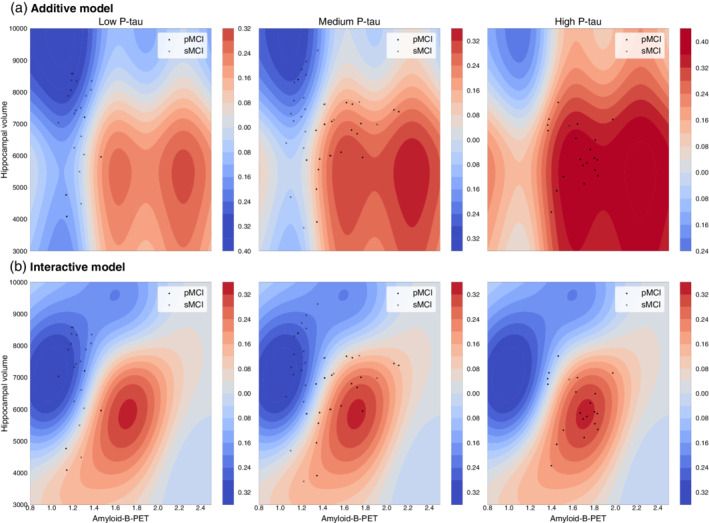
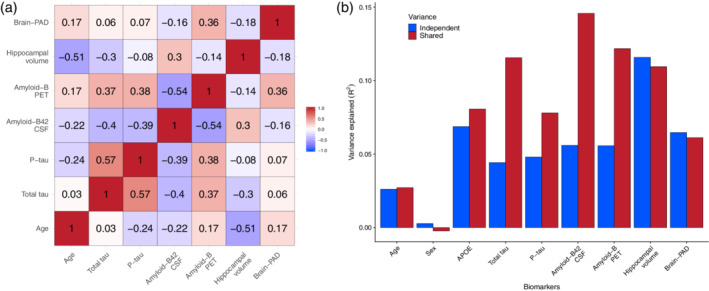
Multiple biomarkers can capture different facets of Alzheimer's disease. However, statistical models of biomarkers to predict outcomes in Alzheimer's rarely model nonlinear interactions between these measures. Here, we used Gaussian Processes to address this, modelling nonlinear interactions to predict progression from mild cognitive impairment (MCI) to Alzheimer's over 3 years, using Alzheimer's Disease Neuroimaging Initiative (ADNI) data. Measures included: demographics, APOE4 genotype, CSF (amyloid-β42, total tau, phosphorylated tau), [18 ]florbetapir, hippocampal volume and brain-age. We examined: (a) the independent value of each biomarker; and (b) whether modelling nonlinear interactions between biomarkers improved predictions. Each measured added complementary information when predicting conversion to Alzheimer's. A linear model classifying stable from progressive MCI explained over half the variance (R = 0.51, p < .001); the strongest independently contributing biomarker was hippocampal volume (R = 0.13). When comparing sensitivity of different models to progressive MCI (independent biomarker models, additive models, nonlinear interaction models), we observed a significant improvement (p < .001) for various two-way interaction models. The best performing model included an interaction between amyloid-β-PET and P-tau, while accounting for hippocampal volume (sensitivity = 0.77, AUC = 0.826). Closely related biomarkers contributed uniquely to predict conversion to Alzheimer's. Nonlinear biomarker interactions were also implicated, and results showed that although for some patients adding additional biomarkers may add little value (i.e., when hippocampal volume is high), for others (i.e., with low hippocampal volume) further invasive and expensive examination may be warranted. Our framework enables visualisation of these interactions, in individual patient biomarker 'space', providing information for personalised or stratified healthcare or clinical trial design.
多种生物标志物能够反映阿尔茨海默病的不同方面。然而,用于预测阿尔茨海默病预后的生物标志物统计模型很少对这些指标之间的非线性相互作用进行建模。在此,我们使用高斯过程来解决这一问题,利用阿尔茨海默病神经影像倡议(ADNI)数据,对非线性相互作用进行建模,以预测3年内从轻度认知障碍(MCI)进展为阿尔茨海默病的情况。测量指标包括:人口统计学特征、APOE4基因型、脑脊液(淀粉样蛋白β42、总tau蛋白、磷酸化tau蛋白)、[18F]氟比他哌、海马体积和脑龄。我们研究了:(a)每种生物标志物的独立价值;以及(b)对生物标志物之间的非线性相互作用进行建模是否能改善预测。在预测向阿尔茨海默病的转化时,每个测量指标都增加了补充信息。一个区分稳定型和进展型MCI的线性模型解释了超过一半的方差(R = 0.51,p < 0.001);独立贡献最强的生物标志物是海马体积(R = 0.13)。当比较不同模型对进展型MCI的敏感性时(独立生物标志物模型、加法模型、非线性相互作用模型),我们观察到各种双向相互作用模型有显著改善(p < 0.001)。表现最佳的模型包括淀粉样蛋白PET与磷酸化tau蛋白之间的相互作用,同时考虑了海马体积(敏感性 = 0.77,AUC = 0.826)。密切相关的生物标志物对预测向阿尔茨海默病的转化有独特贡献。还涉及到生物标志物的非线性相互作用,结果表明,虽然对于一些患者添加额外的生物标志物可能价值不大(即海马体积较大时),但对于另一些患者(即海马体积较小时),可能需要进一步进行侵入性和昂贵的检查。我们的框架能够在个体患者的生物标志物“空间”中可视化这些相互作用,为个性化或分层医疗保健或临床试验设计提供信息。