Department of Chemical Engineering, Massachusetts Institute of Technology, Cambridge, MA, USA.
The Broad Institute, Cambridge, MA, USA.
BMC Bioinformatics. 2020 Jul 11;21(1):300. doi: 10.1186/s12859-020-03635-x.
A common yet still manual task in basic biology research, high-throughput drug screening and digital pathology is identifying the number, location, and type of individual cells in images. Object detection methods can be useful for identifying individual cells as well as their phenotype in one step. State-of-the-art deep learning for object detection is poised to improve the accuracy and efficiency of biological image analysis.
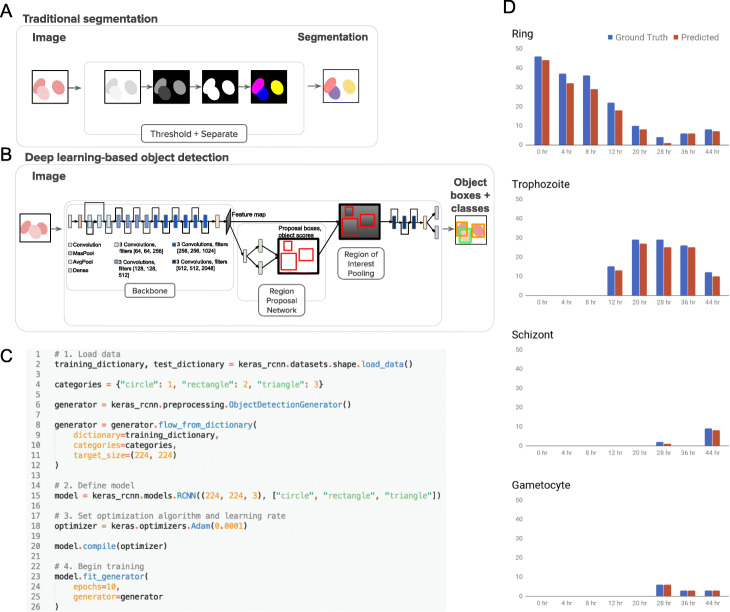
We created Keras R-CNN to bring leading computational research to the everyday practice of bioimage analysts. Keras R-CNN implements deep learning object detection techniques using Keras and Tensorflow ( https://github.com/broadinstitute/keras-rcnn ). We demonstrate the command line tool's simplified Application Programming Interface on two important biological problems, nucleus detection and malaria stage classification, and show its potential for identifying and classifying a large number of cells. For malaria stage classification, we compare results with expert human annotators and find comparable performance.
Keras R-CNN is a Python package that performs automated cell identification for both brightfield and fluorescence images and can process large image sets. Both the package and image datasets are freely available on GitHub and the Broad Bioimage Benchmark Collection.
在基础生物学研究、高通量药物筛选和数字病理学中,识别图像中个体细胞的数量、位置和类型是一项常见但仍需手动完成的任务。目标检测方法可用于一步识别单个细胞及其表型。最先进的深度学习目标检测技术有望提高生物图像分析的准确性和效率。
我们创建了 Keras R-CNN,将领先的计算研究引入生物图像分析师的日常实践中。Keras R-CNN 使用 Keras 和 Tensorflow(https://github.com/broadinstitute/keras-rcnn)实现深度学习目标检测技术。我们展示了命令行工具在两个重要生物学问题(核检测和疟疾阶段分类)上简化的应用程序编程接口,并展示了其识别和分类大量细胞的潜力。对于疟疾阶段分类,我们将结果与专家人类注释者进行比较,发现性能相当。
Keras R-CNN 是一个 Python 包,可用于对明场和荧光图像进行自动细胞识别,并可处理大型图像集。该软件包和图像数据集均可在 GitHub 和 Broad Bioimage Benchmark Collection 上免费获得。