Imaging Platform, Broad Institute of MIT and Harvard, Cambridge, Massachusetts.
Institute of Computational Biology, German Research Center for Environmental Health, Munich, Germany.
Cytometry A. 2019 Sep;95(9):952-965. doi: 10.1002/cyto.a.23863. Epub 2019 Jul 16.
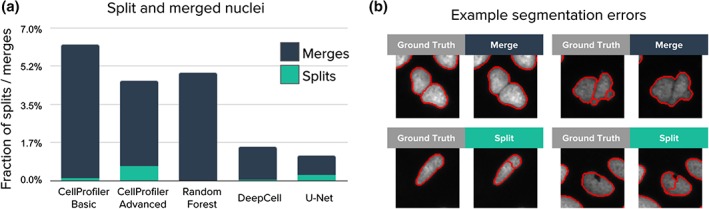
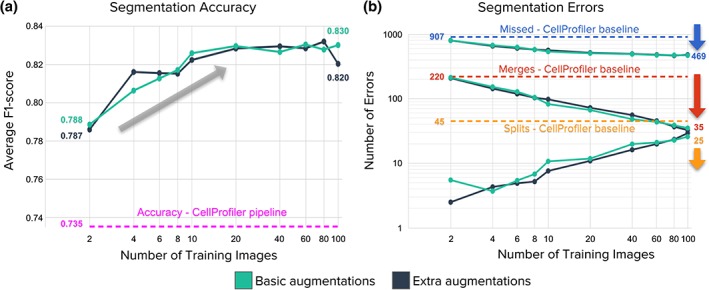
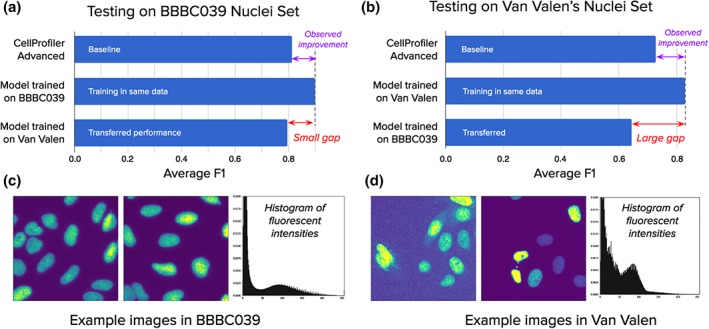
Identifying nuclei is often a critical first step in analyzing microscopy images of cells and classical image processing algorithms are most commonly used for this task. Recent developments in deep learning can yield superior accuracy, but typical evaluation metrics for nucleus segmentation do not satisfactorily capture error modes that are relevant in cellular images. We present an evaluation framework to measure accuracy, types of errors, and computational efficiency; and use it to compare deep learning strategies and classical approaches. We publicly release a set of 23,165 manually annotated nuclei and source code to reproduce experiments and run the proposed evaluation methodology. Our evaluation framework shows that deep learning improves accuracy and can reduce the number of biologically relevant errors by half. © 2019 The Authors. Cytometry Part A published by Wiley Periodicals, Inc. on behalf of International Society for Advancement of Cytometry.
识别细胞核通常是分析细胞显微镜图像的关键第一步,为此,经典的图像处理算法最为常用。深度学习的最新发展可以带来更高的准确性,但细胞核分割的典型评估指标并不能令人满意地捕捉到细胞图像中相关的错误模式。我们提出了一个评估框架来衡量准确性、错误类型和计算效率,并使用它来比较深度学习策略和经典方法。我们公开了一组 23165 个手动标注的细胞核,并提供了源代码以重现实验和运行所提出的评估方法。我们的评估框架表明,深度学习可以提高准确性,并将生物学相关错误的数量减少一半。 2019 年,作者。细胞计量学 A 版由 Wiley 期刊出版,代表国际细胞计量学促进协会。