Department of Nutritional Sciences, The University of Texas at Austin, 200 W 24th Street, Stop A2700, Austin, TX 78712, USA.
Department of Pediatrics, Dell Medical Center, The University of Texas at Austin, 1400 Barbara Jordan Blvd, Austin, TX 78723, USA.
Nutrients. 2020 Jul 9;12(7):2038. doi: 10.3390/nu12072038.
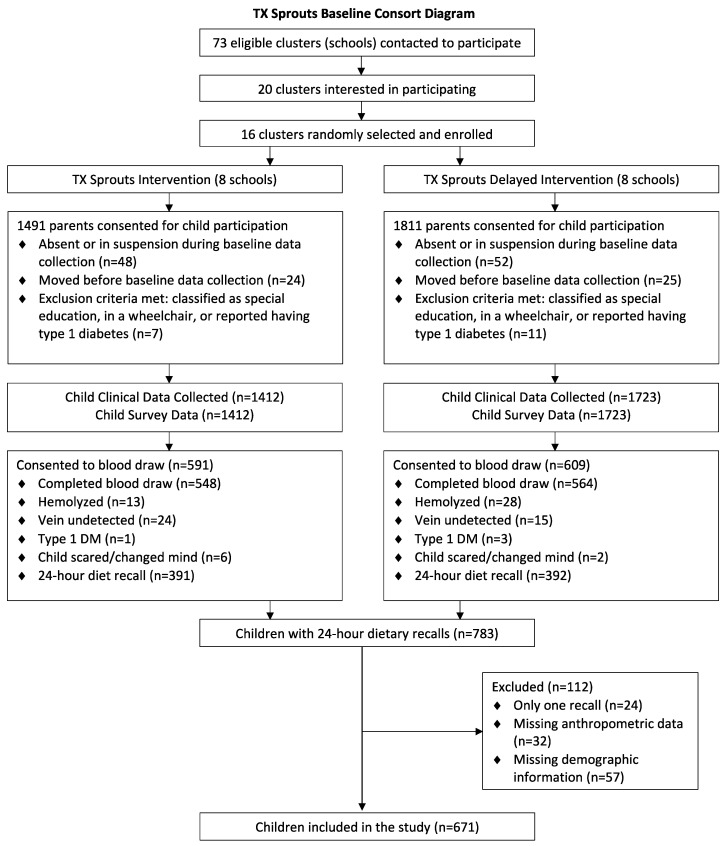
Breakfast consumption is associated with lower obesity prevalence and cardiometabolic risk and higher dietary quality (DQ) in children. Low-income, Hispanic populations are disproportionately affected by obesity and cardiometabolic risks. This study examined the relationship between breakfast consumption groups (BCG) on anthropometric, metabolic, and dietary parameters in predominately low-income, Hispanic children from 16 Texas schools. Cross-sectional data were from TX Sprouts, a school-based gardening, nutrition, and cooking randomized controlled trial. Anthropometric measurements included height, weight, body mass index, body fat percent via bioelectrical impedance, waist circumference, and blood pressure. Metabolic parameters included fasting plasma glucose, insulin, glycated hemoglobin, cholesterol, and triglycerides. DQ and BCG were assessed via two 24-h dietary recalls. Multivariate multiple regression examined relationships between BCG and anthropometric, metabolic, and dietary parameters. This study included 671 students (mean age 9 years, 58% Hispanic, 54% female, 66% free/reduced lunch, 17% breakfast skippers). No relationships were observed between BCG and anthropometric or metabolic parameters. BCG had higher DQ; higher daily protein, total sugar, and added sugar intake; and lower daily fat intake. Skipping breakfast was associated with lower DQ; higher daily fat intake; and lower daily protein intake. Longitudinal research examining breakfast quality on cardiometabolic outcomes in low-income, Hispanic children is warranted.
早餐的摄入与较低的肥胖发生率和心血管代谢风险以及较高的饮食质量(DQ)相关,这在儿童中已得到证实。低收入的西班牙裔人群受到肥胖和心血管代谢风险的影响不成比例。本研究旨在调查在德克萨斯州 16 所学校中,以收入较低、以西班牙裔为主的儿童中,早餐摄入组别(BCG)与人体测量、代谢和饮食参数之间的关系。该研究的数据来自 TX Sprouts,这是一项基于学校的园艺、营养和烹饪的随机对照试验。人体测量学测量包括身高、体重、体重指数、生物电阻抗法测量的体脂肪百分比、腰围和血压。代谢参数包括空腹血糖、胰岛素、糖化血红蛋白、胆固醇和甘油三酯。DQ 和 BCG 通过两次 24 小时饮食回忆来评估。多变量多元回归分析了 BCG 与人体测量、代谢和饮食参数之间的关系。本研究共纳入了 671 名学生(平均年龄 9 岁,58%为西班牙裔,54%为女性,66%享受免费/降价午餐,17%不吃早餐)。BCG 与人体测量或代谢参数之间没有观察到关系。BCG 具有更高的 DQ;更高的每日蛋白质、总糖和添加糖摄入量;以及更低的每日脂肪摄入量。不吃早餐与较低的 DQ 相关;更高的每日脂肪摄入量;以及更低的每日蛋白质摄入量。有必要进行纵向研究,以检验在低收入的西班牙裔儿童中,早餐质量对心血管代谢结果的影响。