Department of Pediatric Infectious Diseases, Vanderbilt University Medical Center, Nashville, Tennessee, USA.
Department of Biostatistics, Vanderbilt University Medical Center, Nashville, Tennessee, USA.
Clin Infect Dis. 2021 Oct 5;73(7):e1525-e1531. doi: 10.1093/cid/ciaa1001.
Norovirus is a leading cause of epidemic acute gastroenteritis (AGE), with most outbreaks occurring during winter. The majority of outbreaks are caused by GII.4 noroviruses; however, data to support whether this is true for sporadic medically attended AGE are limited. Therefore, we sought to compare the clinical characteristics and seasonality of GII.4 vs non-GII.4 viruses.
Children aged 15 days -17 years with AGE symptoms were recruited from the outpatient, emergency department, and inpatient settings at Vanderbilt Children's Hospital, Davidson County, Nashville, Tennessee, from December 2012 -November 2015. Stool specimens were tested using qRT-PCR for GI and GII noroviruses and subsequently genotyped by sequencing a partial region of the capsid gene.
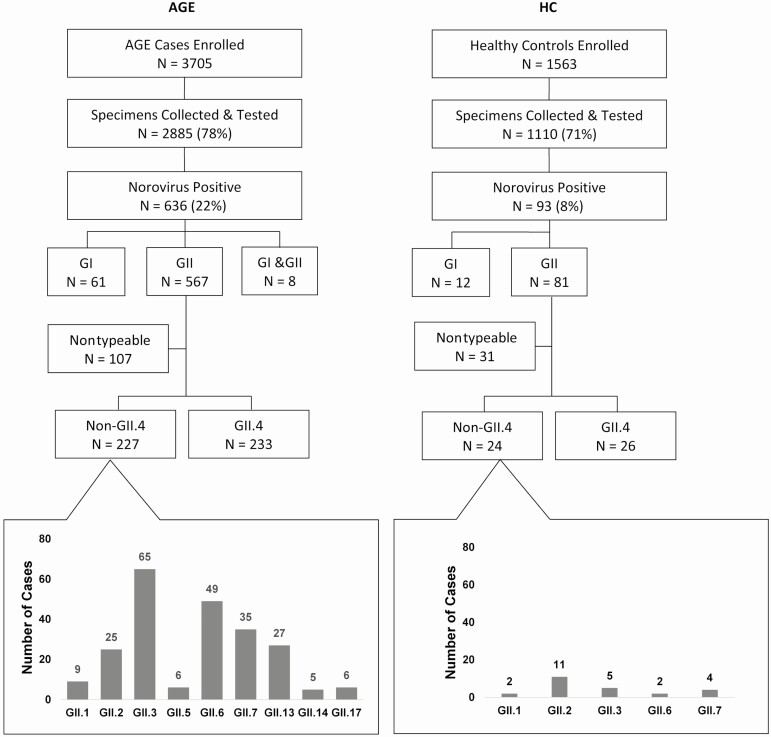
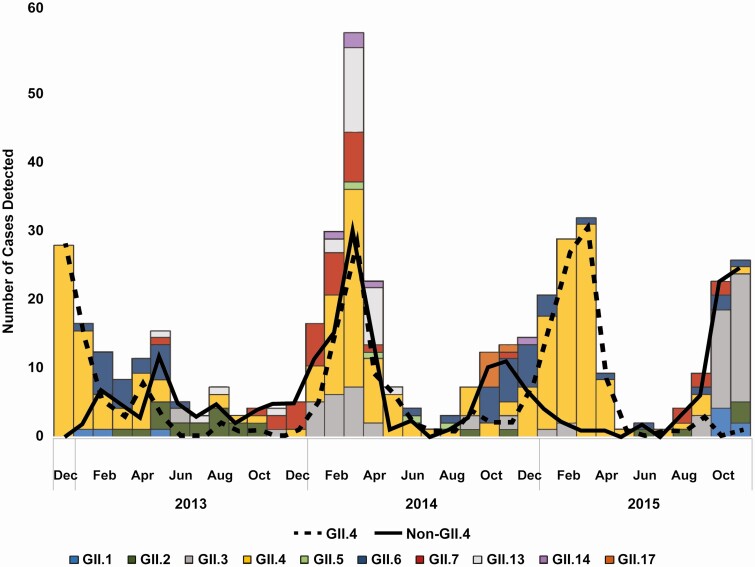
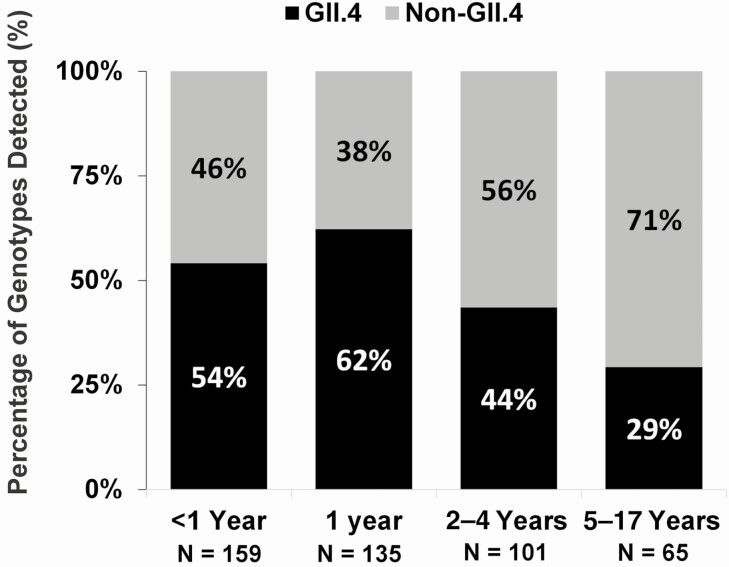
A total of 3705 patients were enrolled, and stool specimens were collected and tested from 2885 (78%) enrollees. Overall, 636 (22%) samples were norovirus-positive, of which 567 (89%) were GII. Of the 460 (81%) genotyped GII-positive samples, 233 (51%) were typed as GII.4 and 227 (49%) as non-GII.4. Compared with children with non-GII.4 infections, children with GII.4 infections were younger, more likely to have diarrhea, and more likely to receive oral rehydration fluids. Norovirus was detected year-round and peaked during winter.
Approximately 40% of sporadic pediatric norovirus AGE cases were caused by GII.4 norovirus. Children infected with GII.4 had more severe symptoms that required more medical care. Seasonal variations were noticed among different genotypes. These data highlight the importance of continuous norovirus surveillance and provide important information on which strains pediatric norovirus vaccines should protect against.
诺如病毒是导致流行性急性肠胃炎(AGE)的主要原因,大多数疫情发生在冬季。大多数疫情是由 GII.4 诺如病毒引起的;然而,支持散发性就医 AGE 确实由 GII.4 引起的数据有限。因此,我们试图比较 GII.4 与非 GII.4 病毒的临床特征和季节性。
从 2012 年 12 月至 2015 年 11 月,在田纳西州纳什维尔戴维森县范德比尔特儿童医院的门诊、急诊和住院部招募了 15 天至 17 岁有 AGE 症状的儿童。使用 qRT-PCR 对 GI 和 GII 诺如病毒进行粪便样本检测,随后通过对衣壳基因的部分区域进行测序对其进行基因分型。
共有 3705 名患者入组,对 2885 名(78%)入组者采集了粪便样本并进行了检测。总体而言,636 份(22%)样本呈诺如病毒阳性,其中 567 份(89%)为 GII 型。在 460 份(81%)经基因分型的 GII 阳性样本中,233 份(51%)为 GII.4 型,227 份(49%)为非 GII.4 型。与感染非 GII.4 的儿童相比,感染 GII.4 的儿童年龄更小,更有可能出现腹泻,更有可能接受口服补液。诺如病毒全年均可检测到,冬季达到高峰。
约 40%的散发性儿科诺如病毒 AGE 病例由 GII.4 诺如病毒引起。感染 GII.4 的儿童症状更严重,需要更多的医疗护理。不同基因型之间存在季节性差异。这些数据强调了持续进行诺如病毒监测的重要性,并提供了有关儿科诺如病毒疫苗应针对哪些菌株进行保护的重要信息。