Steardo Luca, Carbone Elvira Anna, de Filippis Renato, Pisanu Claudia, Segura-Garcia Cristina, Squassina Alessio, De Fazio Pasquale, Steardo Luca
Department of Health Sciences, School of Medicine and Surgery, University Magna Graecia of Catanzaro, Catanzaro, Italy.
Section of Neuroscience and Clinical Pharmacology, Department of Biomedical Sciences, Faculty of Medicine and Surgery, University of Cagliari, Cagliari, Italy.
Front Psychiatry. 2020 Jun 23;11:588. doi: 10.3389/fpsyt.2020.00588. eCollection 2020.
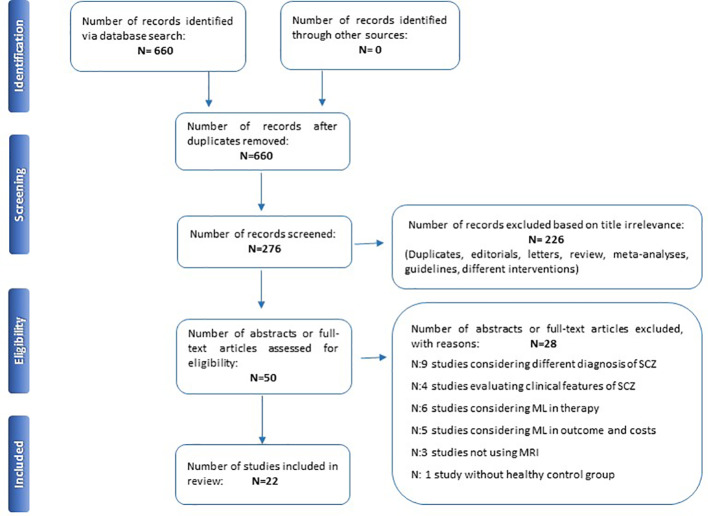
Non-invasive measurements of brain function and structure as neuroimaging in patients with mental illnesses are useful and powerful tools for studying discriminatory biomarkers. To date, functional MRI (fMRI), structural MRI (sMRI) represent the most used techniques to provide multiple perspectives on brain function, structure, and their connectivity. Recently, there has been rising attention in using machine-learning (ML) techniques, pattern recognition methods, applied to neuroimaging data to characterize disease-related alterations in brain structure and function and to identify phenotypes, for example, for translation into clinical and early diagnosis. Our aim was to provide a systematic review according to the PRISMA statement of Support Vector Machine (SVM) techniques in making diagnostic discrimination between SCZ patients from healthy controls using neuroimaging data from functional MRI as input. We included studies using SVM as ML techniques with patients diagnosed with Schizophrenia. From an initial sample of 660 papers, at the end of the screening process, 22 articles were selected, and included in our review. This technique can be a valid, inexpensive, and non-invasive support to recognize and detect patients at an early stage, compared to any currently available assessment or clinical diagnostic methods in order to save crucial time. The higher accuracy of SVM models and the new integrated methods of ML techniques could play a decisive role to detect patients with SCZ or other major psychiatric disorders in the early stages of the disease or to potentially determine their neuroimaging risk factors in the near future.
对精神疾病患者进行脑功能和结构的无创测量作为神经影像学检查,是研究鉴别生物标志物的有用且强大的工具。迄今为止,功能磁共振成像(fMRI)、结构磁共振成像(sMRI)是最常用的技术,可从多个角度提供有关脑功能、结构及其连通性的信息。最近,人们越来越关注使用机器学习(ML)技术、模式识别方法来处理神经影像学数据,以表征与疾病相关的脑结构和功能改变,并识别表型,例如用于临床转化和早期诊断。我们的目的是根据PRISMA声明,对支持向量机(SVM)技术进行系统综述,该技术使用功能磁共振成像的神经影像学数据作为输入,对精神分裂症(SCZ)患者与健康对照进行诊断鉴别。我们纳入了使用SVM作为机器学习技术且患者被诊断为精神分裂症的研究。从最初的660篇论文样本中,在筛选过程结束时,选出了22篇文章并纳入我们的综述。与任何目前可用的评估或临床诊断方法相比,该技术可以作为一种有效、廉价且无创的支持手段,用于在早期识别和检测患者,从而节省关键时间。SVM模型的更高准确性以及机器学习技术的新集成方法,可能在疾病早期检测出精神分裂症患者或其他主要精神疾病患者,或在不久的将来潜在地确定其神经影像学风险因素方面发挥决定性作用。