Klement Rainer J, Schäfer Gabriele, Sweeney Reinhart A
Department of Radiation Oncology, Leopoldina Hospital, Schweinfurt, Germany.
J Tradit Complement Med. 2019 Mar 21;10(3):180-187. doi: 10.1016/j.jtcme.2019.03.007. eCollection 2020 May.
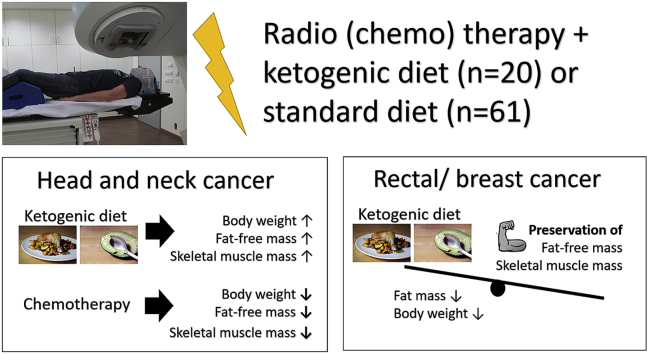
Ketogenic diets (KDs) have gained interest as a complementary treatment for cancer patients. Here we present first results of our ongoing KETOCOMP study (NCT02516501) concerning body composition changes among rectal, breast and head & neck cancer (HNC) patients who consumed a KD during curative radiotherapy (RT).
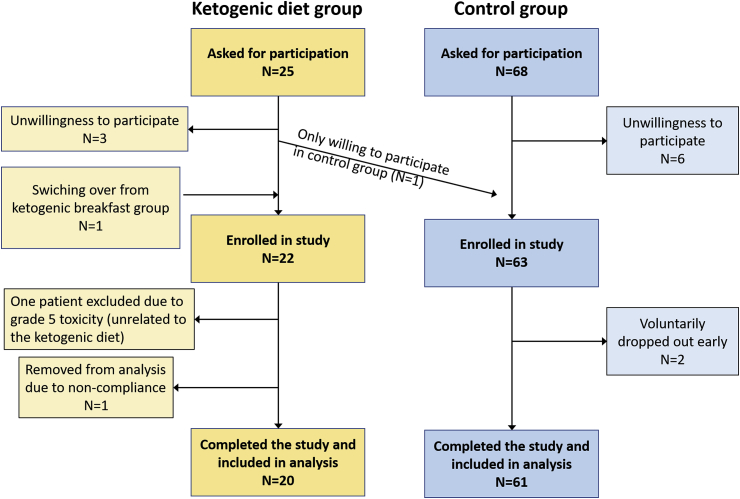
Sixty-one patients eating a non-ketogenic diet were compared to 20 patients on a KD supplemented with 10 g essential amino acids on RT days. Body composition was measured prior to and weekly during RT using 8-electrode bioimpedance analysis. Longitudinal body composition data were analyzed using linear mixed effects models.
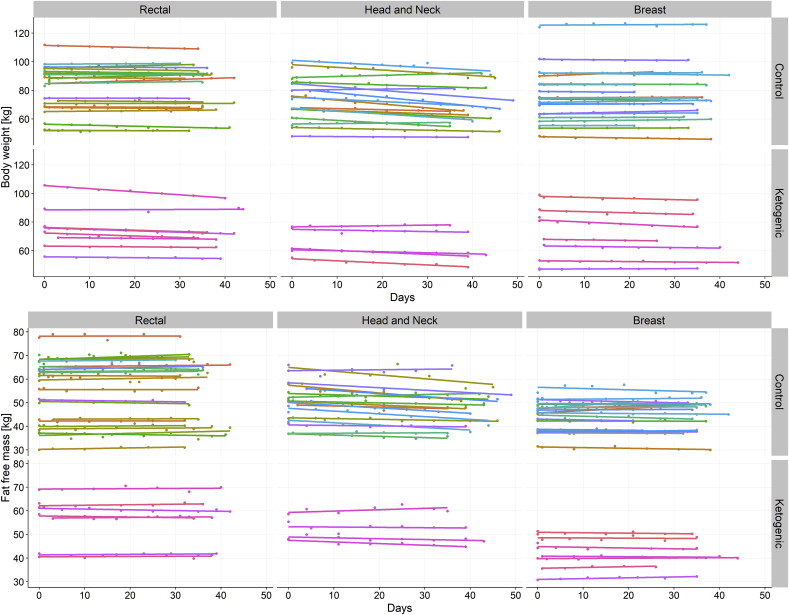
Patients on the KD exhibited nutritional ketosis, defined as serum β-hydroxybutyrate levels ≥0.5 mmol/l, in a median of 69.0% of blood measurements (range 0-100%) performed in our clinic. In rectal and breast cancer patients, KD was significantly associated with a loss of 0.5 and 0.4 kg fat mass per week (p = 0.00089 and 8.49 × 10, respectively), with no significant changes in fat free and skeletal muscle mass. In HNC patients, concurrent chemotherapy was the strongest predictor of body weight, fat free and skeletal muscle mass loss during RT, while consuming a KD was significantly associated with a gain in these measures. These preliminary results confirm prior reports indicating that KDs are safe to consume during standard-of-care therapy. They also provide an important first indication that KDs with ample amino acid intake could improve body composition during RT in curative cancer patients.
生酮饮食(KDs)作为癌症患者的一种辅助治疗方法已引起关注。在此,我们展示了正在进行的KETOCOMP研究(NCT02516501)的首批结果,该研究涉及在根治性放疗(RT)期间食用KD的直肠癌、乳腺癌和头颈癌(HNC)患者的身体成分变化。
将61名食用非生酮饮食的患者与20名在放疗日补充10克必需氨基酸的KD患者进行比较。在放疗前及放疗期间每周使用8电极生物电阻抗分析测量身体成分。使用线性混合效应模型分析纵向身体成分数据。
在我们诊所进行的血液测量中,食用KD的患者中位有69.0%(范围0 - 100%)表现出营养性酮症,定义为血清β - 羟基丁酸水平≥0.5毫摩尔/升。在直肠癌和乳腺癌患者中,KD与每周脂肪量分别显著减少0.5千克和0.4千克显著相关(p分别为0.00089和8.49×10),无脂肪和骨骼肌量的显著变化。在HNC患者中,同步化疗是放疗期间体重、无脂肪和骨骼肌量减少的最强预测因素,而食用KD与这些指标的增加显著相关。这些初步结果证实了先前的报告,表明在标准治疗期间食用KD是安全的。它们还提供了一个重要的初步迹象,即摄入充足氨基酸的KD可以改善根治性癌症患者放疗期间的身体成分。