Diabeteszentrum, Herz- und Diabeteszentrum Nordrhein Westfalen (NRW), Ruhr Universität Bochum, Bad Oeynhausen, Germany.
Klinikum Karlsburg der Klinikgruppe Dr Guth GmbH & Co KG, Karlsburg, Germany.
JAMA Netw Open. 2020 Jul 1;3(7):e2010411. doi: 10.1001/jamanetworkopen.2020.10411.
Diabetic foot ulcers are a common complication of diabetes and require specialized treatment. Cold atmospheric plasma (CAP) has been associated with benefits in wound infection and healing in previous smaller series of case reports. Yet the effect of CAP compared with standard care therapy in wound healing in diabetic foot ulcers remains to be studied.
To determine whether the application of CAP accelerates wound healing in diabetic foot ulcers compared with standard care therapy.
DESIGN, SETTING, AND PARTICIPANTS: A prospective, randomized, placebo-controlled, patient-blinded clinical trial was conducted at 2 clinics with recruitment from August 17, 2016, to April 20, 2019. Patients were scheduled to remain in follow-up until April 30, 2024. Patients with diabetes and diabetic foot ulcers described using the combined Wagner-Armstrong classification of 1B or 2B (superficial or infected diabetic foot ulcers extending to tendon) were eligible. A patient could participate with 1 or more wounds in both groups in both intervention and control groups. Wounds were randomized separately, allowing a participant to be treated several times within the study following a 2 × 2 × 2 randomization strata considering sex, smoking status, and age (≤68 years and >68 years).
Standard care treatment with 8 applications of either CAP generated from argon gas in an atmospheric pressure plasma jet or 8 applications of placebo treatment in a patient-blinded manner.
Primary end points were reduction in wound size, clinical infection, and microbial load compared with treatment start. Secondary end points were time to relevant wound reduction (>10%), reduction of infection, parameters of patient's well-being, and treatment-associated adverse events.
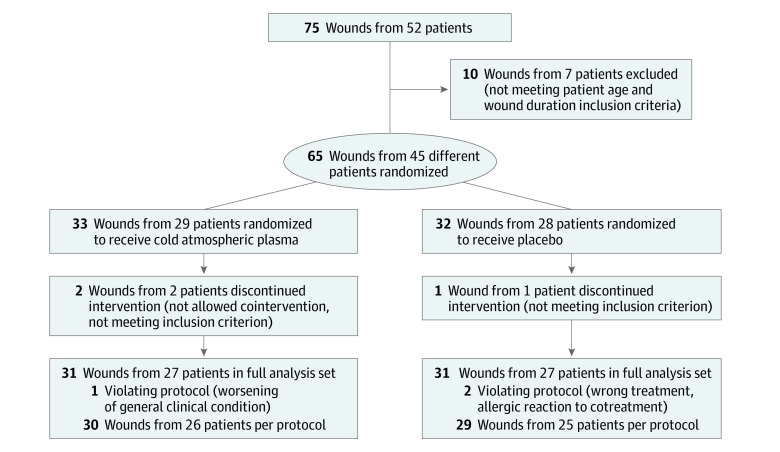
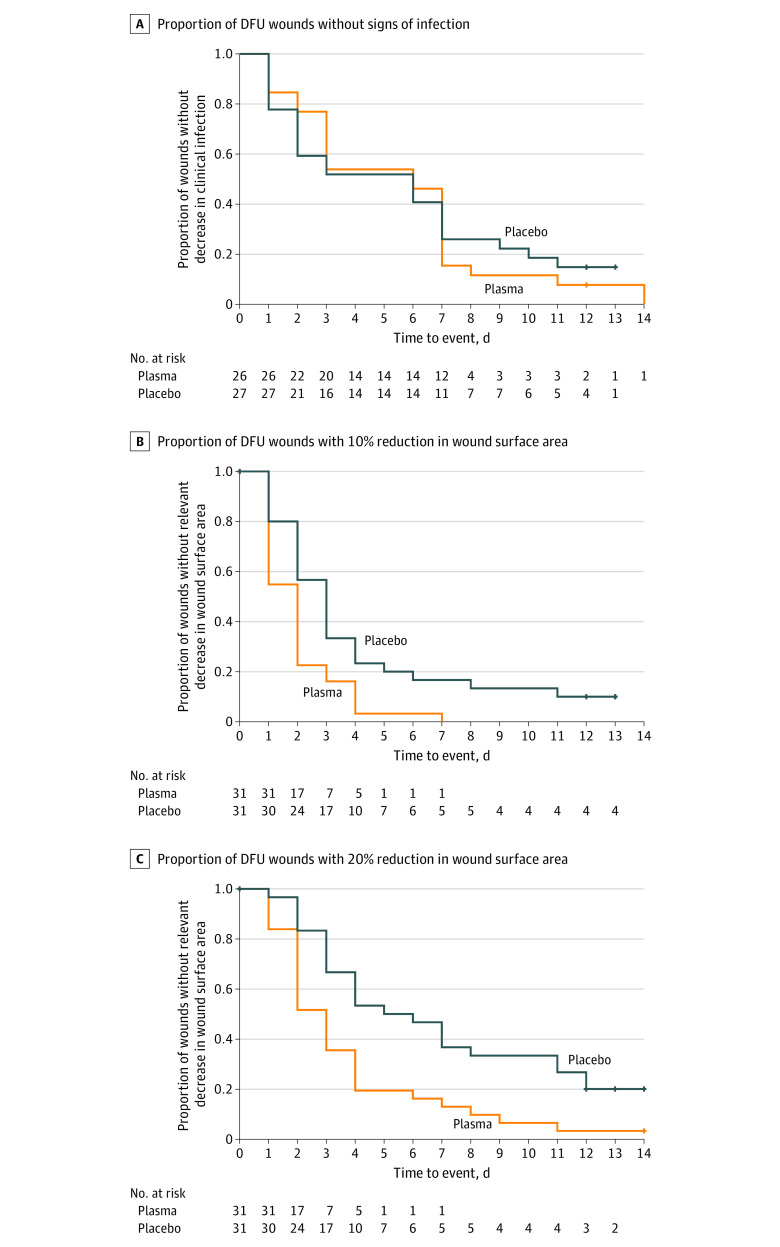
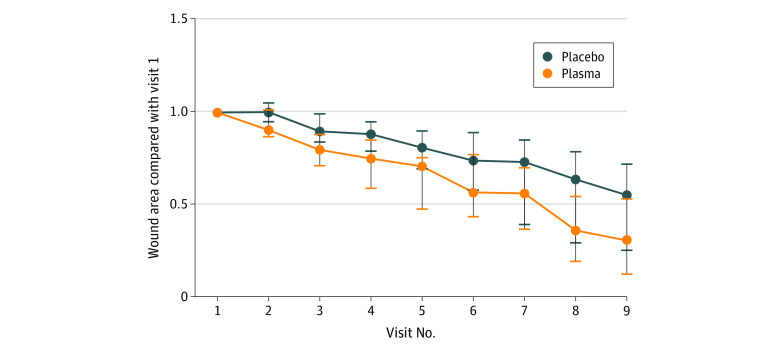
Of 65 diabetic foot ulcer wounds from 45 patients assessed for study, 33 wounds from 29 patients were randomized to CAP and 32 wounds from 28 to placebo, with 62 wounds from 43 patients (31 wounds per group) included for final evaluation (mean [SD] age, 68.5 [9.1] years for full sample). Four patients with 5 wounds of 31 (16.1%) wounds in the CAP group and 3 patients with 4 wounds of 31 (13%) wounds in the placebo group were active smokers. CAP therapy yielded a significant increase in wound healing, both in total mean (SD) area reduction (CAP vs placebo relative units, -26.31 [11.72]; P = .03) and mean (SD) time to relevant wound area reduction (CAP vs placebo relative units, 10% from baseline, 1.60 [0.58]; P = .009). Reduction of infection and microbial load was not significantly different between CAP and placebo. No therapy-related adverse events occurred during therapy; patient's perceptions during therapy were comparable.
In this randomized clinical trial, CAP therapy resulted in beneficial effects in chronic wound treatment in terms of wound surface reduction and time to wound closure independent from background infection.
ClinicalTrials.gov Identifier: NCT04205942.
糖尿病足溃疡是糖尿病的一种常见并发症,需要专门的治疗。冷大气压等离子体 (CAP) 在前瞻性、随机、安慰剂对照、患者盲法临床试验中,与感染和愈合相关的益处。然而,与标准护理治疗相比,CAP 在糖尿病足溃疡愈合中的效果仍有待研究。
确定与标准护理治疗相比,CAP 是否能加速糖尿病足溃疡的愈合。
设计、地点和参与者:2016 年 8 月 17 日至 2019 年 4 月 20 日在 2 家诊所进行了前瞻性、随机、安慰剂对照、患者盲法临床试验。患者计划在 2024 年 4 月 30 日之前进行随访。入选标准为患有糖尿病且足部溃疡符合 Wagner-Armstrong 联合分类 1B 或 2B(浅或感染性糖尿病足溃疡延伸至肌腱)的患者。一名患者可以在干预组和对照组的每个组中都有 1 个或多个伤口。伤口分别随机化,允许患者在研究中进行多次治疗,考虑到性别、吸烟状况和年龄(≤68 岁和>68 岁)进行了 2×2×2 随机分层。
标准护理治疗采用大气压等离子射流中的氩气产生的 CAP 进行 8 次治疗,或在患者盲法下进行 8 次安慰剂治疗。
与治疗开始时相比,伤口大小、临床感染和微生物负荷的减少。次要终点为相关伤口减少(>10%)、感染减少、患者健康状况参数和与治疗相关的不良事件。
对 45 名患者的 65 个糖尿病足溃疡伤口进行了研究评估,其中 29 名患者的 33 个伤口被随机分配至 CAP 组,28 名患者的 32 个伤口被随机分配至安慰剂组,43 名患者的 62 个伤口(每组 31 个伤口)纳入最终评估(全样本平均[标准差]年龄为 68.5[9.1]岁)。CAP 组 31 个伤口中的 5 个伤口(16.1%)和安慰剂组 31 个伤口中的 4 个伤口(13%)的 4 名患者为吸烟者。CAP 治疗在总平均(SD)面积减少(CAP 与安慰剂相对单位,-26.31[11.72];P=0.03)和平均(SD)达到相关伤口面积减少(CAP 与安慰剂相对单位,10%从基线开始,1.60[0.58];P=0.009)方面均显著增加了伤口愈合。CAP 和安慰剂组之间的感染和微生物负荷减少没有显著差异。在治疗过程中没有发生与治疗相关的不良事件;治疗期间患者的感知相当。
在这项随机临床试验中,CAP 治疗在慢性伤口治疗方面具有有益的效果,表现在伤口表面减少和伤口闭合的时间方面,而与背景感染无关。
ClinicalTrials.gov 标识符:NCT04205942。