Saeedi Ali, Hemmert Werner
Department of Electrical and Computer Engineering, Technical University of Munich, Munich, Germany.
Munich School of Bioengineering, Technical University of Munich, Garching, Germany.
Front Neurosci. 2020 Jun 30;14:615. doi: 10.3389/fnins.2020.00615. eCollection 2020.
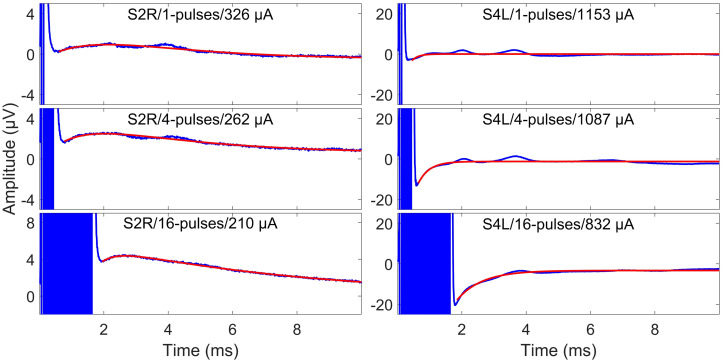
We investigated the effects of electric multi-pulse stimulation on electrically evoked auditory brainstem responses (eABRs). Multi-pulses with a high burst rate of 10,000 pps were assembled from pulses of 45-μs phase duration. Conditions of 1, 2, 4, 8, and 16 pulses were investigated. Psychophysical thresholds (THRs) and most comfortable levels (MCLs) in multi-pulse conditions were measured. Psychophysical temporal integration functions (slopes of THRs/MCLs as a function of number of pulses) were -1.30 and -0.93 dB/doubling of the number of pulses, which correspond to the doubling of pulse duration. A total of 15 eABR conditions with different numbers of pulses and amplitudes were measured. The morphology of eABRs to multi-pulse stimuli did not differ from those to conventional single pulses. eABR wave eV amplitudes and latencies were analyzed extensively. At a fixed stimulation amplitude, an increasing number of pulses caused increasing wave eV amplitudes up to a certain, subject-dependent number of pulses. Then, amplitudes either saturated or even decreased. This contradicted the conventional amplitude growth functions and also contradicted psychophysical results. We showed that destructive interference could be a possible reason for such a finding, where peaks and troughs of responses to the first pulses were suppressed by those of successive pulses in the train. This study provides data on psychophysical THRs and MCLs and corresponding eABR responses for stimulation with single-pulse and multi-pulse stimuli with increasing duration. Therefore, it provides insights how pulse trains integrate at the level of the brainstem.
我们研究了电多脉冲刺激对电诱发听觉脑干反应(eABRs)的影响。具有10,000次/秒高爆发率的多脉冲由相位持续时间为45微秒的脉冲组成。研究了1、2、4、8和16个脉冲的情况。测量了多脉冲条件下的心理物理阈值(THRs)和最舒适水平(MCLs)。心理物理时间整合函数(THRs/MCLs随脉冲数变化的斜率)分别为-1.30和-0.93 dB/脉冲数翻倍,这相当于脉冲持续时间翻倍。总共测量了15种不同脉冲数和幅度的eABR情况。多脉冲刺激诱发的eABR形态与传统单脉冲诱发的eABR形态没有差异。对eABR波eV的幅度和潜伏期进行了广泛分析。在固定刺激幅度下,脉冲数增加会导致波eV幅度增加,直至达到某个与个体相关的脉冲数。然后,幅度要么饱和,甚至下降。这与传统的幅度增长函数相矛盾,也与心理物理结果相矛盾。我们表明,相消干涉可能是导致这一发现的一个可能原因,即对第一个脉冲的反应的峰值和谷值被序列中后续脉冲的峰值和谷值所抑制。本研究提供了关于心理物理THRs和MCLs以及单脉冲和持续时间增加的多脉冲刺激相应eABR反应的数据。因此,它提供了关于脉冲序列在脑干水平如何整合的见解。