Li Yuan, Su Zeqi, Li Ping, Li Yicong, Johnson Nadia, Zhang Qi, Du Shihao, Zhao Huali, Li Kexin, Zhang Chi, Ding Xia
Dongzhimen Hospital, Beijing University of Chinese Medicine, Beijing 100029, China.
Beijing Research Institute of Chinese Medicine, Beijing 100029, China.
Evid Based Complement Alternat Med. 2020 Jul 9;2020:5197201. doi: 10.1155/2020/5197201. eCollection 2020.
There is a lack of research on the relationship between symptoms and dietary factors of chronic gastritis (CG) patients, and the contribution of dietary management in relieving symptoms of CG patients has not attracted enough attention. This study aimed to identify the associations between different symptoms and dietary factors. . All CG patients in this cross-sectional study were recruited from 3 hospitals in Beijing, China, from October 2015 to January 2016. Association Rule Mining analysis was performed to identify the correlations between gastrointestinal symptoms and dietary factors (including eating habits and food preferences), and subgroup analysis focused on gender differences.
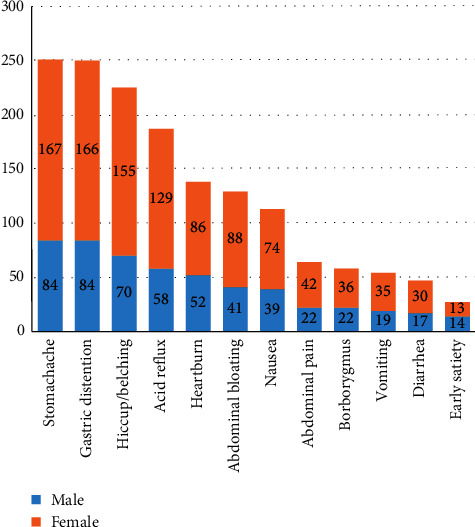
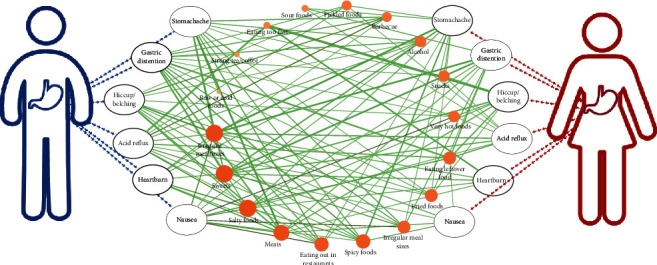
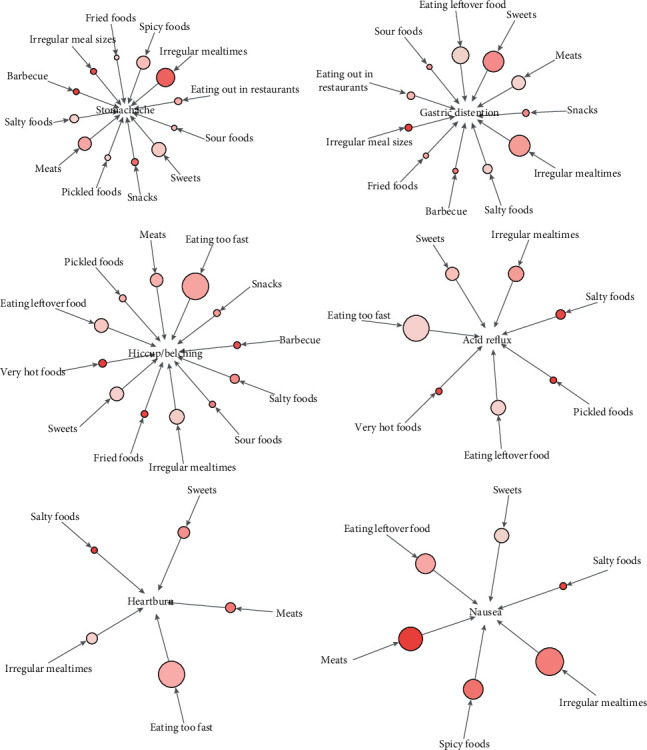
The majority of patients (58.17%) reported that their symptoms were related to dietary factors. About 53% reported that they had the habit of "eating too fast," followed by "irregular mealtimes" (29.66%) and "eating leftover food" (28.14%). Sweets (27.57%), spicy foods (25.10%), and meat (24.33%) were the most popular among all participants. Stomachache and gastric distention were the most common symptoms and were both associated with irregular mealtimes, irregular meal sizes, eating out in restaurants, meats, barbecue, fried foods, sour foods, sweets, snacks, and salty foods (support >0.05 and lift >1.0). Their most strongly associated factors were irregular meal sizes, barbecues, and snacks (lift >1.2). In addition, irregular mealtimes, salty foods, and sweet foods may be important diet factors influencing the symptoms in CG patients (support >0.05 and lift >1.0), as they were associated with almost all dyspeptic symptoms in the whole group and subgroup analyses. Furthermore, alcohol, barbecue, and spicy foods were associated with almost all symptoms for males (support >0.05 and lift >1.0), but sweets were the only dietary factor associated with all symptoms for females (support >0.05 and lift >1.0).
This study has provided new data for the association of symptoms with eating habits and food preferences in CG patients. The role of individual daily management schemes, such as dietary or lifestyle programs, needs more attention.
目前关于慢性胃炎(CG)患者症状与饮食因素之间关系的研究较少,饮食管理对缓解CG患者症状的作用尚未引起足够重视。本研究旨在确定不同症状与饮食因素之间的关联。本横断面研究中的所有CG患者均于2015年10月至2016年1月从中国北京的3家医院招募。进行关联规则挖掘分析以确定胃肠道症状与饮食因素(包括饮食习惯和食物偏好)之间的相关性,并进行亚组分析以关注性别差异。
大多数患者(58.17%)报告其症状与饮食因素有关。约53%的患者报告有“进食过快”的习惯,其次是“用餐时间不规律”(29.66%)和“吃剩饭”(28.14%)。甜食(27.57%)、辛辣食物(25.10%)和肉类(24.33%)在所有参与者中最受欢迎。胃痛和胃胀是最常见的症状,均与用餐时间不规律、用餐量不规律、外出就餐、肉类、烧烤、油炸食品、酸味食品、甜食、零食和咸味食品有关(支持度>0.05且提升度>1.0)。它们最密切相关的因素是用餐量不规律、烧烤和零食(提升度>1.2)。此外,用餐时间不规律、咸味食品和甜食可能是影响CG患者症状的重要饮食因素(支持度>0.05且提升度>1.0),因为在全组和亚组分析中它们与几乎所有消化不良症状都有关。此外,酒精、烧烤和辛辣食物与男性的几乎所有症状都有关(支持度>0.05且提升度>1.0),但甜食是与女性所有症状都有关的唯一饮食因素(支持度>0.05且提升度>1.0)。
本研究为CG患者症状与饮食习惯和食物偏好之间的关联提供了新的数据。个体日常管理方案,如饮食或生活方式计划的作用,需要更多关注。