• 文献检索
  • 文档翻译
  • 深度研究
  • 学术资讯
  • Suppr Zotero 插件Zotero 插件
  • 邀请有礼
  • 套餐&价格
  • 历史记录
应用&插件
Suppr Zotero 插件Zotero 插件浏览器插件Mac 客户端Windows 客户端微信小程序
定价
高级版会员购买积分包购买API积分包
服务
文献检索文档翻译深度研究API 文档MCP 服务
关于我们
关于 Suppr公司介绍联系我们用户协议隐私条款
关注我们

Suppr 超能文献

核心技术专利:CN118964589B侵权必究
粤ICP备2023148730 号-1Suppr @ 2026

文献检索

告别复杂PubMed语法,用中文像聊天一样搜索,搜遍4000万医学文献。AI智能推荐,让科研检索更轻松。

立即免费搜索

文件翻译

保留排版,准确专业,支持PDF/Word/PPT等文件格式,支持 12+语言互译。

免费翻译文档

深度研究

AI帮你快速写综述,25分钟生成高质量综述,智能提取关键信息,辅助科研写作。

立即免费体验

青少年大脑与数字媒体的天然吸引力

Adolescent brain and the natural allure of digital media
.

作者信息

Giedd Jay N

机构信息

University of California, San Diego, California, US.

出版信息

Dialogues Clin Neurosci. 2020 Jun;22(2):127-133. doi: 10.31887/DCNS.2020.22.2/jgiedd.

DOI:10.31887/DCNS.2020.22.2/jgiedd
PMID:32699512
原文链接:https://pmc.ncbi.nlm.nih.gov/articles/PMC7366946/
Abstract

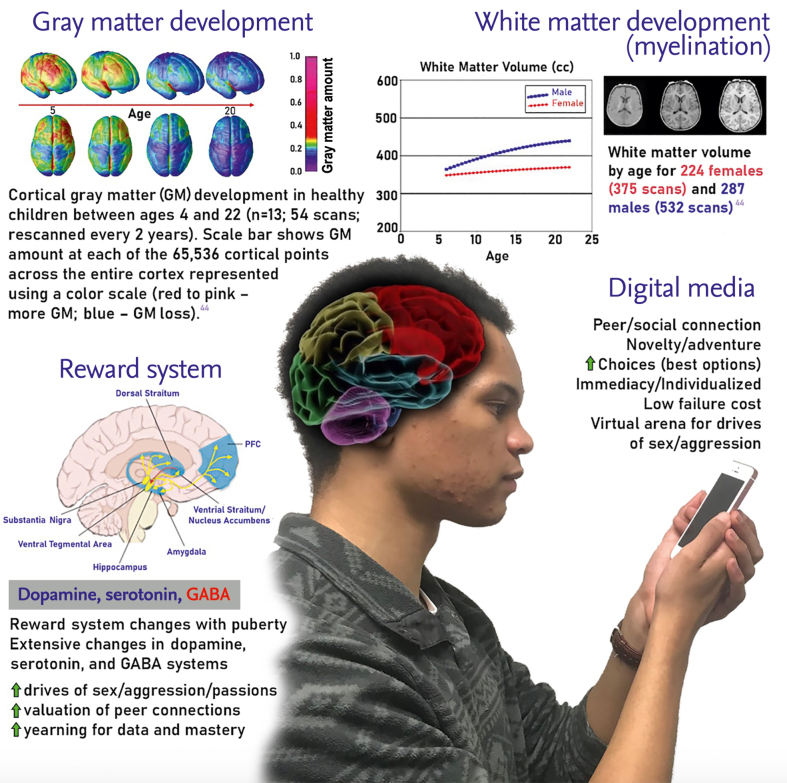
The growing amount of screen time among adolescents has raised concerns about the effects it may have on their physical and psychological health. Although the literature is divided on whether the effects are mostly positive, neutral, or mostly negative, it is likely that the impacts will be highly individualized with a mixture of good and bad consequences for each person. Understanding behavioral and neurobiological phenomena of adolescence may help to guide research and interventions to optimize the benefits and minimize the risks. Particular aspects of adolescent development relevant to the issue include: (i) hunger for human connectedness; (ii) appetite for adventure; and (iii) desire for data.
.

摘要

青少年屏幕使用时间的不断增加引发了人们对其可能对青少年身心健康产生的影响的担忧。尽管关于这些影响主要是积极的、中性的还是消极的,文献中存在分歧,但很可能这些影响会高度个体化,对每个人都有好坏参半的后果。了解青少年期的行为和神经生物学现象可能有助于指导研究和干预措施,以优化益处并将风险降至最低。与该问题相关的青少年发育的特定方面包括:(i)对人际联系的渴望;(ii)对冒险的喜好;以及(iii)对数据的渴望。
https://cdn.ncbi.nlm.nih.gov/pmc/blobs/4800/7366946/d85a43488af1/DCNS_22.2_Giedd_figure1.jpg

相似文献

1
Adolescent brain and the natural allure of digital media
.青少年大脑与数字媒体的天然吸引力
Dialogues Clin Neurosci. 2020 Jun;22(2):127-133. doi: 10.31887/DCNS.2020.22.2/jgiedd.
2
Adolescent development and growing divides in the digital age
.青少年发展与数字时代的成长鸿沟
Dialogues Clin Neurosci. 2020 Jun;22(2):143-149. doi: 10.31887/DCNS.2020.22.2/codgers.
3
The impact of digital technology use on adolescent well-being
.数字技术使用对青少年健康的影响。
Dialogues Clin Neurosci. 2020 Jun;22(2):135-142. doi: 10.31887/DCNS.2020.22.2/tdienlin.
4
The impact of the digital revolution 
on human brain and behavior: where 
do we stand?
.数字革命对人类大脑和行为的影响:我们处于什么位置?
Dialogues Clin Neurosci. 2020 Jun;22(2):101-111. doi: 10.31887/DCNS.2020.22.2/mkorte.
5
Adverse physiological and psychological effects of screen time on children and adolescents: Literature review and case study.屏幕时间对儿童和青少年的不良生理和心理影响:文献综述和案例研究。
Environ Res. 2018 Jul;164:149-157. doi: 10.1016/j.envres.2018.01.015. Epub 2018 Feb 27.
6
Brain health consequences of digital technology use
.数字技术使用对大脑健康的影响。
Dialogues Clin Neurosci. 2020 Jun;22(2):179-187. doi: 10.31887/DCNS.2020.22.2/gsmall.
7
[Screens and adolescence: what issues for the Z generation?].[屏幕与青少年:Z 世代面临哪些问题?]
Rev Med Suisse. 2024 Feb 21;20(862):396-399. doi: 10.53738/REVMED.2024.20.862.396.
8
Annual Research Review: Adolescent mental health in the digital age: facts, fears, and future directions.年度研究综述:数字时代青少年心理健康:事实、担忧和未来方向。
J Child Psychol Psychiatry. 2020 Mar;61(3):336-348. doi: 10.1111/jcpp.13190. Epub 2020 Jan 17.
9
Ethical Considerations for Mental Health Clinicians Working with Adolescents in the Digital Age.数字时代精神健康临床医生与青少年工作的伦理考量
Curr Psychiatry Rep. 2018 Oct 13;20(12):113. doi: 10.1007/s11920-018-0974-z.
10
Shyness and Trajectories of Functional Network Connectivity Over Early Adolescence.青少年早期的害羞与功能网络连通性的轨迹。
Child Dev. 2018 May;89(3):734-745. doi: 10.1111/cdev.13005. Epub 2017 Dec 8.

引用本文的文献

1
Causal effects of physical activity and screen time on childhood intelligence via Mendelian randomization: The mediating role of intracranial volume.通过孟德尔随机化研究身体活动和屏幕使用时间对儿童智力的因果效应:颅内体积的中介作用。
Dev Cogn Neurosci. 2025 Jun 20;74:101586. doi: 10.1016/j.dcn.2025.101586.
2
Internet addiction, sleeping habits and psychological distress in Brazilian adolescents and young adults.巴西青少年和青年中的网络成瘾、睡眠习惯与心理困扰
Psicol Reflex Crit. 2024 Sep 14;37(1):37. doi: 10.1186/s41155-024-00323-0.
3
A Holistic Investigation of the Relationship between Digital Addiction and Academic Achievement among Students.

本文引用的文献

1
Associations between screen time and short sleep duration among adolescents varies by media type: evidence from a cohort study.青少年的屏幕时间与短睡眠持续时间之间的关联因媒体类型而异:来自队列研究的证据。
Sleep Med. 2020 Feb;66:92-102. doi: 10.1016/j.sleep.2019.08.007. Epub 2019 Aug 26.
2
Associations Between Screen-Based Media Use and Brain White Matter Integrity in Preschool-Aged Children.屏幕媒体使用与学龄前儿童脑白质完整性的关联。
JAMA Pediatr. 2020 Jan 1;174(1):e193869. doi: 10.1001/jamapediatrics.2019.3869. Epub 2020 Jan 6.
3
Births in the United States, 2018.
学生数字成瘾与学业成绩关系的全面调查
Eur J Investig Health Psychol Educ. 2023 Sep 22;13(10):2006-2034. doi: 10.3390/ejihpe13100143.
4
The associations between screen time and mental health in adolescents: a systematic review.青少年的屏幕时间与心理健康之间的关联:系统评价。
BMC Psychol. 2023 Apr 20;11(1):127. doi: 10.1186/s40359-023-01166-7.
5
Youth Screen Media Activity Patterns and Associations With Behavioral Developmental Measures and Resting-state Brain Functional Connectivity.青少年屏幕媒体活动模式及其与行为发育测量和静息态脑功能连接的关联。
J Am Acad Child Adolesc Psychiatry. 2023 Sep;62(9):1051-1063. doi: 10.1016/j.jaac.2023.02.014. Epub 2023 Mar 22.
6
Revealing the Intellectual Structure and Evolution of Digital Addiction Research: An Integrated Bibliometric and Science Mapping Approach.揭示数字成瘾研究的知识结构和演变:一种综合的文献计量学和科学图谱方法。
Int J Environ Res Public Health. 2022 Nov 12;19(22):14883. doi: 10.3390/ijerph192214883.
7
Positive Effects of Digital Technology Use by Adolescents: A Scoping Review of the Literature.青少年使用数字技术的积极影响:文献综述的范围界定
Int J Environ Res Public Health. 2022 Oct 27;19(21):14009. doi: 10.3390/ijerph192114009.
8
Quantifying and characterising tobacco content in the most in-demand streamed series in 10 low/middle-income countries in 2019.定量分析并描述 2019 年 10 个中低收入国家最受欢迎的流媒体系列中的烟草含量。
Tob Control. 2023 Dec 13;33(1):45-51. doi: 10.1136/tobaccocontrol-2022-057278.
2018年美国的出生情况。
NCHS Data Brief. 2019 Jul(346):1-8.
4
Why increases in adolescent depression may be linked to the technological environment.青少年抑郁增加的原因可能与技术环境有关。
Curr Opin Psychol. 2020 Apr;32:89-94. doi: 10.1016/j.copsyc.2019.06.036. Epub 2019 Jul 16.
5
Growing a social brain.培育社会脑。
Nat Hum Behav. 2018 Sep;2(9):624-636. doi: 10.1038/s41562-018-0384-6. Epub 2018 Aug 6.
6
The association between adolescent well-being and digital technology use.青少年福祉与数字技术使用之间的关系。
Nat Hum Behav. 2019 Feb;3(2):173-182. doi: 10.1038/s41562-018-0506-1. Epub 2019 Jan 14.
7
Screen media activity and brain structure in youth: Evidence for diverse structural correlation networks from the ABCD study.屏幕媒体活动与青少年脑结构:来自 ABCD 研究的不同结构相关网络的证据。
Neuroimage. 2019 Jan 15;185:140-153. doi: 10.1016/j.neuroimage.2018.10.040. Epub 2018 Oct 16.
8
Media use and brain development during adolescence.青少年时期的媒体使用与大脑发育
Nat Commun. 2018 Feb 21;9(1):588. doi: 10.1038/s41467-018-03126-x.
9
Decreases in psychological well-being among American adolescents after 2012 and links to screen time during the rise of smartphone technology.2012 年以后美国青少年心理健康水平下降,与智能手机技术兴起时期的屏幕时间有关。
Emotion. 2018 Sep;18(6):765-780. doi: 10.1037/emo0000403. Epub 2018 Jan 22.
10
Everything in Moderation: Moderate Use of Screens Unassociated with Child Behavior Problems.适度为好:适度使用屏幕与儿童行为问题无关。
Psychiatr Q. 2017 Dec;88(4):797-805. doi: 10.1007/s11126-016-9486-3.