Olszewska-Widdrat Agata, Alexandri Maria, López-Gómez José Pablo, Schneider Roland, Venus Joachim
Department of Bioengineering, Leibniz Institute for Agricultural Engineering and Bioeconomy, Max-Eyth-Allee 100, 14469 Potsdam, Germany.
Microorganisms. 2020 Jul 21;8(7):1084. doi: 10.3390/microorganisms8071084.
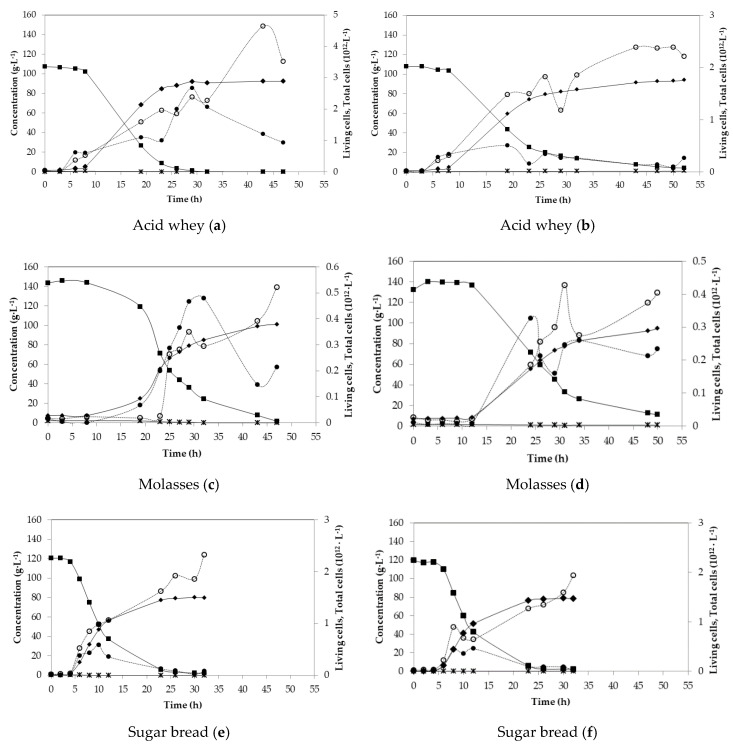
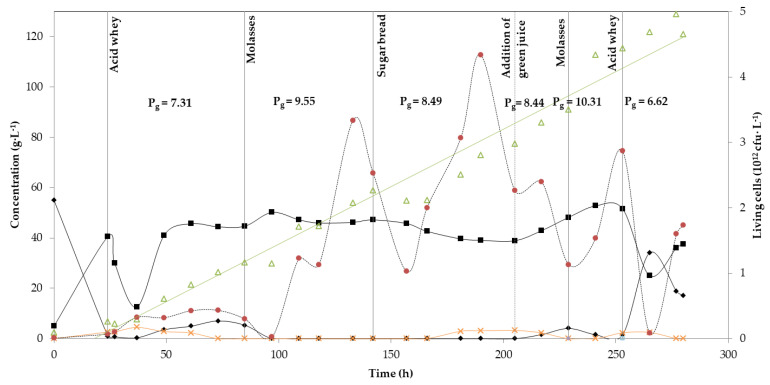
The utilisation of waste materials and industrial residues became a priority within the bioeconomy concept and the production of biobased chemicals. The aim of this study was to evaluate the feasibility to continuously produce L-lactic acid from different renewable substrates, in a multi-substrate strategy mode. Based on batch experiments observations, A534 strain was able to continuously metabolise acid whey, sugar beet molasses, sugar bread, alfalfa press green juice and tapioca starch. Additionally, reference experiments showed its behaviour in standard medium. Continuous fermentations indicated that the highest productivity was achieved when molasses was employed with a value of 10.34 g·L·h, while the lactic acid to sugar conversion yield was 0.86 g·g. This study demonstrated that LA can be efficiently produced in continuous mode regardless the substrate, which is a huge advantage in comparison to other platform chemicals.
在生物经济概念和生物基化学品生产中,废料和工业残渣的利用成为了一个优先事项。本研究的目的是评估在多底物策略模式下从不同可再生底物连续生产L-乳酸的可行性。基于分批实验观察,A534菌株能够连续代谢酸乳清、甜菜糖蜜、糖面包、苜蓿压榨绿汁和木薯淀粉。此外,参考实验展示了其在标准培养基中的行为。连续发酵表明,当使用糖蜜时生产率最高,为10.34 g·L·h,而乳酸与糖的转化率为0.86 g·g。本研究表明,无论使用何种底物,都可以以连续模式高效生产乳酸,与其他平台化学品相比,这是一个巨大的优势。