Department of Medicine, Biomedical, Clinical and Experimental Sciences, University of Verona, 37134 Verona, Italy.
Department of Research, Epidemiology and Prevention Unit, Fondazione IRCCS Istituto Nazionale dei Tumori, 20133 Milan, Italy.
Int J Environ Res Public Health. 2020 Jul 24;17(15):5351. doi: 10.3390/ijerph17155351.
Despite the benefits related to physical exercise, large numbers of cancer patients are not sufficiently active.
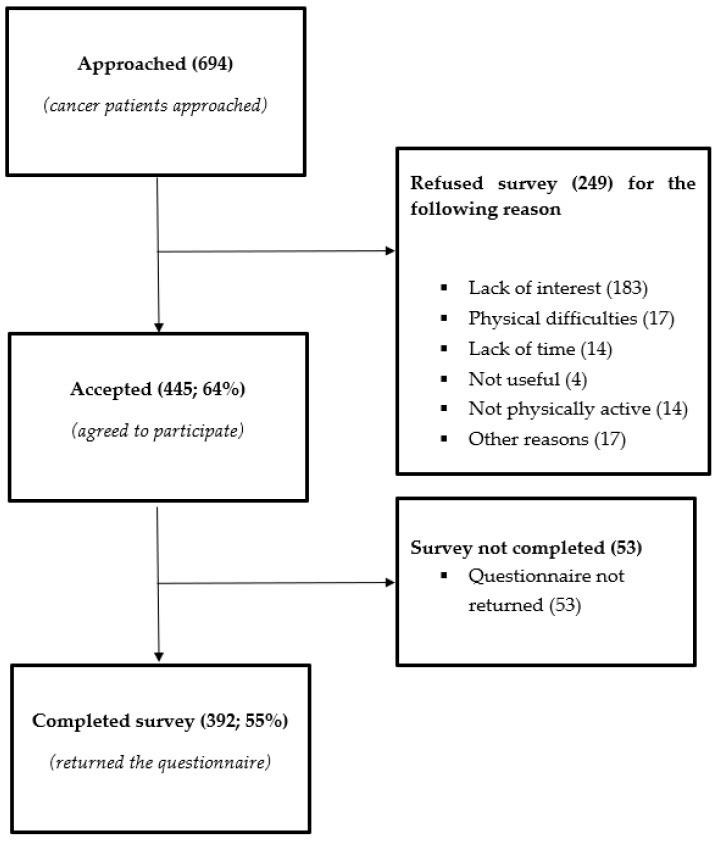
To investigate exercise levels and preferences in cancer patients, a cross-sectional study was conducted on a random sample of 392 cancer outpatients who anonymously completed a questionnaire investigating general and medical characteristics, and expressed willingness to participate in exercise programs. Current exercise levels were estimated with the Leisure Score Index (LSI).
Most patients (93%) were insufficiently active but 80% declared an interest in exercise programs. Patients preferred oncologist-instructed programs and specified particular exercise needs. Multivariate logistic regression showed that willingness to exercise was associated with education (OR: 1.87; 95% CI: 1.15-3.04 beyond age 14 years vs. up to 14 years) and current physical activity (OR: 1.92; 95% CI: 1.92-3.63 for sweat-inducing activity >2 times/week vs. <1 time/week). Patients given chemotherapy were less inclined to exercise (OR: 0.45; 95% CI: 0.23-0.86) than those who did not. LSI was lower if cancer stage was advanced (β: -0.36; 95% CI: -0.75 to -0.02) than if it was in remission. High LSI was also associated with longer education, lower BMI, and longer time after diagnosis.
Cancer patients are insufficiently active but are willing to participate in personalized exercise programs. Information from this survey may help in designing personalized interventions so these patients will achieve sufficient exercise.
尽管体育锻炼有益健康,但仍有大量癌症患者运动不足。
为了调查癌症患者的运动水平和偏好,对 392 名癌症门诊患者进行了横断面研究,这些患者随机抽取并匿名填写了一份调查问卷,内容包括一般特征和医疗特征,并表达了参加运动项目的意愿。当前的运动水平用休闲评分指数(LSI)来估计。
大多数患者(93%)运动不足,但 80%的患者表示有兴趣参加运动项目。患者更喜欢肿瘤医生指导的项目,并具体说明了特定的运动需求。多变量逻辑回归显示,愿意运动与教育有关(OR:1.87;95%CI:14 岁以上 vs. 14 岁以下,1.15-3.04),与当前体力活动有关(OR:1.92;95%CI:每周运动 2 次以上 vs. 每周运动 1 次以下,1.92-3.63)。与未接受化疗的患者相比,接受化疗的患者更不愿意运动(OR:0.45;95%CI:0.23-0.86)。癌症分期较晚(β:-0.36;95%CI:-0.75 至 -0.02)时,LSI 较低。LSI 较高与教育时间较长、BMI 较低、诊断后时间较长有关。
癌症患者运动不足,但愿意参加个性化的运动项目。本研究结果可为设计个性化干预措施提供信息,以帮助这些患者达到足够的运动量。