Dai Jiahe, Tao Liang, Shi Chongyin, Yang Shuwen, Li Depeng, Sheng Jun, Tian Yang
College of Food Science and Technology Yunnan Agricultural University Kunming China.
Yunnan Provincial Key Laboratory of Biological Big Data Yunnan Agricultural University Kunming China.
Food Sci Nutr. 2020 May 25;8(7):3692-3703. doi: 10.1002/fsn3.1653. eCollection 2020 Jul.
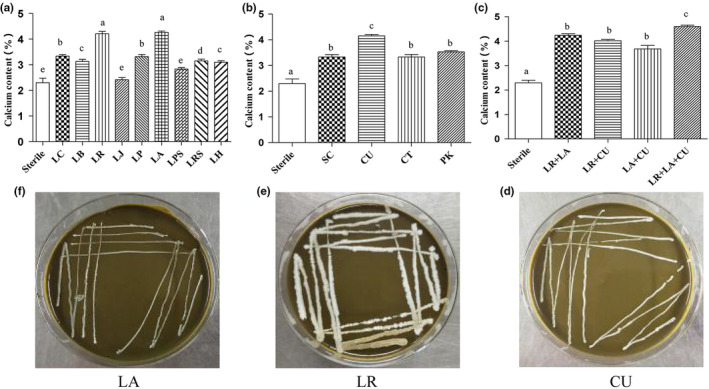
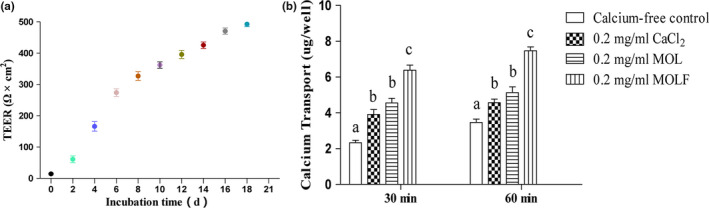
Nowadays, there is an increasing demand of healthier plant calcium supplements. leaves (MOL) are rich in calcium and thus are promising candidates for developing efficient calcium supplements. Here, using fermentation-based approaches, we developed a leaf ferment (MOLF), which contents higher levels of calcium. The therapeutic potential of the MOLF was also examined both in vitro and in vivo. Nine lactic acid bacteria and four yeasts were tested for better fermentation of MOL. Calcium-deficient rats were used for evaluating the therapeutic effects of MOLF. The results of liquid fermentation showed that the mixture of and elevated the content of MOL calcium most strikingly, with the content of calcium increased nearly 2.4-fold (from 2.08% to 4.90%). The resulting MOLF was then subjected to cell experiments and animal experiments. The results showed that calcium absorption in Caco-2 cells in MOLF group was higher than that in CaCl group significantly. Interestingly, in calcium-deficient rats, MOLF treatment significantly increased the thickness of cortical bone, rat body weight, wet weight of the femur, and the femur bone density, whereas it decreased osteoclast numbers. These results indicate that microbial fermentation increased calcium bioavailability of MOL, promote the growth and development of calcium-deficient rats, bone calcium deposition, and bone growth; enhance bone strength; reduce bone resorption; and prevent calcium deficiency.
如今,对更健康的植物钙补充剂的需求日益增加。树叶(MOL)富含钙,因此是开发高效钙补充剂的有潜力的候选物。在此,我们采用基于发酵的方法开发了一种树叶发酵物(MOLF),其钙含量更高。还在体外和体内研究了MOLF的治疗潜力。测试了九种乳酸菌和四种酵母对MOL进行更好的发酵效果。使用缺钙大鼠来评估MOLF的治疗效果。液体发酵结果表明,[具体物质1]和[具体物质2]的混合物最显著地提高了MOL的钙含量,钙含量增加了近2.4倍(从2.08%增至4.90%)。然后将所得的MOLF进行细胞实验和动物实验。结果表明,MOLF组中Caco-2细胞的钙吸收显著高于CaCl组。有趣的是,在缺钙大鼠中,MOLF治疗显著增加了皮质骨厚度、大鼠体重、股骨湿重和股骨骨密度,同时减少了破骨细胞数量。这些结果表明,微生物发酵提高了MOL的钙生物利用度,促进了缺钙大鼠的生长发育、骨钙沉积和骨骼生长;增强了骨骼强度;减少了骨吸收;并预防了缺钙。