Barroga Toni Rose M, Morales Reildrin G, Benigno Carolyn C, Castro Samuel Joseph M, Caniban Mardi M, Cabullo Maria Fe B, Agunos Agnes, de Balogh Katinka, Dorado-Garcia Alejandro
Food and Agriculture Organization of the United Nations-Philippine Component on the Global Efforts to Combat Antimicrobial Resistance Using One Health Approach (GCP/GLO/UK/710), Quezon City, Philippines.
Department of Agriculture, Bureau of Animal Industry, Quezon City, Philippines.
Front Vet Sci. 2020 Jul 8;7:329. doi: 10.3389/fvets.2020.00329. eCollection 2020.
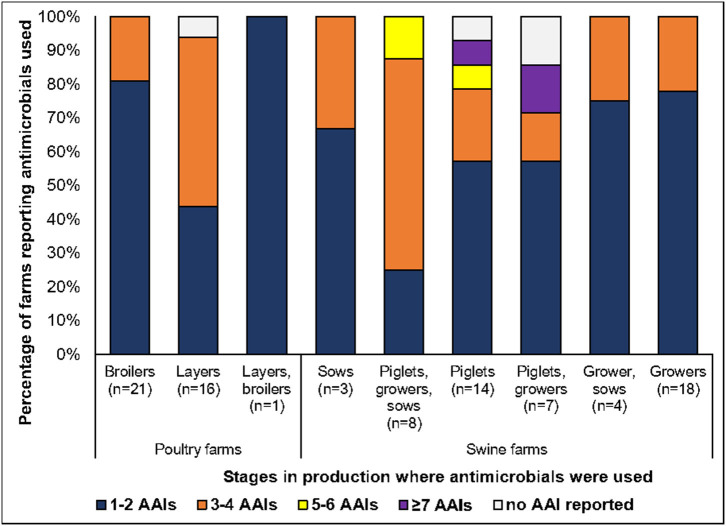
Chicken and pork are the most frequently consumed meat products in the Philippines. Swine and poultry are reared in either commercial farms (CMf) or backyard farms (BYf); the latter production system is relatively common and essential to food security in low- and middle-income countries (LMICs) such as the Philippines. Similar to resource-limited LMICs, antimicrobial use (AMU) surveillance has not yet been established; thus, AMU in food animals is a knowledge gap in understanding the emergence of antimicrobial resistance (AMR) in zoonotic foodborne bacteria in the country. This qualitative AMU pilot study aims to describe the antimicrobial active ingredients (AAIs) used and associated AMU practices (e.g., source of AAIs and informed AMU decisions) by poultry and swine CMf and BYf in the Philippines. Ninety-three farms across four regions in the Philippines voluntarily provided AMU information as part of a larger biosecurity and good practices study. The percentage of farms using AAI over the total number of farms was the metric used to describe AMU. In total, there were 30 AAIs used (CMf: =27 and BYf: = 13); per farm, the number of AAIs used ranged from 1 to 7. The spectrum of AAIs was more diverse in swine ( = 24) compared to poultry ( = 18). Enrofloxacin was the most frequently reported AAI in poultry (33%) and swine (36%) farms. Respiratory diseases were the most frequently reported reason for AMU in both species. Between production systems, significant differences were observed in the percentage of farms using amoxicillin (27% CMf vs. 3% BYf), colistin (17% CMf vs. 3% BYf), and oxytetracycline (12% CMf vs. 39% BYf). In terms of AMU practices, of important concern was the over-the-counter access of AAIs at retail outlets and the limited veterinary oversight in BYf. Our data indicated that antimicrobials critically important for human medicine are frequently used in poultry and swine farms in the Philippines. This study can inform the development of guidelines for curbing AMR through prudent AMU and serves as a reference point for AMU surveillance capacity development in the Philippines.
鸡肉和猪肉是菲律宾消费最为频繁的肉类产品。猪和家禽养殖于商业农场(CMf)或后院农场(BYf);后一种生产系统相对常见,对菲律宾等中低收入国家(LMICs)的粮食安全至关重要。与资源有限的中低收入国家类似,抗菌药物使用(AMU)监测尚未建立;因此,食用动物中的抗菌药物使用情况是了解该国食源性人畜共患病细菌中抗菌药物耐药性(AMR)出现情况的知识空白。这项定性的抗菌药物使用试点研究旨在描述菲律宾商业农场和后院农场的家禽和猪所使用的抗菌活性成分(AAIs)以及相关的抗菌药物使用做法(例如,抗菌活性成分的来源和明智的抗菌药物使用决策)。菲律宾四个地区的93个农场自愿提供抗菌药物使用信息,作为一项更大规模的生物安全和良好做法研究的一部分。使用抗菌活性成分的农场占农场总数的百分比是用于描述抗菌药物使用情况的指标。总共使用了30种抗菌活性成分(商业农场:=27种,后院农场:=13种);每个农场使用的抗菌活性成分数量从1种到7种不等。与家禽(=18种)相比,猪使用的抗菌活性成分种类(=24种)更多样化。恩诺沙星是家禽农场(33%)和猪农场(36%)中报告频率最高的抗菌活性成分。呼吸道疾病是这两个物种中报告频率最高的抗菌药物使用原因。在生产系统之间,观察到使用阿莫西林的农场百分比(商业农场27%对后院农场3%)、使用粘菌素的农场百分比(商业农场17%对后院农场3%)以及使用土霉素的农场百分比(商业农场12%对后院农场39%)存在显著差异。在抗菌药物使用做法方面,零售网点非处方获取抗菌活性成分以及后院农场兽医监督有限是重要关注点。我们的数据表明,对人类医学至关重要的抗菌药物在菲律宾的家禽和猪农场中经常使用。这项研究可为通过审慎使用抗菌药物制定遏制抗菌药物耐药性的指南提供信息,并作为菲律宾抗菌药物使用监测能力发展的参考点。