Dhaka Pankaj, Chantziaras Ilias, Vijay Deepthi, Bedi Jasbir Singh, Makovska Iryna, Biebaut Evelien, Dewulf Jeroen
Faculty of Veterinary Medicine, Department of Internal Medicine, Reproduction and Population Medicine, Ghent University, Salisburylaan 133, 9820 Merelbeke, Belgium.
Centre for One Health, College of Veterinary Science, Guru Angad Dev Veterinary and Animal Sciences University, Ludhiana 141004, India.
Antibiotics (Basel). 2023 May 11;12(5):893. doi: 10.3390/antibiotics12050893.
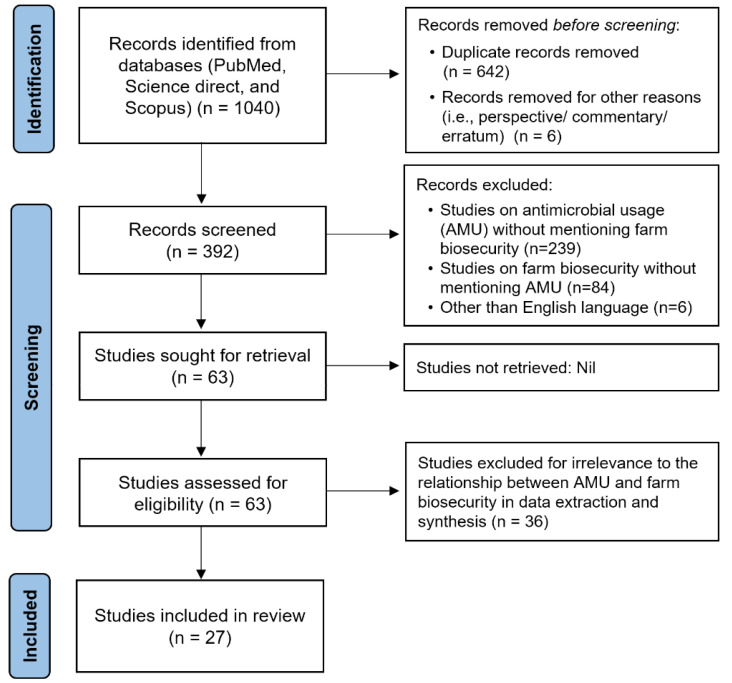
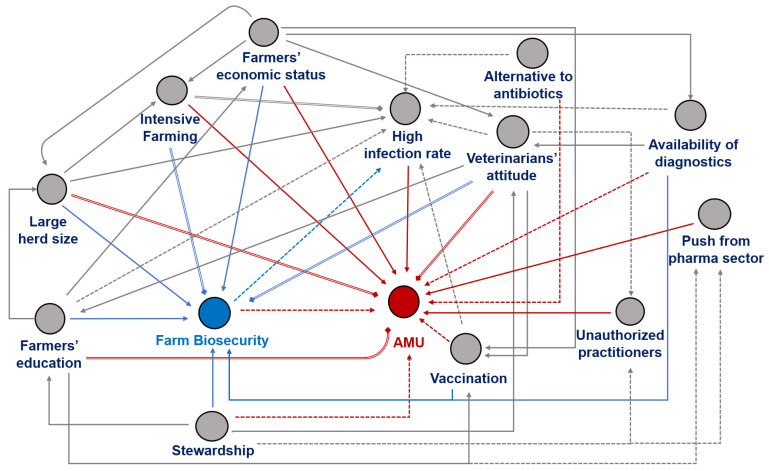
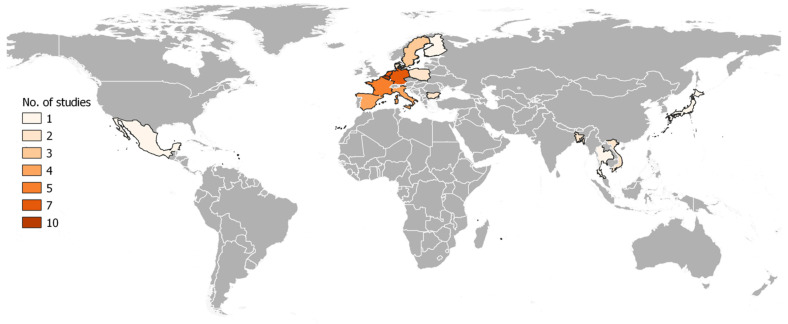
Limited and judicious antimicrobial usage (AMU) is considered the key to saving the success of human and veterinary medicine in treating infections. With the limited alternatives for antimicrobials, farm biosecurity (and herd management) is considered a promising tool to mitigate the non-judicious AMU and to maintain animal health, production, and welfare. The present scoping review aims to analyse the effect of farm biosecurity on AMU in livestock systems and formulate recommendations. Peer-reviewed manuscripts published between 2001-2022 were analyzed using the PRISMA framework using PubMed, Scopus, and Science Direct databases. After applying the inclusion criteria, 27 studies were found to assess the effect of farm biosecurity (or management practices) on AMU at the herd/farm level in quantitative/semi-quantitative terms. These studies were carried out in 16 countries, of which 74.1% (20/27) were from 11 European countries. The highest number of studies were from pig farms [51.8% (14/27)], followed by poultry (chicken) farms [25.9% (7/27)], cattle farms [11.1% (3/27)], and a single study from a turkey farm. Two studies include both pig and poultry farms. Most of the studies were cross-sectional [70.4% (19/27)], seven were longitudinal, and one was a case-control study. Complex interactions were observed among factors influencing AMU, such as biosecurity measures, farm characteristics, farmers' attitudes, availability of animal health services, stewardship, etc. A positive association between farm biosecurity and reduction in AMU was observed in 51.8% (14/27) of the studies, and 18.5% (5/27) showed that improvement in farm management practices was associated with a reduction in AMU. Two studies highlighted that coaching and awareness among farmers might lead to a decrease in AMU. A single study on economic assessment concluded biosecurity practices as a cost-effective way to reduce AMU. On the other hand, five studies showed an uncertain or spurious association between farm biosecurity and AMU. We recommend the reinforcement of the concept of farm biosecurity, especially in lower- and middle-income countries (LMICs). Further, there is a need to strengthen the evidence on the association between farm biosecurity and AMU in region- and species-specific farm settings.
有限且合理地使用抗菌药物(AMU)被认为是保障人类和兽医学在治疗感染方面取得成功的关键。鉴于抗菌药物的选择有限,农场生物安全(以及畜群管理)被视为一种有前景的工具,可减少不合理的抗菌药物使用,并维持动物健康、生产和福利。本综述旨在分析农场生物安全对畜牧系统中抗菌药物使用的影响,并提出建议。使用PRISMA框架,通过PubMed、Scopus和ScienceDirect数据库对2001年至2022年间发表的同行评审手稿进行了分析。应用纳入标准后,发现有27项研究以定量/半定量方式评估了农场生物安全(或管理措施)对畜群/农场层面抗菌药物使用的影响。这些研究在16个国家开展,其中74.1%(20/27)来自11个欧洲国家。研究数量最多的是猪场[51.8%(14/27)],其次是家禽(鸡)场[25.9%(7/27)]、牛场[11.1%(3/27)],还有一项来自火鸡场的研究。两项研究涵盖了猪场和家禽场。大多数研究为横断面研究[70.4%(19/27)],七项为纵向研究,一项为病例对照研究。在影响抗菌药物使用的因素之间观察到复杂的相互作用,如生物安全措施、农场特征、农民态度、动物健康服务的可及性、管理等。51.8%(14/27)的研究观察到农场生物安全与抗菌药物使用减少之间存在正相关,18.5%(5/27)的研究表明农场管理措施的改善与抗菌药物使用减少有关。两项研究强调,对农民进行培训和提高认识可能会导致抗菌药物使用减少。一项关于经济评估的研究得出结论,生物安全措施是减少抗菌药物使用的一种具有成本效益的方式。另一方面,五项研究表明农场生物安全与抗菌药物使用之间存在不确定或虚假的关联。我们建议强化农场生物安全的概念,尤其是在低收入和中等收入国家(LMICs)。此外,有必要加强在特定区域和特定物种的农场环境中关于农场生物安全与抗菌药物使用之间关联的证据。