Department of Environmental Health Sciences, Mailman School of Public Health, Columbia University, New York, NY, USA.
Department of Environmental Health Sciences, Robert Stempel College of Public Health & Social Work, Florida International University, Miami, FL, 33199, USA.
Mol Neurobiol. 2020 Nov;57(11):4467-4487. doi: 10.1007/s12035-020-02042-w. Epub 2020 Aug 2.
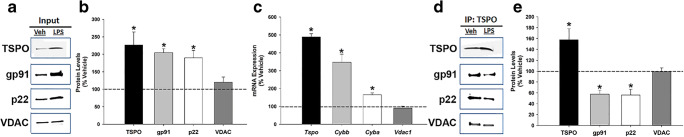
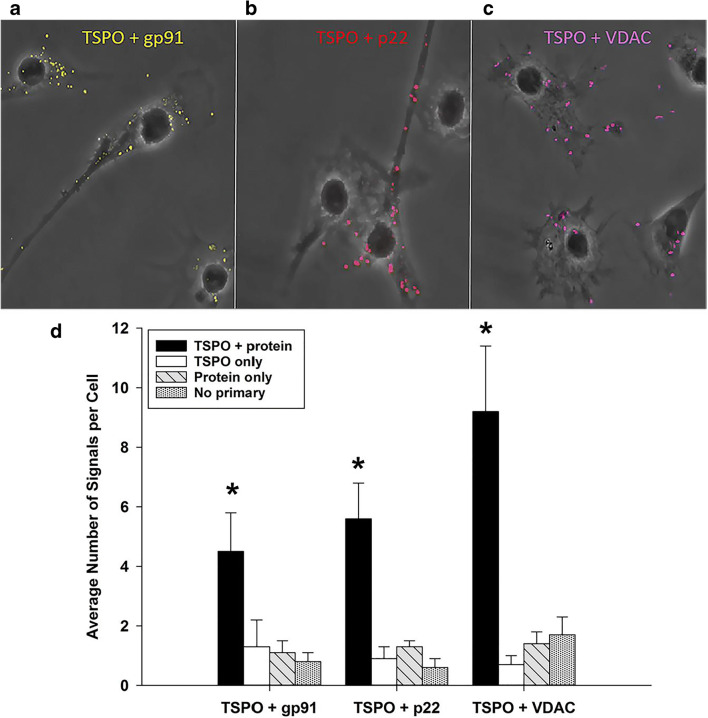
In the brain neuropil, translocator protein 18 kDa (TSPO) is a stress response protein that is upregulated in microglia and astrocytes in diverse central nervous system pathologies. TSPO is widely used as a biomarker of neuroinflammation in preclinical and clinical neuroimaging studies. However, there is a paucity of knowledge on the function(s) of TSPO in glial cells. In this study, we explored a putative interaction between TSPO and NADPH oxidase 2 (NOX2) in microglia. We found that TSPO associates with gp91 and p22, the principal subunits of NOX2 in primary murine microglia. The association of TSPO with gp91 and p22 was observed using co-immunoprecipitation, confocal immunofluorescence imaging, and proximity ligation assay. We found that besides gp91 and p22, voltage-dependent anion channel (VDAC) also co-immunoprecipitated with TSPO consistent with previous reports. When we compared lipopolysaccharide (LPS) stimulated microglia to vehicle control, we found that a lower amount of gp91 and p22 protein co-immunoprecipitated with TSPO suggesting a disruption of the TSPO-NOX2 subunits association. TSPO immuno-gold electron microscopy confirmed that TSPO is present in the outer mitochondrial membrane but it is also found in the endoplasmic reticulum (ER), mitochondria-associated ER membrane (MAM), and in the plasma membrane. TSPO localization at the MAM may represent a subcellular site where TSPO interacts with gp91 and p22 since the MAM is a point of communication between outer mitochondria membrane proteins (TSPO) and ER proteins (gp91 and p22) where they mature and form the cytochrome b (Cytb) heterodimer. We also found that an acute burst of reactive oxygen species (ROS) increased TSPO levels on the surface of microglia and this effect was abrogated by a ROS scavenger. These results suggest that ROS production may alter the subcellular distribution of TSPO. Collectively, our findings suggest that in microglia, TSPO is associated with the major NOX2 subunits gp91 and p22. We hypothesize that this interaction may regulate Cytb formation and modulate NOX2 levels, ROS production, and redox homeostasis in microglia.
在脑神经间质中,18kDa 转位蛋白(TSPO)是一种应激反应蛋白,在多种中枢神经系统疾病中的小胶质细胞和星形胶质细胞中上调。TSPO 被广泛用作临床前和临床神经影像学研究中神经炎症的生物标志物。然而,关于 TSPO 在神经胶质细胞中的功能知之甚少。在这项研究中,我们探讨了 TSPO 与小胶质细胞中 NADPH 氧化酶 2(NOX2)之间的假定相互作用。我们发现 TSPO 与 gp91 和 p22 结合,gp91 和 p22 是原代小鼠小胶质细胞中 NOX2 的主要亚基。使用共免疫沉淀、共聚焦免疫荧光成像和邻近连接测定观察到 TSPO 与 gp91 和 p22 的结合。我们发现,除了 gp91 和 p22 之外,电压依赖性阴离子通道(VDAC)也与 TSPO 共免疫沉淀,这与之前的报道一致。当我们将脂多糖(LPS)刺激的小胶质细胞与载体对照进行比较时,我们发现与 TSPO 共免疫沉淀的 gp91 和 p22 蛋白量减少,这表明 TSPO-NOX2 亚基的结合被破坏。TSPO 免疫金电子显微镜证实 TSPO 存在于外线粒体膜中,但也存在于内质网(ER)、线粒体相关内质网膜(MAM)和质膜中。TSPO 在 MAM 中的定位可能代表 TSPO 与 gp91 和 p22 相互作用的亚细胞部位,因为 MAM 是外线粒体膜蛋白(TSPO)和 ER 蛋白(gp91 和 p22)之间进行交流的地方,它们在那里成熟并形成细胞色素 b(Cytb)异二聚体。我们还发现,活性氧(ROS)的急性爆发增加了小胶质细胞表面的 TSPO 水平,而 ROS 清除剂则消除了这种作用。这些结果表明,ROS 的产生可能会改变 TSPO 的亚细胞分布。总的来说,我们的发现表明,在小胶质细胞中,TSPO 与主要的 NOX2 亚基 gp91 和 p22 结合。我们假设这种相互作用可能调节 Cytb 的形成,并调节小胶质细胞中 NOX2 的水平、ROS 的产生和氧化还原平衡。