Department of Psychological and Brain Sciences, Boston University, Boston, MA 02215.
Department of Physiology and Biophysics, University of Washington, Seattle, WA 98195.
Proc Natl Acad Sci U S A. 2020 Aug 18;117(33):20274-20283. doi: 10.1073/pnas.1917197117. Epub 2020 Aug 3.
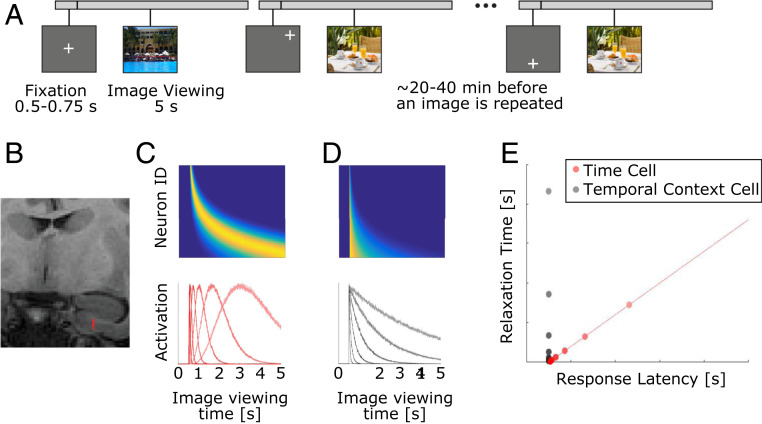
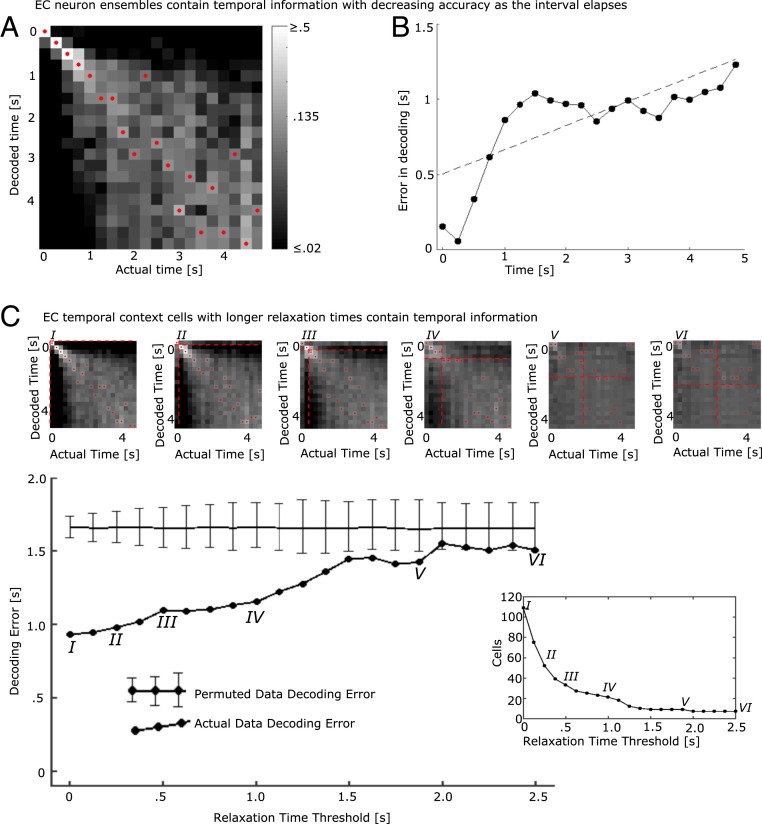
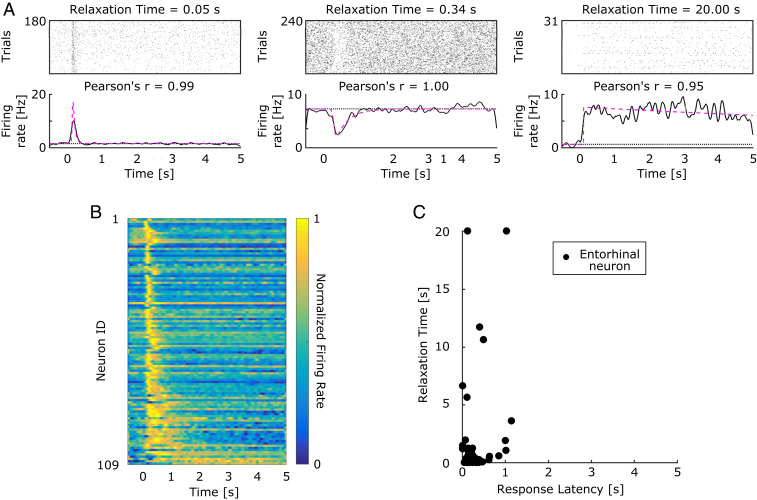
Episodic memory is believed to be intimately related to our experience of the passage of time. Indeed, neurons in the hippocampus and other brain regions critical to episodic memory code for the passage of time at a range of timescales. The origin of this temporal signal, however, remains unclear. Here, we examined temporal responses in the entorhinal cortex of macaque monkeys as they viewed complex images. Many neurons in the entorhinal cortex were responsive to image onset, showing large deviations from baseline firing shortly after image onset but relaxing back to baseline at different rates. This range of relaxation rates allowed for the time since image onset to be decoded on the scale of seconds. Further, these neurons carried information about image content, suggesting that neurons in the entorhinal cortex carry information about not only when an event took place but also, the identity of that event. Taken together, these findings suggest that the primate entorhinal cortex uses a spectrum of time constants to construct a temporal record of the past in support of episodic memory.
情景记忆被认为与我们对时间流逝的体验密切相关。事实上,海马体和其他对情景记忆至关重要的大脑区域中的神经元以一系列时间尺度对时间流逝进行编码。然而,这种时间信号的起源尚不清楚。在这里,我们在猕猴观看复杂图像时检查了内嗅皮层的时间反应。内嗅皮层中有许多神经元对图像开始有反应,在图像开始后不久就表现出与基线发射的巨大偏差,但以不同的速率恢复到基线。这种弛豫率范围允许在秒的范围内对图像开始以来的时间进行解码。此外,这些神经元携带有关图像内容的信息,这表明内嗅皮层中的神经元不仅携带有关事件发生时间的信息,还携带有关该事件身份的信息。总之,这些发现表明,灵长类动物的内嗅皮层使用一系列时间常数来构建过去的时间记录,以支持情景记忆。