Center of Excellence Food Technology and Nutrition, University of Applied Sciences Upper Austria, Stelzhamerstraße 23, 4600 Wels, Austria.
FFoQSI GmbH-Austrian Competence Centre for Feed and Food Quality, Safety and Innovation, Technopark 1C, 3430 Tulln, Austria.
Biomolecules. 2020 Aug 3;10(8):1139. doi: 10.3390/biom10081139.
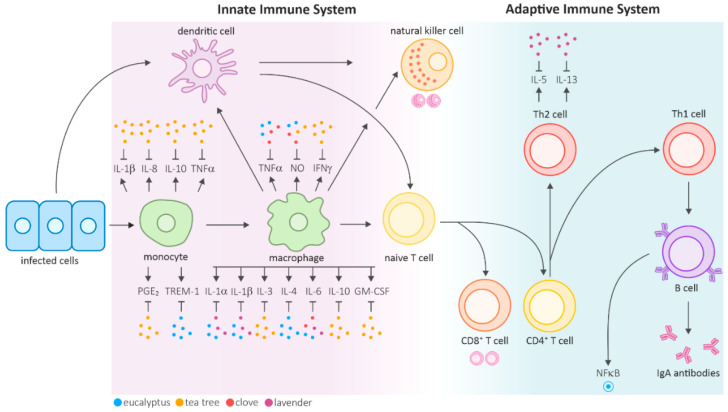
Recently, the application of herbal medicine for the prevention and treatment of diseases has gained increasing attention. Essential oils (EOs) are generally known to exert various pharmacological effects, such as antiallergic, anticancer, anti-inflammatory, and immunomodulatory effects. Current literature involving in vitro and in vivo studies indicates the potential of various herbal essential oils as suitable immunomodulators for the alternative treatment of infectious or immune diseases. This review highlights the cellular effects induced by EOs, as well as the molecular impacts of EOs on cytokines, immunoglobulins, or regulatory pathways. The results reviewed in this article revealed a significant reduction in relevant proinflammatory cytokines, as well as induction of anti-inflammatory markers. Remarkably, very little clinical study data involving the immunomodulatory effects of EOs are available. Furthermore, several studies led to contradictory results, emphasizing the need for a multiapproach system to better characterize EOs. While immunomodulatory effects were reported, the toxic potential of EOs must be clearly considered in order to secure future applications.
近年来,草药在疾病预防和治疗方面的应用越来越受到关注。众所周知,精油(EOs)具有多种药理作用,如抗过敏、抗癌、抗炎和免疫调节作用。目前的文献涉及体外和体内研究表明,各种草药精油作为合适的免疫调节剂,可用于替代治疗感染或免疫性疾病。本文重点介绍了 EOs 诱导的细胞效应,以及 EOs 对细胞因子、免疫球蛋白或调节途径的分子影响。本文综述的结果表明,相关促炎细胞因子显著减少,抗炎标志物显著诱导。值得注意的是,涉及 EOs 免疫调节作用的临床研究数据非常有限。此外,一些研究得出了相互矛盾的结果,强调需要采用多方法系统来更好地表征 EOs。虽然报道了免疫调节作用,但必须明确考虑 EOs 的潜在毒性,以确保未来的应用。