Health Research Centre, University of Almería, Almería, Spain.
UD Almería, Almería, Spain.
PLoS One. 2020 Aug 6;15(8):e0236959. doi: 10.1371/journal.pone.0236959. eCollection 2020.
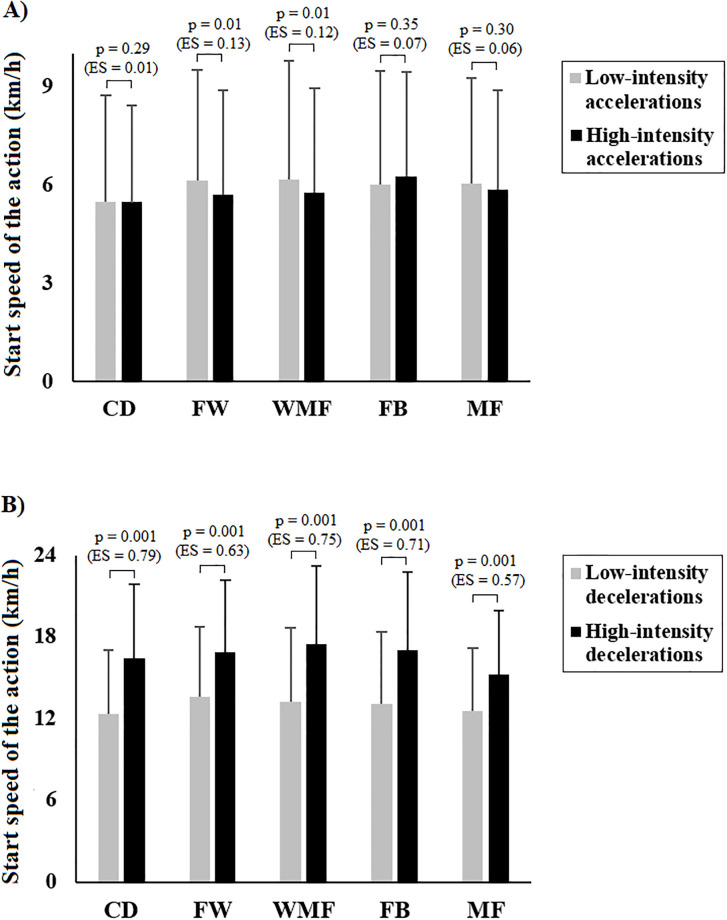
The study aims were to describe positional differences in the acceleration and sprint profiles of professional football players in match-play, and analyse start speeds required based on the intensity of accelerations and decelerations. This longitudinal study was conducted over thirteen competitive microcycles in a professional football team from LaLiga 123. Data were collected through electronic performance tracking systems. Every player was categorised based on the playing position: central defender (CD), full-back (FB), forward (FW), midfielder (MF), and wide midfielder (WMF). In respect of acceleration profile, positional differences were found for all variables (p < 0.05), except average magnitude of accelerations (ACCAVG, p = 0.56) and decelerations (DECAVG, p = 0.76). The sprint profile also showed positional differences for all variables (p < 0.05), apart from sprint duration (p = 0.07). In addition, although low-intensity accelerations required significantly greater start speeds (Vo) than high-intensity accelerations in WMF (0.4 ± 0.2 km/h; p < 0.05) and FW (0.4 ± 0.2 km/h; p < 0.05), no significant differences (p > 0.05) were found in CD, FB, and MF. However, high-intensity decelerations were performed at significantly higher Vo than low-intensity decelerations in MF (2.65 ± 0.1 km/h; p < 0.05), FW (3.3 ± 0.1 km/h; p < 0.05), FB (3.9 ± 0.4 km/h; p < 0.05), WMF (4.3 ± 0.3 km/h; p < 0.05), and CD (4.1 ± 0.7 km/h; p < 0.05). Therefore, positional differences exist for most variables of the acceleration and sprint profiles. In addition, different Vo were observed between high-intensity and low-intensity accelerations as well as high-intensity and low-intensity decelerations.
本研究旨在描述职业足球运动员在比赛中的加速度和冲刺表现的位置差异,并分析基于加速和减速强度所需的起跑速度。这项纵向研究是在拉利加 123 的一支职业足球队的十三个竞争微周期中进行的。数据通过电子绩效跟踪系统收集。每个球员都根据场上位置进行分类:中后卫(CD)、边后卫(FB)、前锋(FW)、中场(MF)和边中场(WMF)。在加速度曲线方面,除了平均加速度大小(ACCAVG,p = 0.56)和减速大小(DECAVG,p = 0.76)外,所有变量的位置差异均有统计学意义(p < 0.05)。冲刺曲线也显示了所有变量的位置差异(p < 0.05),除了冲刺持续时间(p = 0.07)。此外,尽管低强度加速度在 WMF(0.4 ± 0.2 公里/小时;p < 0.05)和 FW(0.4 ± 0.2 公里/小时;p < 0.05)中需要比高强度加速度更大的起跑速度(Vo),但在 CD、FB 和 MF 中没有发现显著差异(p > 0.05)。然而,MF(2.65 ± 0.1 公里/小时;p < 0.05)、FW(3.3 ± 0.1 公里/小时;p < 0.05)、FB(3.9 ± 0.4 公里/小时;p < 0.05)、WMF(4.3 ± 0.3 公里/小时;p < 0.05)和 CD(4.1 ± 0.7 公里/小时;p < 0.05)中,高强度减速的 Vo 明显高于低强度减速。因此,加速度和冲刺曲线的大多数变量都存在位置差异。此外,在高强度和低强度加速度以及高强度和低强度减速之间观察到不同的 Vo。