Yang Na, He Liyun, Li Yuxiu, Xu Lingling, Ping Fan, Li Wei, Zhang Huabing
Department of Endocrinology, Key Laboratory of Endocrinology of National Health Commission, Peking Union Medical College Hospital, Chinese Academy of Medical Sciences and Peking Union Medical College, Beijing, People's Republic of China.
Diabetes Metab Syndr Obes. 2020 Jul 17;13:2541-2550. doi: 10.2147/DMSO.S257884. eCollection 2020.
High dietary magnesium intake may reduce insulin resistance (IR) and metabolic syndrome (MetS). The aim of the cross-sectional analysis was to evaluate the association between dietary magnesium intake, IR, and MetS using data from China Health and Nutrition Survey.
Dietary magnesium intake was defined as daily dietary magnesium intake divided by body weight. Logistic regression analysis was used to calculate the odds ratio (OR) for IR and the prevalence of MetS across the quartile categories of dietary magnesium intake. In addition, we used the macro PROCESS to perform the mediation analyses.
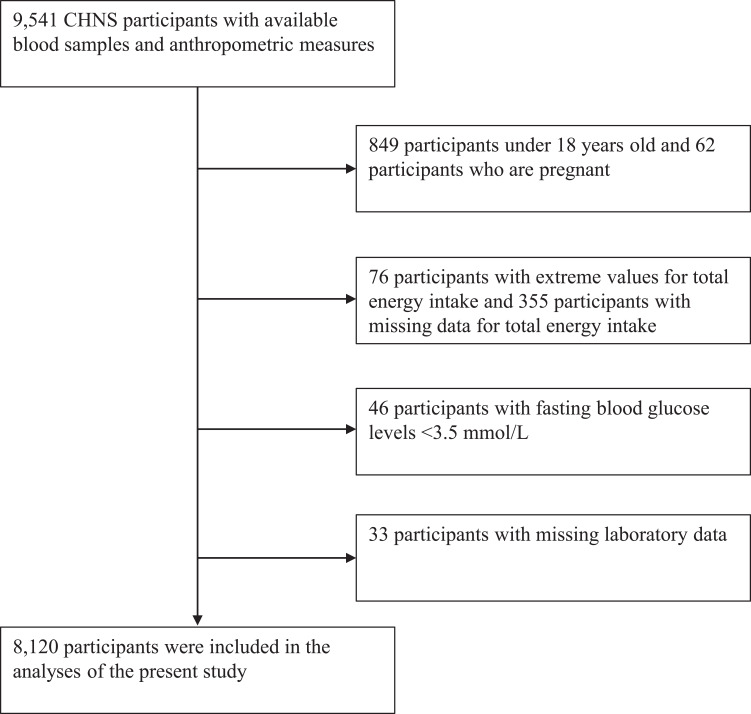
A total of 8120 participants were included in the final analysis. We found a significant negative association between dietary magnesium intake and IR, the multivariable-adjusted OR for HOMA-IR comparing the highest to the lowest quartile of dietary magnesium intake was 0.435 (95% confidence intervals [CI] 0.376 to 0.502). The prevalence of the MetS was 38.6%, 28.9%, 22.5%, and 16.5% for increasing quartiles of dietary magnesium intake (p <0.001). The mediation model analysis displayed that insulin resistance mediated the effect of dietary magnesium on MetS. The direct effect and indirect effect of dietary magnesium on MetS were found significant, and the calculated percentage of mediation by insulin resistance was 19.6%.
Our study demonstrated a significant and independent negative relationship among weight-adjusted dietary magnesium intake, HOMA-IR, and MetS in a large Chinese population. IR partly mediated the relationship between dietary magnesium intake and MetS.
高膳食镁摄入量可能降低胰岛素抵抗(IR)和代谢综合征(MetS)。横断面分析的目的是利用中国健康与营养调查的数据评估膳食镁摄入量、IR和MetS之间的关联。
膳食镁摄入量定义为每日膳食镁摄入量除以体重。采用逻辑回归分析计算膳食镁摄入量四分位数类别中IR的比值比(OR)和MetS的患病率。此外,我们使用宏PROCESS进行中介分析。
最终分析共纳入8120名参与者。我们发现膳食镁摄入量与IR之间存在显著的负相关,膳食镁摄入量最高四分位数与最低四分位数相比,HOMA-IR的多变量调整OR为0.435(95%置信区间[CI]0.376至0.502)。随着膳食镁摄入量四分位数的增加,MetS的患病率分别为38.6%、28.9%、22.5%和16.5%(p<0.001)。中介模型分析显示,胰岛素抵抗介导了膳食镁对MetS的影响。发现膳食镁对MetS的直接效应和间接效应均显著,胰岛素抵抗介导作用的计算百分比为19.6%。
我们的研究表明,在一大群中国人群中,体重调整后的膳食镁摄入量、HOMA-IR和MetS之间存在显著且独立的负相关关系。IR部分介导了膳食镁摄入量与MetS之间的关系。