Belloumi N, Maalej Bellaj S, Bachouche I, Chermiti Ben Abdallah F, Fenniche S
Pulmonology Department Pavilion 4 Abderrahman Mami Hospital Ariana, Tunisia.
Pulmonology Department Pavilion D Abderrahman Mami Hospital Ariana, Tunisia.
Sleep Disord. 2020 Jun 30;2020:8235238. doi: 10.1155/2020/8235238. eCollection 2020.
Preservation of sleep quality is a modifiable and treatable factor, which may enhance the patient's adherence to other supportive and palliative care procedures. The outcome of sleep disturbances in lung cancer patients before and after treatment aren't reported. The aim of this study was to investigate changes in sleep quality before and after chemotherapy in locally advanced or metastatic NSCLC patients.
It was a prospective study including 64 patients with stage III or IV nonsmall-cell lung cancer. Patients answered the Tunisian dialectal version of the following questionnaires: PSQI and QLQ-C30 in order to evaluate, respectively, the sleep quality and the quality of life. The assessments took place before chemotherapy and then repeated after the chemotherapy course was over.
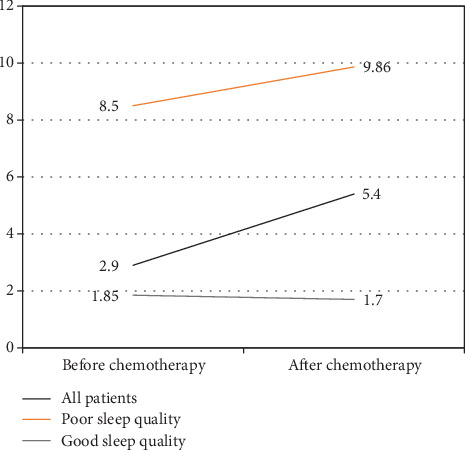
The mean age was 62.9 years. All patients were active smokers. Before chemotherapy, there were 10 patients (15%) with poor sleep quality. The most frequent complaints were daytime sleepiness (70%) and nocturnal arousals (100%). After chemotherapy, the mean PSQI score increased from 2.9 to 5.4, and 45% of all patients had poor sleep quality. Most frequent complaints were the extension of sleep latency (69%), daytime sleepiness (98%), and nocturnal arousals (100%). Predicting factors of sleep disturbance according to statistical univariate analysis were delayed diagnosis confirmation ( = 0.05), delayed treatment onset ( < 10), depressive mood ( = 0.001), and anxious mood ( = 0.001). Multivariate analysis had shown a significant and independent correlation between sleep quality and shortened diagnosis and treatment delays. Sociodemographic parameters, clinical parameters, and factors related to treatment procedure had no correlation with sleep quality.
Our study demonstrates the persistence and potential intensity worsening of sleep disturbances in advanced stage nonsmall-cell lung cancer patients. We, hereby, reported a statistical correlation between sleep quality and quality of life in our patients.
保持睡眠质量是一个可调节和可治疗的因素,这可能会增强患者对其他支持性和姑息性治疗程序的依从性。肺癌患者治疗前后睡眠障碍的结果尚未见报道。本研究的目的是调查局部晚期或转移性非小细胞肺癌患者化疗前后睡眠质量的变化。
这是一项前瞻性研究,纳入了64例III期或IV期非小细胞肺癌患者。患者回答了以下问卷的突尼斯方言版本:PSQI和QLQ-C30,以便分别评估睡眠质量和生活质量。评估在化疗前进行,化疗疗程结束后重复进行。
平均年龄为62.9岁。所有患者均为现吸烟者。化疗前,有10名患者(15%)睡眠质量差。最常见的抱怨是白天嗜睡(70%)和夜间觉醒(100%)。化疗后,PSQI平均得分从2.9增加到5.4,所有患者中有45%睡眠质量差。最常见的抱怨是睡眠潜伏期延长(69%)、白天嗜睡(98%)和夜间觉醒(100%)。根据单变量统计分析,睡眠障碍的预测因素为确诊延迟(=0.05)、治疗开始延迟(<10)、抑郁情绪(=0.001)和焦虑情绪(=0.001)。多变量分析显示睡眠质量与缩短诊断和治疗延迟之间存在显著且独立的相关性。社会人口统计学参数、临床参数以及与治疗程序相关的因素与睡眠质量均无相关性。
我们的研究表明晚期非小细胞肺癌患者睡眠障碍持续存在且可能强度加重。在此,我们报告了患者睡眠质量与生活质量之间的统计学相关性。