Department of Environmental Medicine and Behavioral Science, Kindai University Faculty of Medicine, Osakasayama, 589-8511, Japan.
Department of Architecture and Building Engineering, School of Environment and Society, Tokyo Institute of Technology, Tokyo, 152-8550, Japan.
Environ Res. 2020 Nov;190:110042. doi: 10.1016/j.envres.2020.110042. Epub 2020 Aug 12.
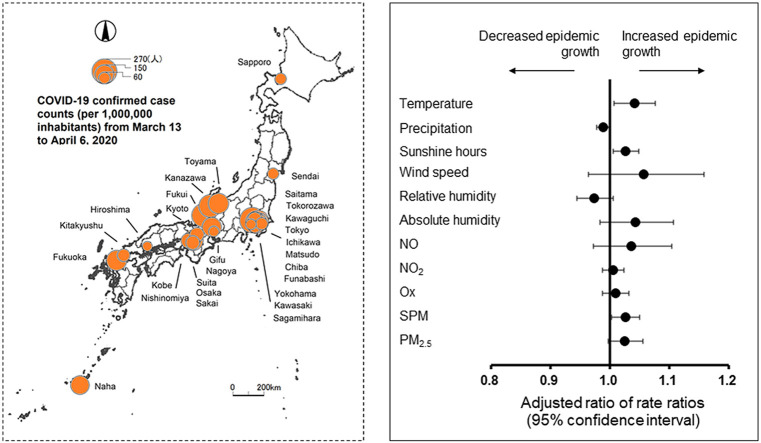
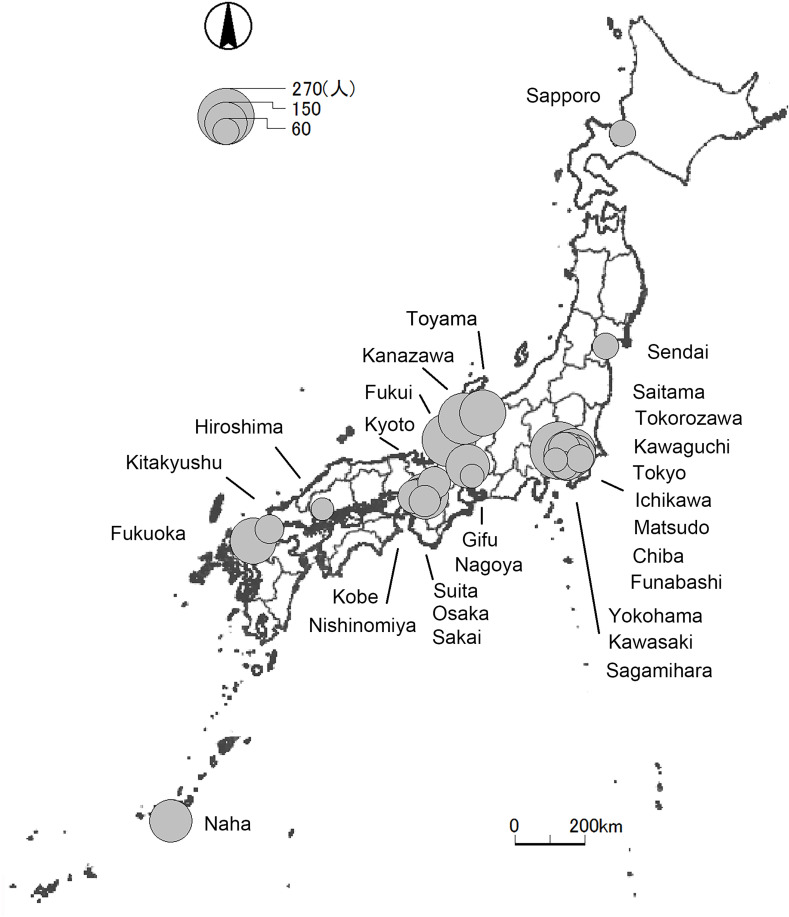
Coronavirus disease 2019 (COVID-19) rapidly spread worldwide in the first quarter of 2020 and resulted in a global crisis. Investigation of the potential association of the spread of the COVID-19 infection with climate or ambient air pollution could lead to the development of preventive strategies for disease control. To examine this association, we conducted a longitudinal cohort study of 28 geographical areas of Japan with documented outbreaks of COVID-19. We analyzed data obtained from March 13 to April 6, 2020, before the Japanese government declared a state of emergency. The results revealed that the epidemic growth of COVID-19 was significantly associated with increase in daily temperature or sunshine hours. This suggests that an increase in person-to-person contact due to increased outing activities on a warm and/or sunny day might promote the transmission of COVID-19. Our results also suggested that short-term exposure to suspended particles might influence respiratory infections caused by the severe acute respiratory syndrome coronavirus 2 (SARS-CoV-2). Further research by well-designed or well-controlled study models is required to ascertain this effect. Our findings suggest that weather has an indirect role in the transmission of COVID-19 and that daily adequate preventive behavior decreases the transmission.
2020 年第一季度,2019 冠状病毒病(COVID-19)在全球迅速蔓延,引发了全球性危机。研究 COVID-19 感染的传播与气候或环境空气污染之间的潜在关联,可能会促使制定疾病防控的预防策略。为了探究这种关联,我们对日本 28 个有 COVID-19 爆发记录的地理区域进行了一项纵向队列研究。我们分析了 2020 年 3 月 13 日至 4 月 6 日的数据,当时日本政府尚未宣布进入紧急状态。结果表明,COVID-19 的疫情增长与每日温度或日照时间的增加呈显著相关。这表明,在温暖或阳光充足的日子里,由于户外活动的增加,人与人之间的接触可能会增加,从而促进 COVID-19 的传播。我们的结果还表明,短期暴露于悬浮颗粒可能会影响由严重急性呼吸综合征冠状病毒 2(SARS-CoV-2)引起的呼吸道感染。需要通过精心设计或精心控制的研究模型进行进一步研究,以确定这种影响。我们的研究结果表明,天气对 COVID-19 的传播有间接作用,日常充分的预防行为可降低传播风险。