Department of Systems Biotechnology, Chung-Ang University, Anseong 17546, Republic of Korea.
J Microbiol Biotechnol. 2020 Oct 28;30(10):1583-1591. doi: 10.4014/jmb.2006.06036.
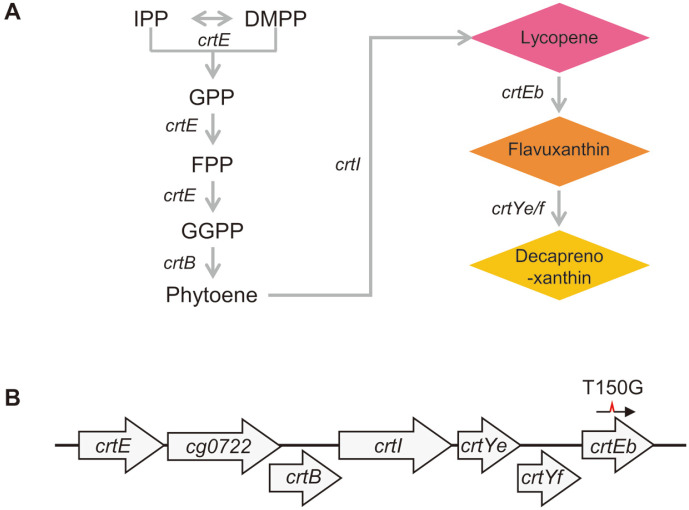
CRISPR/Cpf1 has emerged as a new CRISPR-based genome editing tool because, in comparison with CRIPSR/Cas9, it has a different T-rich PAM sequence to expand the target DNA sequence. Single-base editing in the microbial genome can be facilitated by oligonucleotide-directed mutagenesis (ODM) followed by negative selection with the CRISPR/Cpf1 system. However, single point mutations aided by Cpf1 negative selection have been rarely reported in . This study aimed to introduce an amber stop codon in encoding lycopene hydratase, through ODM and Cpf1-mediated negative selection; deficiency of this enzyme causes pink coloration due to lycopene accumulation in . Consequently, on using double-, triple-, and quadruple-basemutagenic oligonucleotides, 91.5-95.3% pink cells were obtained among the total live cells. However, among the negatively selected live cells, 0.6% pink cells were obtained using single-base-mutagenic oligonucleotides, indicating that very few single-base mutations were introduced, possibly owing to mismatch tolerance. This led to the consideration of various targetmismatched crRNAs to prevent the death of single-base-edited cells. Consequently, we obtained 99.7% pink colonies after CRISPR/Cpf1-mediated negative selection using an appropriate singlemismatched crRNA. Furthermore, Sanger sequencing revealed that single-base mutations were successfully edited in the 99.7% of pink cells, while only two of nine among 0.6% of pink cells were correctly edited. The results indicate that the target-mismatched Cpf1 negative selection can assist in efficient and accurate single-base genome editing methods in .
CRISPR/Cpf1 已成为一种新的基于 CRISPR 的基因组编辑工具,因为与 CRISPR/Cas9 相比,它具有不同的富含 T 的 PAM 序列,可以扩展目标 DNA 序列。通过寡核苷酸定向诱变 (ODM) 并随后使用 CRISPR/Cpf1 系统进行负选择,可以促进微生物基因组中的单碱基编辑。然而,通过 Cpf1 负选择辅助的单点突变在 中很少有报道。本研究旨在通过 ODM 和 Cpf1 介导的负选择,在 编码番茄红素水合酶的基因中引入一个琥珀终止密码子;由于该酶的缺乏,番茄红素在 中积累导致粉红色着色。因此,在使用双、三、四碱基诱变寡核苷酸时,在总活 细胞中获得了 91.5-95.3%的粉红色细胞。然而,在经过负选择的活细胞中,使用单碱基诱变寡核苷酸仅获得了 0.6%的粉红色细胞,表明引入的单碱基突变很少,可能是由于错配容忍度。这导致考虑使用各种靶标错配的 crRNA 来防止单碱基编辑细胞的死亡。因此,在用适当的单错配 crRNA 进行 CRISPR/Cpf1 介导的负选择后,我们获得了 99.7%的粉红色菌落。此外,Sanger 测序显示,在 99.7%的粉红色细胞中成功编辑了单碱基突变,而在 0.6%的粉红色细胞中只有 9 个中的 2 个正确编辑。结果表明,靶标错配的 Cpf1 负选择可以辅助在 中进行高效、准确的单碱基基因组编辑方法。