Community Medicine Training Program- Medical Education, Hamad Medical Corporation, P.O. Box 3050, Doha, State of Qatar.
Community Medicine Training Program- Primary Health Care Corporation, Doha, Qatar.
BMC Infect Dis. 2020 Aug 20;20(1):617. doi: 10.1186/s12879-020-05344-5.
Millions of lives around the world are being saved annually through blood transfusion. However, blood transfusion is among the essential vehicles for transmitting infections. The overall prevalence of Transfusion Transmissible Infections among blood donors differs around the world, reflecting the variation in the prevalence of these infections. This study aims to assess the prevalence and trends of Transfusion Transmissible Infections among blood donors in Qatar.
This is a cross-sectional study utilizing donation records of 5 years from January 2013 to December 2017. We included in the study results for all screening and confirmatory tests for Hepatitis B Virus, Hepatitis C Virus, Human T-lymphotropic Virus-I/II, Syphilis and Malaria.
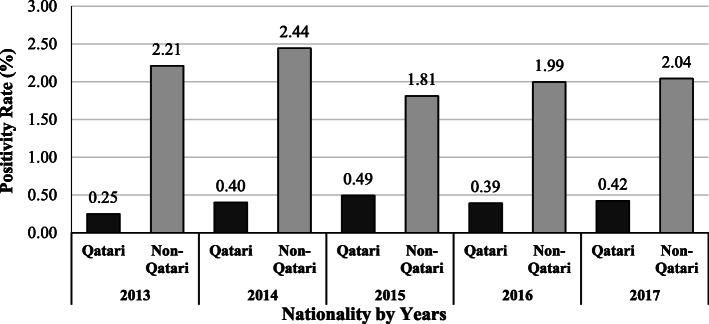
Among the 190,509 donations received at the donation centre during the study period, about 91% of donations were received from males and 9% from females. The overall positivity rate for all tests was 1.87, 2.23, 1.78, 2.31, 2.67% for the years 2013 through 2017, with an increasing yearly trend by 6% each year. The overall positivity rates for Hepatitis C Virus, Human T-lymphotropic Virus-I/II, Hepatitis B Virus, Syphilis and Malaria (2013-2017) were 0.60, 0.18, 0.30, 0.43 and 0.20%, respectively.
The overall positivity rate of all tests combined for the Transfusion Transmissible Infections demonstrated a gradually increasing trend from 2013 to 2017. However, the trend for each infection (Hepatitis C Virus, Hepatitis B Virus, Syphilis and Malaria) was fluctuating except for Human T-lymphotropic Virus-I/II, which was increasing. Supporting the development of effective prevention and control strategies requires further comprehensive investigations for better estimation of the burden of these infections.
全世界每年有数百万生命因输血而得以挽救。然而,输血是传播感染的主要途径之一。全球献血者中输血传播感染的总体流行率存在差异,反映了这些感染的流行率不同。本研究旨在评估卡塔尔献血者中输血传播感染的流行率和趋势。
这是一项利用 2013 年 1 月至 2017 年 12 月 5 年的献血记录进行的横断面研究。我们将乙型肝炎病毒、丙型肝炎病毒、人类 T 淋巴细胞病毒-I/II、梅毒和疟疾的所有筛查和确认检测结果纳入研究。
在研究期间,献血中心共收到 190509 份献血,其中约 91%的献血来自男性,9%来自女性。所有检测的总体阳性率为 1.87%、2.23%、1.78%、2.31%和 2.67%,2013 年至 2017 年呈逐年上升趋势,每年增加 6%。丙型肝炎病毒、人类 T 淋巴细胞病毒-I/II、乙型肝炎病毒、梅毒和疟疾(2013-2017 年)的总体阳性率分别为 0.60%、0.18%、0.30%、0.43%和 0.20%。
所有输血传播感染检测的综合总体阳性率从 2013 年到 2017 年呈逐渐上升趋势。然而,除人类 T 淋巴细胞病毒-I/II呈上升趋势外,每种感染(丙型肝炎病毒、乙型肝炎病毒、梅毒和疟疾)的趋势均呈波动状态。支持制定有效的预防和控制策略需要进一步进行全面调查,以更好地评估这些感染的负担。