da Silva Ramon Gomes, Ribeiro Matheus Henrique Dal Molin, Mariani Viviana Cocco, Coelho Leandro Dos Santos
Industrial & Systems Engineering Graduate Program (PPGEPS), Pontifical Catholic University of Parana (PUCPR), 1155, Rua Imaculada Conceicao, Curitiba, PR, Brazil, 80215-901.
Department of Mathematics, Federal Technological University of Parana (UTFPR), Via do Conhecimento, KM 01 - Fraron, Pato Branco, PR, Brazil, 85503-390.
Chaos Solitons Fractals. 2020 Oct;139:110027. doi: 10.1016/j.chaos.2020.110027. Epub 2020 Jun 30.
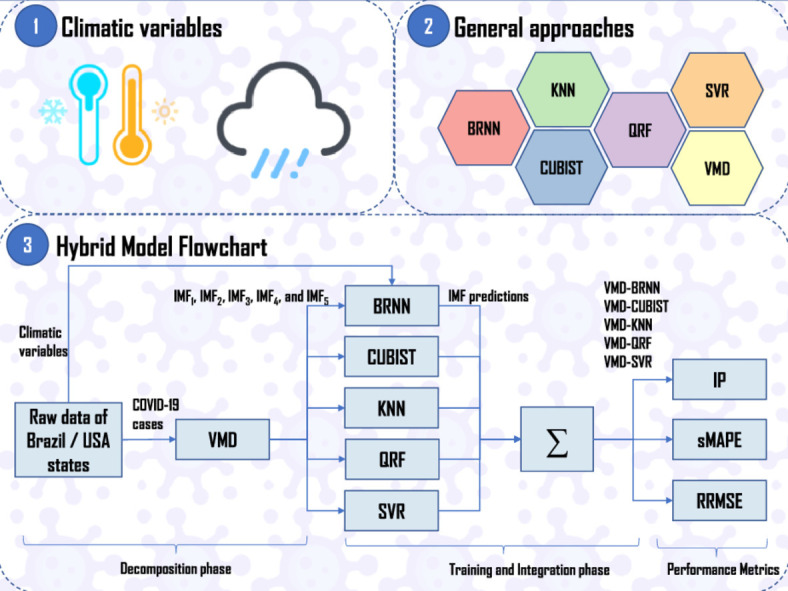
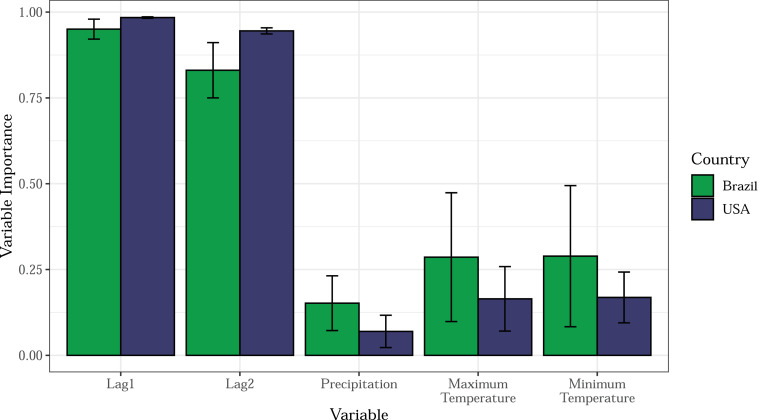
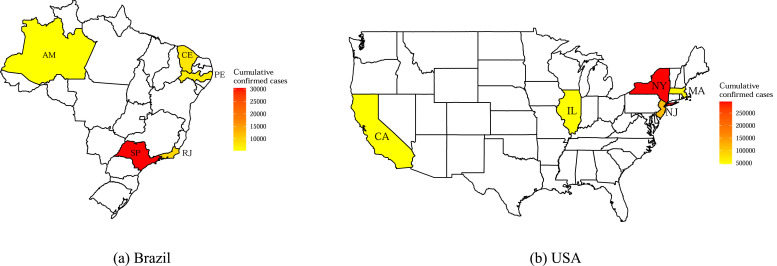
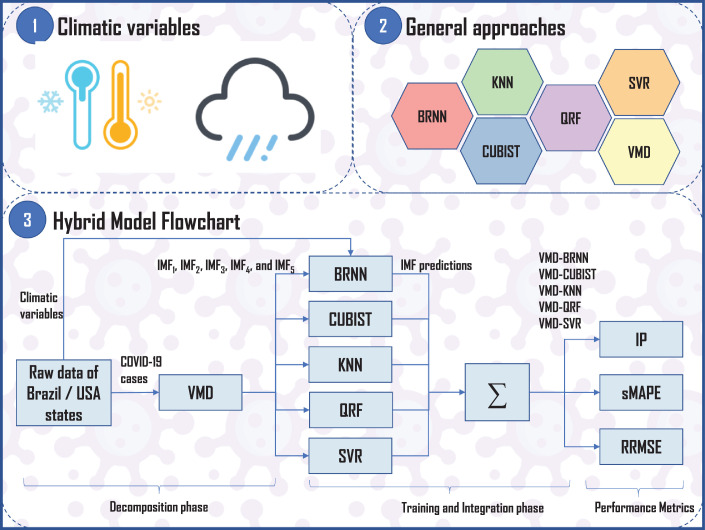
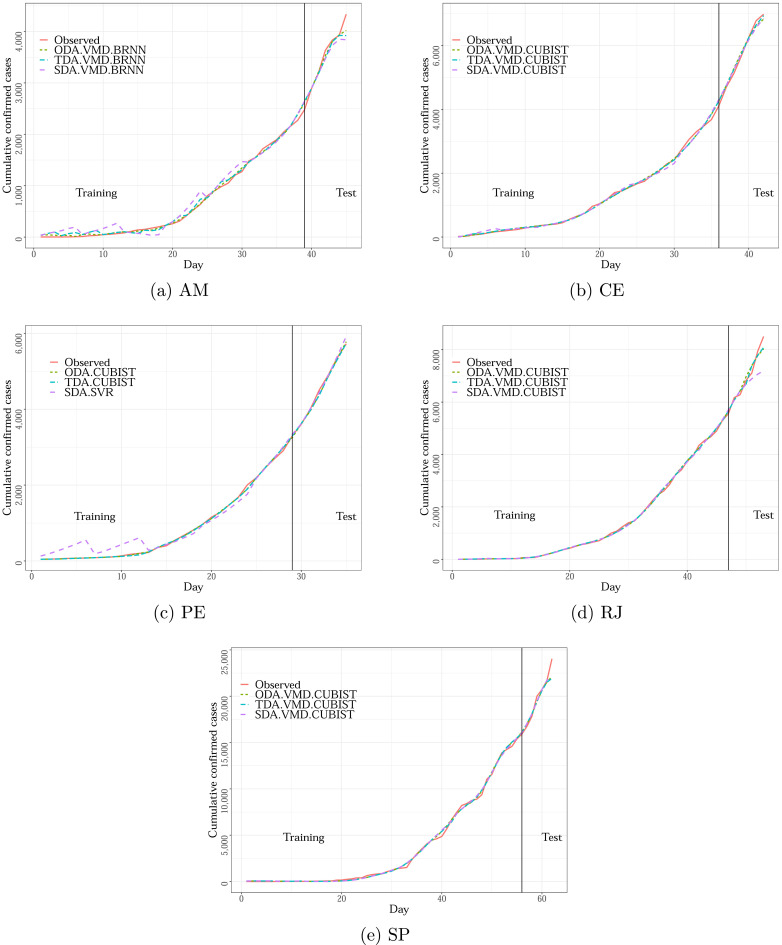
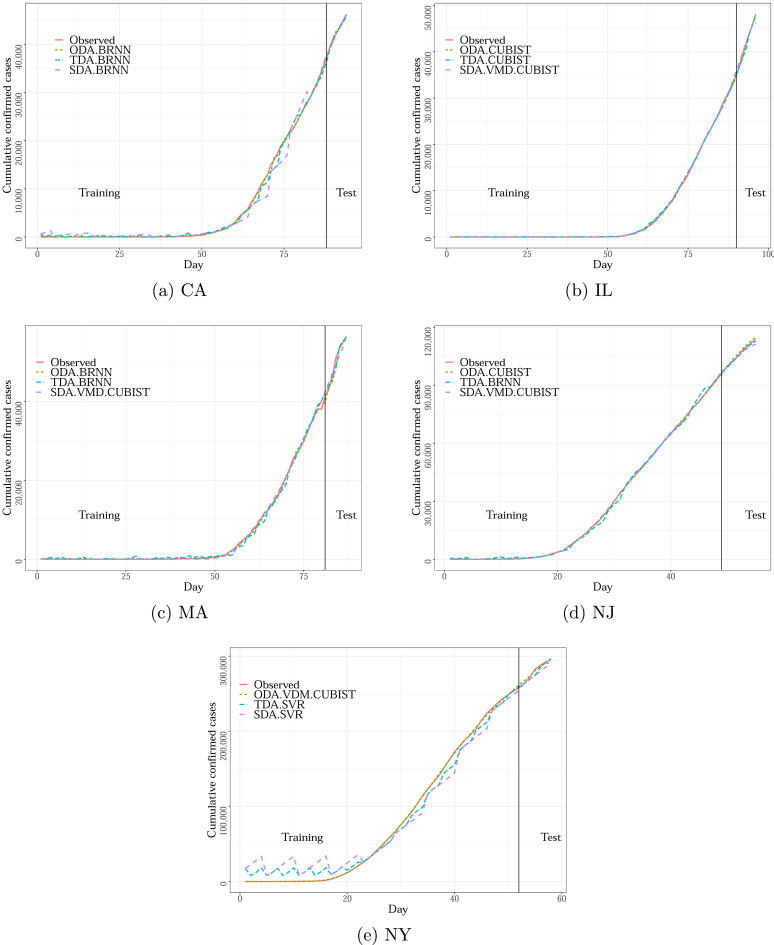
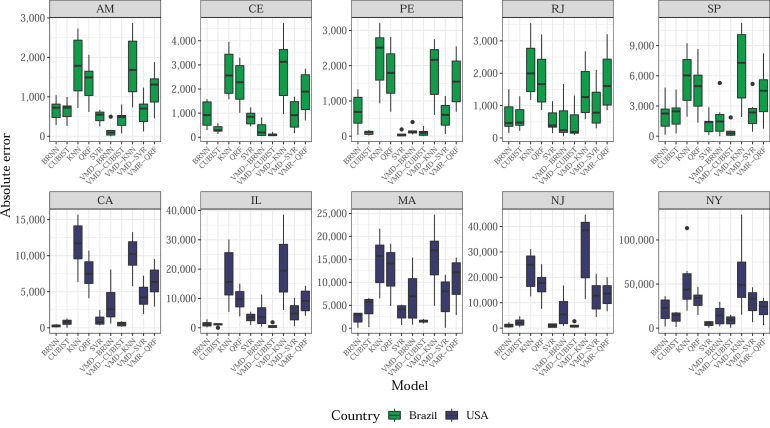
The novel coronavirus disease (COVID-19) is a public health problem once according to the World Health Organization up to June 24th, 2020, more than 9.1 million people were infected, and more than 470 thousand have died worldwide. In the current scenario, the Brazil and the United States of America present a high daily incidence of new cases and deaths. Therefore, it is important to forecast the number of new cases in a time window of one week, once this can help the public health system developing strategic planning to deals with the COVID-19. The application of the forecasting artificial intelligence (AI) models has the potential of deal with dynamical behavior of time-series like of COVID-19. In this paper, Bayesian regression neural network, cubist regression, -nearest neighbors, quantile random forest, and support vector regression, are used stand-alone, and coupled with the recent pre-processing variational mode decomposition (VMD) employed to decompose the time series into several intrinsic mode functions. All AI techniques are evaluated in the task of time-series forecasting with one, three, and six-days-ahead the cumulative COVID-19 cases in five Brazilian and American states, with a high number of cases up to April 28th, 2020. Previous cumulative COVID-19 cases and exogenous variables as daily temperature and precipitation were employed as inputs for all forecasting models. The models' effectiveness are evaluated based on the performance criteria. In general, the hybridization of VMD outperformed single forecasting models regarding the accuracy, specifically when the horizon is six-days-ahead, the hybrid VMD-single models achieved better accuracy in 70% of the cases. Regarding the exogenous variables, the importance ranking as predictor variables is, from the upper to the lower, past cases, temperature, and precipitation. Therefore, due to the efficiency of evaluated models to forecasting cumulative COVID-19 cases up to six-days-ahead, the adopted models can be recommended as a promising models for forecasting and be used to assist in the development of public policies to mitigate the effects of COVID-19 outbreak.
新型冠状病毒病(COVID-19)是一个公共卫生问题。根据世界卫生组织的数据,截至2020年6月24日,全球有超过910万人感染,超过47万人死亡。在当前情况下,巴西和美利坚合众国的新增病例和死亡人数每日都很高。因此,预测一周时间窗口内的新增病例数很重要,因为这有助于公共卫生系统制定应对COVID-19的战略规划。预测人工智能(AI)模型的应用有潜力处理像COVID-19这样的时间序列的动态行为。在本文中,贝叶斯回归神经网络、Cubist回归、k近邻、分位数随机森林和支持向量回归被单独使用,并与最近采用的预处理变分模态分解(VMD)相结合,将时间序列分解为几个固有模态函数。所有人工智能技术都在预测巴西和美国五个州未来1天、3天和6天的COVID-19累计病例的时间序列预测任务中进行了评估,截至2020年4月28日这些州的病例数很多。之前的COVID-19累计病例以及每日温度和降水等外部变量被用作所有预测模型的输入。根据性能标准评估模型的有效性。总体而言,VMD的混合模型在准确性方面优于单一预测模型,特别是当预测期为6天时,混合VMD-单一模型在70%的情况下取得了更好的准确性。关于外部变量,作为预测变量的重要性排名从高到低依次为既往病例、温度和降水。因此,由于所评估的模型在预测未来6天的COVID-19累计病例方面效率较高,所采用的模型可被推荐为有前景的预测模型,并用于协助制定公共政策以减轻COVID-19疫情的影响。