Department of Health Communication, Graduate School of Medicine, The University of Tokyo, Bunkyo-ku, Tokyo, Japan.
Department of Health Communication, School of Public Health, The University of Tokyo, Bunkyo-ku, Tokyo, Japan.
J Med Internet Res. 2020 Aug 25;22(8):e19777. doi: 10.2196/19777.
Approximately one-third of Japanese couples currently worry or previously worried about infertility. To develop strategies for the primary prevention of infertility as a population approach, it is important for the general population to be knowledgeable about fertility and infertility. The internet may contribute to the dissemination of information regarding infertility and fertility. However, few studies have examined online information about fertility.
This study aimed to quantitatively examine online Japanese-language information about lifestyle factors associated with reduced fertility.
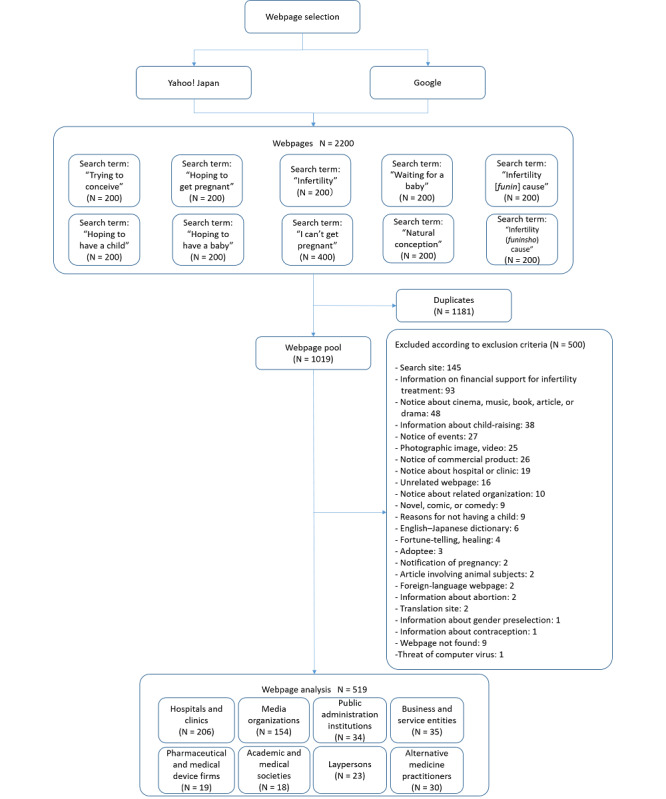
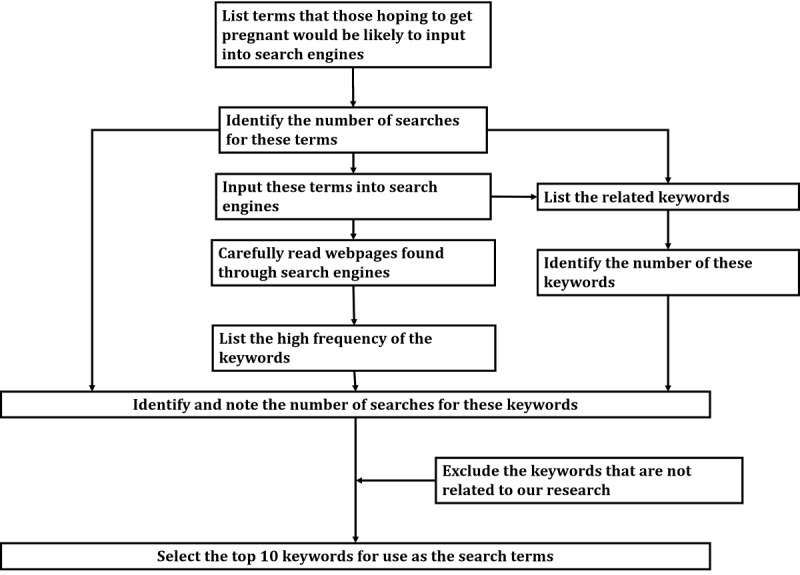
We conducted online searches, using the 10 search terms with the highest numbers of searches that people hoping to conceive are likely to input in two major search engines in Japan (Google Japan and Yahoo! Japan). From the 2200 retrieved websites, 1181 duplicates and 500 websites unrelated to our objective were excluded, resulting in a final dataset of 519 websites. Coding guidelines were developed for the following lifestyle factors associated with reduced fertility: sexually transmitted diseases, psychological stress, cigarette smoking, alcohol use, nutrition and diet, physical activity and exercise, underweight, overweight and obesity, and environmental pollutants.
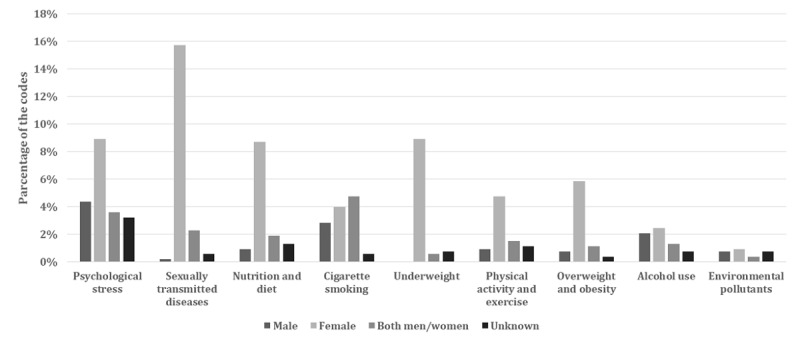
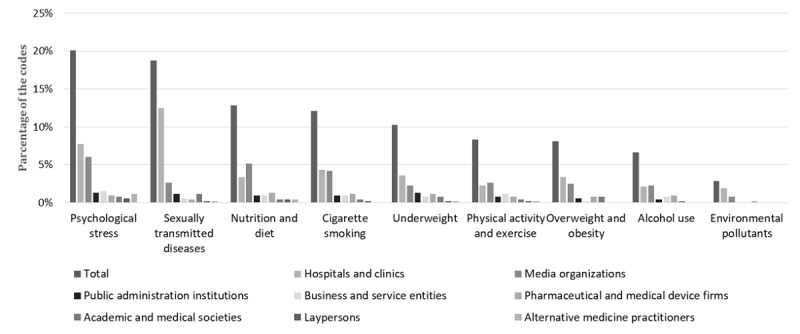
In terms of the website author's professional expertise, 69.6 % of the coding instances for the selected lifestyle factors were mentioned by hospitals, clinics, or the media, whereas only 1.7% were mentioned by laypersons. Psychological stress (20.1%) and sexually transmitted diseases (18.8%) were the most frequently mentioned lifestyle factors associated with reduced fertility. In contrast, cigarette smoking, alcohol use, nutrition and diet, physical activity and exercise, underweight, overweight and obesity, and environmental pollutants were mentioned relatively infrequently. The association between reduced fertility and sexually transmitted diseases was mentioned significantly more frequently by hospitals and clinics than by the media (P<.001). The association between reduced fertility and nutrition and diet was mentioned significantly more frequently by the media than by hospitals and clinics (P=.008). With regard to the sex of the target audience for the information, female-specific references to psychological stress, sexually transmitted diseases, nutrition and diet, underweight, physical activity and exercise, and overweight and obesity were significantly more frequent than were male-specific references to these lifestyle factors (psychological stress: P=.002, sexually transmitted diseases: P<.001, nutrition and diet: P<.001, underweight: P<.001, physical activity and exercise: P<.001, overweight and obesity: P<.001).
Of the lifestyle factors known to be related to reduced fertility, cigarette smoking, alcohol use, and male-specific lifestyle factors are mentioned relatively infrequently in online information sources in Japan, and these factors should be discussed more in information published on websites.
目前,大约有三分之一的日本夫妇对不孕不育感到担忧或曾经担忧过。为了制定预防不孕不育的初级策略,作为一种人群方法,普通民众需要了解生育和不孕不育的知识。互联网可能有助于传播有关不孕不育和生育的信息。然而,很少有研究检查过关于生育的在线信息。
本研究旨在定量研究与生育能力降低相关的生活方式因素的在线日语信息。
我们使用人们在日本的两个主要搜索引擎(谷歌日本和雅虎日本)中可能输入的 10 个搜索词进行了在线搜索。在检索到的 2200 个网站中,排除了 1181 个重复项和 500 个与我们的目标无关的网站,最终数据集为 519 个网站。为以下与生育能力降低相关的生活方式因素制定了编码指南:性传播疾病、心理压力、吸烟、饮酒、营养和饮食、体力活动和锻炼、体重过轻、超重和肥胖以及环境污染物。
就网站作者的专业知识而言,所选生活方式因素的编码实例中,69.6%是由医院、诊所或媒体提及的,而只有 1.7%是由非专业人士提及的。心理压力(20.1%)和性传播疾病(18.8%)是与生育能力降低最相关的生活方式因素。相比之下,吸烟、饮酒、营养和饮食、体力活动和锻炼、体重过轻、超重和肥胖以及环境污染物则较少被提及。医院和诊所比媒体更频繁地提到生育能力降低与性传播疾病之间的关联(P<.001)。媒体比医院和诊所更频繁地提到生育能力降低与营养和饮食之间的关联(P=.008)。关于信息受众的性别,与这些生活方式因素相关的针对女性的心理压力、性传播疾病、营养和饮食、体重过轻、体力活动和锻炼以及超重和肥胖的特定于性别的参考明显比针对男性的参考更频繁(心理压力:P=.002,性传播疾病:P<.001,营养和饮食:P<.001,体重过轻:P<.001,体力活动和锻炼:P<.001,超重和肥胖:P<.001)。
在已知与生育能力降低相关的生活方式因素中,吸烟、饮酒和男性特有的生活方式因素在日本的在线信息来源中提及较少,这些因素应在网站上发布的信息中更深入地讨论。