Chemical Biology of Microbe-Host Interactions, Leibniz Institute for Natural Product Research and Infection Biology e. V., Hans-Knöll-Institute, Beutenbergstraße 11a, 07745 Jena, Germany.
Bio Pilot Plant, Leibniz Institute for Natural Product Research and Infection Biology e. V., Hans-Knöll-Institute, Beutenbergstraße 11a, 07745 Jena, Germany.
Int J Syst Evol Microbiol. 2020 Oct;70(10):5255-5262. doi: 10.1099/ijsem.0.004403. Epub 2020 Aug 26.
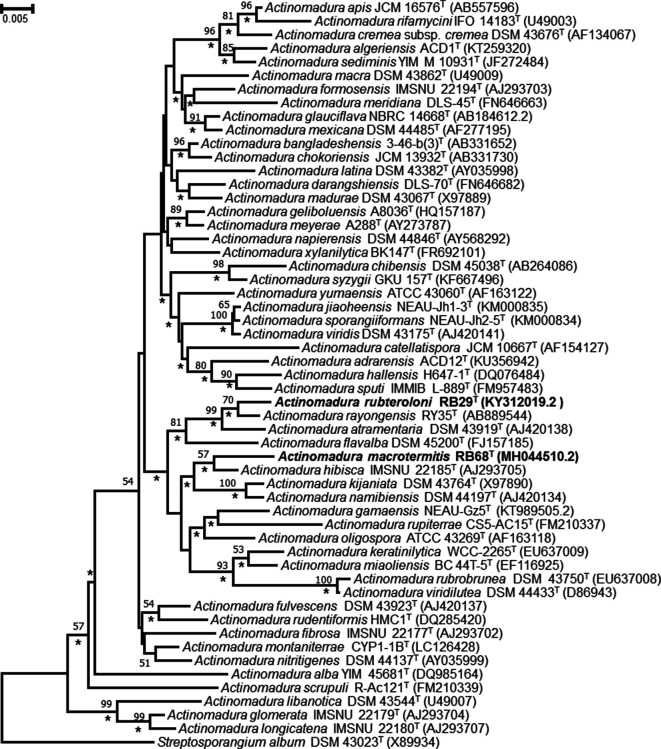
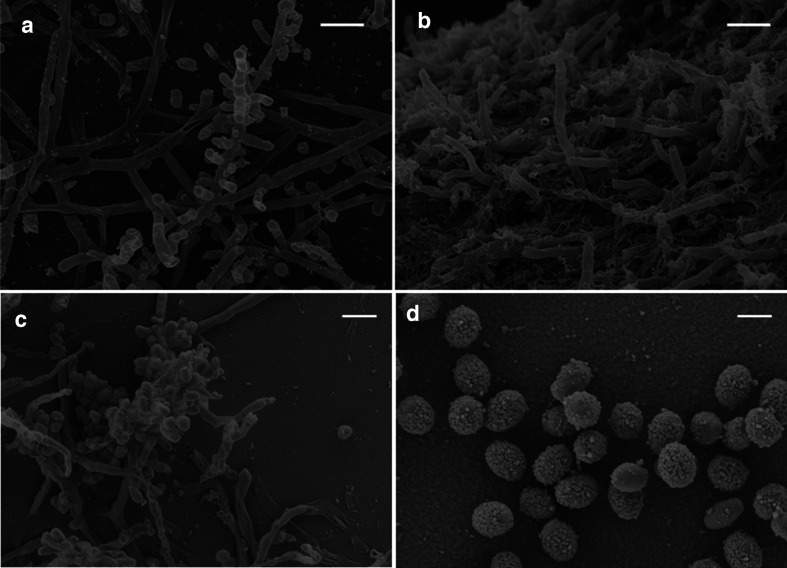
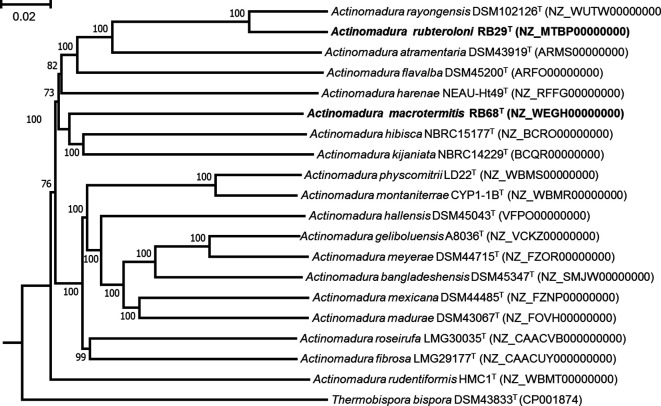
The taxonomic positions of two novel aerobic, Gram-positive actinobacteria, designated strains RB29 and RB68, were determined using a polyphasic approach. Based on 16S rRNA gene sequence analysis, the closest phylogenetic neighbours of RB29 were identified as DSM 102126 (99.2 % similarity) and DSM 43919 (98.7 %), and for strain RB68 was DSM 44148 (98.3 %). Digital DNA-DNA hybridization (dDDH) between RB29 and its closest phylogenetic neighbours, DSM 102126 and DSM 43919, resulted in similarity values of 53.2 % (50.6-55.9 %) and 26.4 % (24.1-28.9 %), respectively. Additionally, the average nucleotide identity (ANI) was 93.2 % (94.0 %) for DSM 102126 and 82.3 % (78.9 %) for DSM 43919. dDDH analysis between strain RB68 and DSM 44148 gave a similarity value of 24.5 % (22.2-27.0 %). Both strains, RB29 and RB68, revealed morphological characteristics and chemotaxonomic features typical for the genus , such as the presence of -diaminopimelic acid in the cell wall, galactose and glucose as major sugar components within whole-cell hydrolysates and the absence of mycolic acids. The major phospholipids were diphosphatidylglycerol, phosphatidylglycerol, phosphatidylinositol and phosphatidylinositol mannoside. Predominant menaquinones were MK-9(H) and MK-9(H) for RB29 and MK-9(H) and MK-9(H) for RB68. The main fatty acids were identified as 10-methyloctadecanoic acid (10-methyl C), 14-methylpentadecanoic acid (iso-C), hexadecanoic acid (C) and -9-octadecanoic acid (C ω9). Here, we propose two novel species of the genus : sp. nov. with the type strain RB29 (=CCUG 72668=NRRL B-65537) and sp. nov. with the type strain RB68 (=CCUG 72669=NRRL B-65538).
两株新型需氧革兰氏阳性放线菌 RB29 和 RB68 的分类地位采用多相分类法确定。基于 16S rRNA 基因序列分析,RB29 的最接近的系统发育近邻被鉴定为 DSM 102126(99.2%相似性)和 DSM 43919(98.7%相似性),而对于菌株 RB68 则是 DSM 44148(98.3%相似性)。RB29 与其最接近的系统发育近邻 DSM 102126 和 DSM 43919 之间的数字 DNA-DNA 杂交(dDDH)产生的相似性值分别为 53.2%(50.6-55.9%)和 26.4%(24.1-28.9%)。此外,DSM 102126 和 DSM 43919 的平均核苷酸同一性(ANI)分别为 93.2%(94.0%)和 82.3%(78.9%)。菌株 RB68 与 DSM 44148 之间的 dDDH 分析产生的相似性值为 24.5%(22.2-27.0%)。两种菌株 RB29 和 RB68 均表现出形态特征和化学分类特征,与属的特征典型一致,例如细胞壁中存在 -二氨基庚二酸,全细胞水解物中主要糖组分为半乳糖和葡萄糖,以及不存在分枝菌酸。主要磷脂为双磷脂酰甘油、磷脂酰甘油、磷脂酰肌醇和磷脂酰肌醇甘露糖苷。优势类异戊二烯醌为 MK-9(H)和 MK-9(H),用于 RB29,MK-9(H)和 MK-9(H),用于 RB68。主要脂肪酸鉴定为 10-甲基十八烷酸(10-甲基 C)、14-甲基十五烷酸(异-C)、十六烷酸(C)和 -9-十八烷酸(C ω9)。在此,我们提出了属的两个新种:新型种,其模式株为 RB29(=CCUG 72668=NRRL B-65537)和新型种,其模式株为 RB68(=CCUG 72669=NRRL B-65538)。